


Shopping Cart
Remove All Your shopping cart is currently empty


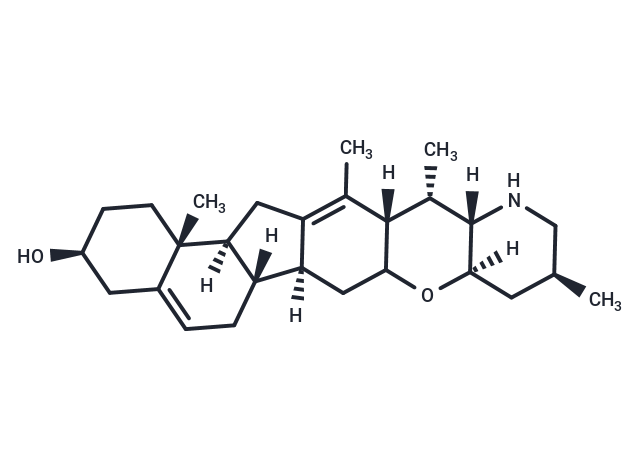
Synonyms: 11-Deoxojervine
| Pack Size | Price | USA Stock | Global Stock | Quantity |
|---|---|---|---|---|
| 5 mg | $48 | In Stock | In Stock | |
| 10 mg | $74 | In Stock | In Stock | |
| 25 mg | $136 | In Stock | In Stock | |
| 50 mg | $224 | In Stock | In Stock | |
| 100 mg | $357 | In Stock | In Stock | |
| 1 mL x 10 mM (in DMSO) | $54 | In Stock | In Stock |
| Description | Cyclopamine (11-Deoxojervine) is a natural small molecule steroidal alkaloid extracted from plants of the genus Aconitum. Cyclopamine acts as an antagonist of the Hedgehog pathway with an IC50 of 46 nM in cellular assays. Additionally, Cyclopamine functions as a selective Smo inhibitor. Cyclopamine is applicable for research in embryonic development, tumorigenesis, and targeted therapies. |
| Targets & IC50 | Smo:46 nM (TM3Hh12 cells) |
| In vitro | Methods: Primary hepatocytes isolated from C57BL/6N mice were treated with Cyclopamine (10 μM) and Rapamycin (50 nM) for 24 hours. Mitochondrial oxygen consumption rate (OCR) was measured using the Seahorse XF analyzer to calculate parameters including basal respiration, maximal respiration, and ATP yield. Results: The combination of Cyclopamine and Rapamycin significantly reduced maximal respiration and ATP yield. [1] Methods: HeLa cells were treated with Cyclopamine (5 μM) for 24 hours. Western blot analysis measured the ratio of mature (31 kDa) to immature (53 kDa) forms of cathepsin D. Results: Cyclopamine treatment significantly reduced the mature/immature cathepsin D ratio, indicating impaired lysosomal maturation. [2] |
| In vivo | Methods: Transgenic Drosophila expressing APP-C99-Gal4 and UAS-GRIM (γ-secretase cleavage activates GRIM, causing eye roughness) were fed food containing Cyclopamine (100 nM) from the larval to adult stage. Observations were made within 24 hours post-adult emergence. Results: The severity of the rough eye phenotype was significantly reduced in the cyclopamine-treated group, and in vivo reduction of γ-secretase-mediated APP cleavage was also observed. [2] |
| Synonyms | 11-Deoxojervine |
| Kinase Assay | This assay measures the end stage of the Hh signaling pathway, that is, the transcriptional modulation of Gli, using Luciferase as readout (Gli-Luc assay). Cyclopamine is prepared for assay by serial dilution in DMSO and then added to empty assay plates. TM3Hh12 cells (TM3 cells containing Hh-responsive reporter gene construct pTA-8xGli-Luc) are resuspended in F12 Ham's/DMEM (1:1) containing 5% FBS and 15 mM Hepes pH 7.3, added to assay plates and incubated with Cyclopamine for approximately 30 minutes at 37 °C in 5% CO2. 1 nM Hh-Ag 1.5 is then added to assay plates and incubated at 37 °C in the presence of 5% CO2. After 48 hours, either Bright-Glo or MTS reagent is added to the assay plates and luminescence or absorbance at 492 nm is determined. IC50 value, defined as the inflection point of the logistic curve, is determined by non-linear regression of the Gli-driven luciferase luminescence or absorbance signal from MTS assay vs log10 (concentration) of Cyclopamine using the R statistical software pack [1]. |
| Cell Research | Cells were cultured in triplicate in 96-well plates in assay media to which 5E1 monoclonal antibody, ShhNp and/or cyclopamine were added at 0 h at concentrations indicated in the main text. Viable cell mass was determined by optical density measurements at 490 nm (OD490) at 2 and 4 days using the CellTiter96 colorimetric assay. Relative growth was calculated as OD (day 4) 2 OD (day 2)/OD (day 2) [3]. |
| Animal Research | A total of 0.1 ml Hanks' balanced salt solution and matrigel (1:1) containing 2 × 10^6 cells were injected subcutaneously into CD-1 nude mice. Tumours were grown for 4 days to a minimum volume of 125 mm3; treatment was initiated simultaneously for all subjects. Mice were injected subcutaneously with vector alone (triolein:ethanol 4:1 v/v) or a cyclopamine suspension (1.2 mg per mouse in triolein: ethanol 4:1 v/v) daily for 7 days. At the end of the treatment period, tumours were excised from mice, weighed and then fixed for 3 h at 4 °C with 4% paraformaldehyde, embedded in paraffin wax and sectioned (6 μm). Apoptotic cells were identified by TUNEL using recombinant Tdt as previously described29. Sections were then counterstained with eosin. Eight ×20-magnified fields from regions corresponding to the exterior, middle and interior of two control and two cyclopamine-treated tumours were chosen at random [5]. |
| Molecular Weight | 411.62 |
| Formula | C27H41NO2 |
| Cas No. | 4449-51-8 |
| Smiles | [H][C@@]12CC3O[C@]4([H])C[C@H](C)CN[C@@]4([H])[C@@H](C)[C@@]3([H])C(C)=C1C[C@@]1([H])[C@@]2([H])CC=C2C[C@@H](O)CC[C@]12C |
| Relative Density. | 1.14g/cm3 |
| Storage | Powder: -20°C for 3 years | In solvent: -80°C for 1 year Shipping with blue ice/Shipping at ambient temperature. | ||||||||||||||||||||
| Solubility Information | DMSO: 4.12 mg/mL (10.01 mM), Sonication is recommended.  | ||||||||||||||||||||
Solution Preparation Table | |||||||||||||||||||||
DMSO
Note : The dilution table applies only to solid products. For liquid products, please calculate the stock solution based on the stated concentration and/or density. | |||||||||||||||||||||
 For example, if the intended dosage is 10 mg/kg for animals weighing 20 g , with a dosing volume of 100 μL per animal, and a total of 10 animals are to be administered, using a formulation of
  10% DMSO+ 40% PEG300+ 5% Tween 80+ 45% Saline/PBS/ddH2O , the resulting working solution concentration would be 2 mg/mL.
Dissolve 2 mg of the compound in 100 μL DMSO to obtain a stock solution at a concentration of 20 mg/mL . If the required concentration exceeds the compound's known solubility, please contact us for technical support before proceeding.
1) Add 100 μL of the DMSO stock solution to 400 µL PEG300 and mix thoroughly until the solution becomes clear.
2) Add 50 µL Tween 80 and mix well until fully clarified.
3) Add 450 µL Saline,PBS or ddH2O and mix thoroughly until a homogeneous solution is obtained.
| Size | Quantity | Unit Price | Amount | Operation |
|---|
 Feedback
 Hello! How can I help you today?
Copyright © 2015-2026 TargetMol Chemicals Inc. All Rights Reserved.
