Shopping Cart
Remove All
  • TargetMol
    Your shopping cart is currently empty

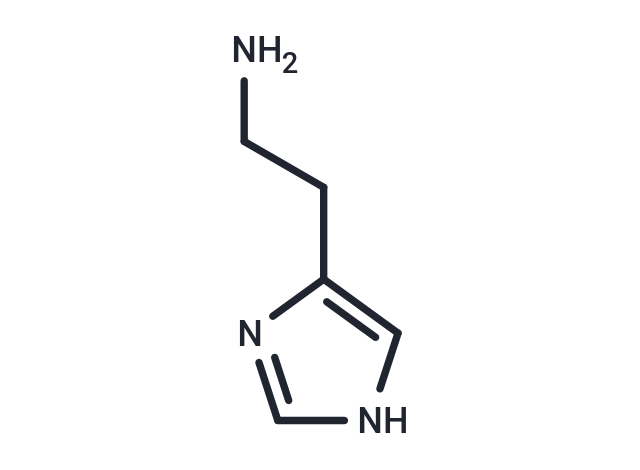
Histamine

Copy Product Info
😃Good
Catalog No. T0965Cas No. 51-45-6
Alias Ergamine

Histamine (Ergamine) is an amine derived by the enzymatic decarboxylation of histamine. Histamine is a potent stimulant of gastric secretion, a constrictor of bronchial smooth muscle, a vasodilator, and a neurotransmitter of central action.

Histamine

Histamine

Copy Product Info
😃Good
Purity: 99.96%
Catalog No. T0965Alias ErgamineCas No. 51-45-6
Histamine (Ergamine) is an amine derived by the enzymatic decarboxylation of histamine. Histamine is a potent stimulant of gastric secretion, a constrictor of bronchial smooth muscle, a vasodilator, and a neurotransmitter of central action.
Pack SizePriceUSA WarehouseGlobal WarehouseQuantity
50 mg$34In StockIn Stock
100 mg$48In StockIn Stock
200 mg$51In StockIn Stock
500 mg$56-In Stock
1 g$68-In Stock
Add to Cart
Add to Quotation
In Stock Estimated shipping dateUSA Warehouse[1-2 days] Global Warehouse[5-7 days]
All TargetMol products are for research purposes only and cannot be used for human consumption. We do not provide products or services to individuals. Please comply with the intended use and do not use TargetMol products for any other purpose.
Questions
TargetMol
View More

Batch Information

Select Batch
Purity:99.96%
Color:White to Yellow
Contact us for more batch information

Resource Download

Product Introduction

Histamine AI Summary
Histamine exhibits a range of bioactivities including both activation and inhibition of various enzymes and receptors. It shows in vitro activation of Human cloned isozyme carbonic anhydrase I (KA = 2.0 uM), carbonic anhydrase II (KA = 125.0 uM), and carbonic anhydrase IV from bovine lung microsomes (KA = 41.0 uM). Additionally, the compound activates multiple recombinant carbonic anhydrase isoforms, with varying affinities for CA1, CA2, CA4, CA13, and others, highlighting its potential as a modulator of carbonic anhydrase enzymatic activity. Histamine also demonstrates bioactivity toward histamine receptors. It functions as an agonist at the human histamine H1, H2, H3, and H4 receptors with varying potency (EC50 = 190.55 nM for H1, EC50 = 1202.26 nM for H2, EC50 = 25.12 nM for H3, EC50 = 11.02 nM for H4). The compound inhibits histamine binding to the H3 receptor (Ki = 12.59 nM for human H3) and the H4 receptor (Ki = 19.95 nM for human H4), indicating significant receptor affinity and potential regulatory effects on histamine-mediated pathways. In addition to these properties, Histamine exhibits cardiovascular effects, including decreases in systolic and diastolic blood pressure and heart rate in anesthetized rats, indicating potential hypotensive activity. Moreover, the compound shows diverse interactions with other biological targets, including moderate inhibitory activity against bacterial beta-carbonic anhydrases, antiviral activity against SARS-CoV-2, and transporter substrate behavior in studies with TP transporter and OCT transporters. Overall, Histamine is a potent and versatile bioactive compound with significant potential as a therapeutic agent influencing carbonic anhydrase activity, histamine receptor modulation, and cardiovascular effects..
Note: Summary generated by AI. Data source: ChEMBL
Bioactivity
Description
Histamine (Ergamine) is an amine derived by the enzymatic decarboxylation of histamine. Histamine is a potent stimulant of gastric secretion, a constrictor of bronchial smooth muscle, a vasodilator, and a neurotransmitter of central action.
Targets&IC50
HEK293 cells:13 nM (EC50), CHO cells:640 nM (EC50), Sf9 cells:11 nM (EC50)
Disease Modeling Protocol
Duodenal Ulcer Model
  • Modeling Mechanism:

    Histamine needs to act synergistically with indomethacin to induce a rat model of duodenal ulcer. It strongly promotes gastric acid secretion by binding to H₂ receptors on parietal cells, and synergizes with indomethacin to inhibit duodenal bicarbonate secretion and weaken mucosal defense function, resulting in a sharp increase in acid load in the duodenum, damage to mucosal epithelial cells, and ultimately ulcer formation.

  • Related Products:

    Histamine (T0965)

  • Modeling Method:

    Experimental Subject:

    Rats, Donryu, Male, Body weight 230-260g, Fasted for 24 hours

    Dosage and Administration Route:

    ① Core modeling: Indomethacin (5 mg/kg) suspended in saline with a trace of Tween 80 via subcutaneous injection (0.5 ml/100g body weight); 30 minutes later, histamine dihydrochloride (40 mg/kg) dissolved in 10% gelatin via subcutaneous injection, 3 doses total with 2.5-hour intervals between doses;
    ② Control treatment: Single subcutaneous injection of indomethacin (5 mg/kg) alone, histamine (40 mg/kg, 3 doses with 2.5-hour intervals) alone, or isovolumetric vehicle (saline with Tween 80/10% gelatin);
    ③ Intervention validation (optional): Cimetidine (3-100 mg/kg) suspended in saline via oral gavage; 16,16-dimethylprostaglandin E₂ (dmPGE₂, 3-30 μg/kg) first dissolved in absolute ethanol then diluted with saline via oral gavage; both administered 30 minutes prior to indomethacin injection

    Dosing Frequency and Duration Model:

    Single indomethacin injection+3 histamine injections (2.5-hour intervals)

  • Validation:

    1. Pathological indicators: 1-2 round ulcer lesions (area 9.8±1.4 mm²) in the proximal duodenum with 100% ulcer incidence; a few scattered lesions in the gastric corpus and antrum; 30%-40% of duodenal ulcers penetrated the muscularis mucosae, and a single large round ulcer was still visible after 32 hours; no ulcer formation with indomethacin or histamine alone; 2. Biochemical indicators: Gastric acid secretion significantly increased compared with the control group (peak value 23-25 μEq/15 min for histamine alone, >30 μEq/15 min for combined administration); duodenal basal HCO₃⁻ secretion slightly inhibited, and acid-stimulated HCO₃⁻ secretion completely blocked; 3. Drug intervention validation: Cimetidine (≥10 mg/kg) dose-dependently inhibited ulcer formation and significantly reduced gastric acid secretion; dmPGE₂ (3-30 μg/kg) dose-dependently reduced the area of duodenal and antral ulcers and significantly increased HCO₃⁻ secretion; both reduced the acid load in the duodenum (peak value 24.2±1.6 μEq/30 min in the cimetidine group, 35.1±4.8 μEq/30 min in the dmPGE₂ group).

*Precautions: Subjects were euthanized and sampled 8 hours after indomethacin administration; some animals were normally fed for 24 hours after the last histamine injection and sampled 32 hours after indomethacin administration.

*References:Takeuchi K,et,al. A new model of duodenal ulcers induced in rats by indomethacin plus histamine. Gastroenterology. 1986 Mar;90(3):636-45.

SynonymsErgamine
Chemical Properties
Molecular Weight111.15
FormulaC5H9N3
Cas No.51-45-6
SmilesNCCc1c[nH]cn1
Relative Density.1.14g/cm3
Storage & Solubility Information
Storagestore at low temperature | Powder: -20°C for 3 years | In solvent: -80°C for 1 year | Shipping with blue ice/Shipping at ambient temperature.
Solubility Information
DMSO: 260 mg/mL (2339.18 mM), Sonication is recommended.

Solution Preparation Table
DMSO
1mg5mg10mg50mg
1 mM8.9969 mL44.9843 mL89.9685 mL449.8426 mL
5 mM1.7994 mL8.9969 mL17.9937 mL89.9685 mL
10 mM0.8997 mL4.4984 mL8.9969 mL44.9843 mL
20 mM0.4498 mL2.2492 mL4.4984 mL22.4921 mL
50 mM0.1799 mL0.8997 mL1.7994 mL8.9969 mL
100 mM0.0900 mL0.4498 mL0.8997 mL4.4984 mL

Calculator

  • Molarity Calculator
  • Dilution Calculator
  • Reconstitution Calculator
  • Molecular Weight Calculator

In Vivo Formulation Calculator (Clear solution)

Please enter your animal experiment information in the following box and click Calculate to obtain the stock solution preparation method and in vivo formula preparation method:
TargetMol | Animal experiments For example, if the intended dosage is 10 mg/kg for animals weighing 20 g , with a dosing volume of 100 μL per animal, TargetMol | Animal experiments and a total of 10 animals are to be administered, using a formulation of TargetMol | reagent 10% DMSO+ 40% PEG300+ 5% Tween 80+ 45% Saline/PBS/ddH2O , the resulting working solution concentration would be 2 mg/mL.

Stock Solution Preparation:

Dissolve 2 mg of the compound in 100 μL DMSOTargetMol | reagent to obtain a stock solution at a concentration of 20 mg/mL . If the required concentration exceeds the compound's known solubility, please contact us for technical support before proceeding.

Preparation of the In Vivo Formulation:

1) Add 100 μL of the DMSOTargetMol | reagent stock solution to 400 μL PEG300TargetMol | reagent and mix thoroughly until the solution becomes clear.

2) Add 50 μL Tween 80 and mix well until fully clarified.

3) Add 450 μL Saline,PBS or ddH2OTargetMol | reagent and mix thoroughly until a homogeneous solution is obtained.

This example is provided solely to demonstrate the use of the In Vivo Formulation Calculator and does not constitute a recommended formulation for any specific compound. Please select an appropriate dissolution and formulation strategy based on your experimental model and route of administration.
All co-solvents required for this protocol, includingDMSO, PEG300/PEG400, Tween 80, SBE-β-CD, and Corn oil, are available for purchase on the TargetMol website.
1 Enter information below:
mg/kg
g
μL
2 Enter the in vivo formulation:
% DMSO
%
% Tween 80
% Saline/PBS/ddH2O

Dose Conversion

You can also refer to dose conversion for different animals. More Dose Conversion

Tech Support

Please see Inhibitor Handling Instructions for more frequently ask questions. Topics include: how to prepare stock solutions, how to store products, and cautions on cell-based assays & animal experiments, etc

Keywords

Related Tags: buy Histamine | purchase Histamine | Histamine cost | order Histamine | Histamine chemical structure | Histamine formula | Histamine molecular weight