


Shopping Cart
Remove All Your shopping cart is currently empty


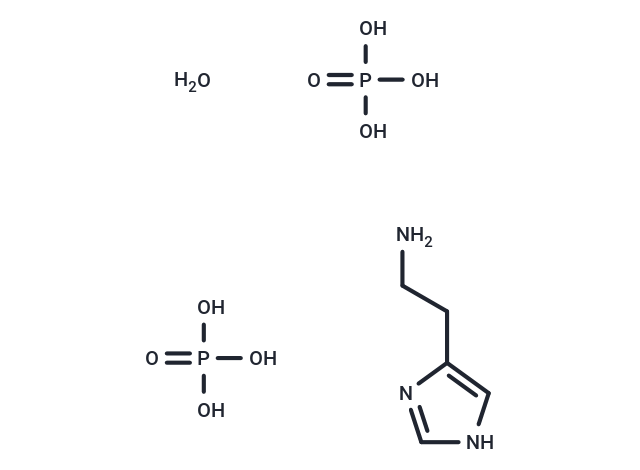
Synonyms: Histamine diphosphate, Histamine acid phosphate
| Pack Size | Price | USA Stock | Global Stock | Quantity |
|---|---|---|---|---|
| 100 mg | $29 | In Stock | In Stock |
| Description | Histamine phosphate is a potent agonist of histamine receptors and a vasodilatory neurotransmitter. It can activate nitric oxide synthase and is commonly used to induce gastric ulcer models. |
| In vitro | Histamine (10 μM) gives a larger inositol monophosphate accumulation in bovine adrenal chromaffin cells. Histamine (10 μM) stimulates the level of radioactivity into the InsP3-containing fraction in bovine adrenal chromaffin cells. Histamine (100 μM) stimulates incorporation into the InsP3-containing eluate in a less extent than for angiotensin I1 and bradykinin. [1] |
| In vivo | Histamine phosphate (0.025 mg/kg) produces a mean increase in basilar blood flow of 145% of control in dogs. Histamine phosphate produces considerable increases in basilar blood flow as well as a decrease in femoral arterial blood pressure in dogs when injected intravenously and measured with an electromagnetic flow transducer. [2] Histamine phosphate (4 μg/kg) causes lymph flow to increase from 6.0 to 27.0 (SEM) ml/h in unanesthetized sheep. Histamine phosphate (4 μg/kg) also causes increases in lung water, pulmonary vascular resistance, arterial PCO2, pH, and hematocrit, and decreases in cardiac output and arterial PO2 in unanesthetized sheep. [3] Histamine phosphate (8.3 mg/kg/min) causes no significant change in pulmonary lymph flow (QL) or protein concentration (CL) in anesthetized open-chested dogs, however, both are increased after alloxan. Histamine phosphate (8.3 mg/kg/min) also causes no significant change in the pulmonary capillary membrane filtration coefficient (Kf) and the maximum capillary pressure (PCcritical) in anesthetized open-chested dogs. [4] Histamine phosphate (50 mg/kg) produces a pronounced rise in acid secretion but the output of pepsin remained unchanged in the unanaesthetized intact rat. Histamine phosphate (50 mg/kg) produces maximal stimulation of gastric acid secretion and is free from toxic effects in the unanaesthetized intact rat. [5] |
| Synonyms | Histamine diphosphate, Histamine acid phosphate |
| Disease Modeling Protocol | Duodenal Ulcer Model
*Precautions: Subjects were euthanized and sampled 8 hours after indomethacin administration; some animals were normally fed for 24 hours after the last histamine injection and sampled 32 hours after indomethacin administration. |
| Molecular Weight | 307.14 |
| Formula | C5H9N·2H3O4P |
| Cas No. | 51-74-1 |
| Smiles | O.OP(O)(O)=O.OP(O)(O)=O.NCCc1c[nH]cn1 |
| Relative Density. | no data available |
| Storage | Keep away from moisture Powder: -20°C for 3 years | In solvent: -80°C for 1 year Shipping with blue ice/Shipping at ambient temperature. | ||||||||||||||||||||
| Solubility Information | H2O: 10 mM, Sonication is recommended. DMSO: Insoluble | ||||||||||||||||||||
Solution Preparation Table | |||||||||||||||||||||
H2O
Note : The dilution table applies only to solid products. For liquid products, please calculate the stock solution based on the stated concentration and/or density. | |||||||||||||||||||||
 For example, if the intended dosage is 10 mg/kg for animals weighing 20 g , with a dosing volume of 100 μL per animal, and a total of 10 animals are to be administered, using a formulation of
  10% DMSO+ 40% PEG300+ 5% Tween 80+ 45% Saline/PBS/ddH2O , the resulting working solution concentration would be 2 mg/mL.
Dissolve 2 mg of the compound in 100 μL DMSO to obtain a stock solution at a concentration of 20 mg/mL . If the required concentration exceeds the compound's known solubility, please contact us for technical support before proceeding.
1) Add 100 μL of the DMSO stock solution to 400 µL PEG300 and mix thoroughly until the solution becomes clear.
2) Add 50 µL Tween 80 and mix well until fully clarified.
3) Add 450 µL Saline,PBS or ddH2O and mix thoroughly until a homogeneous solution is obtained.
| Size | Quantity | Unit Price | Amount | Operation |
|---|
 Feedback
 Hello! How can I help you today?
Copyright © 2015-2026 TargetMol Chemicals Inc. All Rights Reserved.
