


Shopping Cart
Remove All Your shopping cart is currently empty

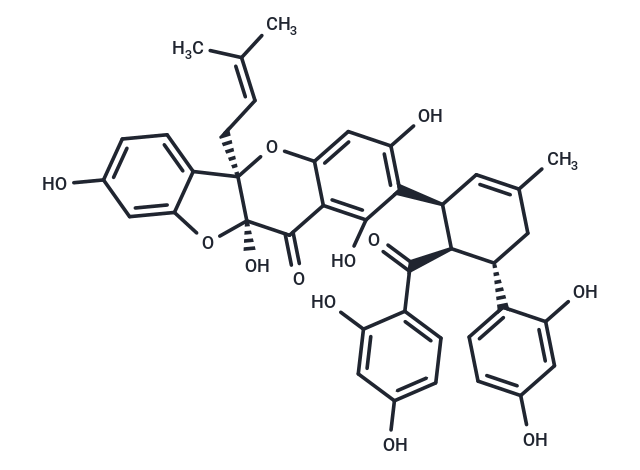
Synonyms: Sanggenone C

| Pack Size | Price | USA Stock | Global Stock | Quantity |
|---|---|---|---|---|
| 1 mg | $85 | In Stock | In Stock | |
| 5 mg | $198 | In Stock | In Stock | |
| 10 mg | $297 | In Stock | In Stock | |
| 25 mg | $519 | In Stock | In Stock | |
| 50 mg | $738 | - | In Stock | |
| 100 mg | $987 | - | In Stock | |
| 200 mg | $1,370 | - | In Stock | |
| 1 mL x 10 mM (in DMSO) | $298 | In Stock | In Stock |
| Description | Sanggenon C is a flavanone Diels-Alder adduct compound isolated from the root bark of Morus alba. Sanggenon C can inhibit NF-κB activity, inhibit the expression of inducible nitric oxide synthase in RAW264.7 cells, and inhibit tumor necrosis factor-α-stimulated cell adhesion and vascular cell adhesion molecule-1 expression; Sanggenon C also has antioxidant and anti-inflammatory effects, and also has the effect of inhibiting pancreatic lipase. [1,2] |
| In vitro | METHODS: Appropriate concentrations of Sanggenon C (10 and 20 μM) were administered to U-87MG and LN-229, as well as dimethyl sulfoxide (DMSO) as a control, for 48 hours. Cell viability was determined by MTT assay. RESULTS Sanggenon C inhibited the cell proliferation of GBM cell lines U-87 MG and LN-229 in a concentration-dependent manner.[1] METHODS: U-87 MG and LN-229 cells were treated with Sanggenon C (10 μM), cell apoptosis was detected by flow cytometry, and the expression levels of related proteins were analyzed by Western blot. RESULTS Silencing of DAPK1 reduced Sanggenon C-induced cell apoptosis. Western blot analysis further showed that in GBM cells treated with Sanggenon C, the protein levels of C-PARP and C-Caspase3 were reduced by silencing DAPK1. [1] METHODS: Human colon cancer cell line (HT-29) was treated with Sanggenon C (0, 5, 10, 20, 40 and 80 μM) for 0, 12, 24, 48 or 72 h. As a measure of intracellular ROS and ATP, the production of NO in cells was measured by the Griess method according to the instructions of the NO detection kit. RESULTS Sanggenon C can increase the level of intracellular ROS in human colon cancer cells, and this accumulation is enhanced when the dose is increased; Sanggenon C can interfere with the level of intracellular ROS; Sanggenon C can interfere with and increase the levels of intracellular Ca2+ and ATP, both in a time-dependent manner, and this accumulation is enhanced when the dose is increased; Sanggenon C can significantly interfere with and inhibit the production of NO in a dose- and time-dependent manner. [2] |
| In vivo | METHODS: Mice were intraperitoneally injected with Sanggennaon C (10 mg, 20 mg/kg/day) for 3 weeks. Four weeks after surgery, the hearts, lungs, and tibiae of the mice were dissected and weighed or measured, and the heart weight (HW)/body weight (BW) (mg/g), HW/tibia length (TL) (mg/mm), and lung weight (LW)/BW (mg/g) ratios were compared among the different groups. RESULTS Sanggennaon C treatment prevented the development of ventricular dysfunction, such as decreased left ventricular end-diastolic diameter, left ventricular end-systolic diameter, and increased LVFS and LVEF; Sanggennaon C-treated mice showed attenuated cardiac hypertrophy, such as decreased CSA, and reduced HW/BW and HW/TL ratios. [2] |
| Synonyms | Sanggenone C |
| Molecular Weight | 708.71 |
| Formula | C40H36O12 |
| Cas No. | 80651-76-9 |
| Smiles | CC(C)=CC[C@]12Oc3cc(O)c([C@H]4C=C(C)C[C@@H]([C@H]4C(=O)c4ccc(O)cc4O)c4ccc(O)cc4O)c(O)c3C(=O)[C@@]1(O)Oc1cc(O)ccc21 |
| Relative Density. | 1.512 g/cm3 |
| Storage | Store at low temperature Powder: -20°C for 3 years | In solvent: -80°C for 1 year Shipping with blue ice/Shipping at ambient temperature. | |||||||||||||||||||||||||||||||||||
| Solubility Information | DMSO: 150 mg/mL (211.65 mM), Sonication is recommended.  | |||||||||||||||||||||||||||||||||||
| In Vivo Formulation | 10% DMSO+90% Saline: < 10 mg/mL (14.11 mM), Lower concentrations may be soluble, but exact solubility limit is unknown. 10% DMSO+40% PEG300+5% Tween 80+45% Saline: < 10 mg/mL (14.11 mM), Lower concentrations may be soluble, but exact solubility limit is unknown. 10% DMSO+90% (20% SBE-β-CD in Saline): 10 mg/mL (14.11 mM), Suspension. Please add the solvents sequentially, clarifying the solution as much as possible before adding the next one. Dissolve by heating and/or sonication if necessary. Working solution is recommended to be prepared and used immediately. The formulation provided above is for reference purposes only. In vivo formulations may vary and should be modified based on specific experimental conditions. | |||||||||||||||||||||||||||||||||||
Solution Preparation Table | ||||||||||||||||||||||||||||||||||||
DMSO
Note : The dilution table applies only to solid products. For liquid products, please calculate the stock solution based on the stated concentration and/or density. | ||||||||||||||||||||||||||||||||||||
 For example, if the intended dosage is 10 mg/kg for animals weighing 20 g , with a dosing volume of 100 μL per animal, and a total of 10 animals are to be administered, using a formulation of
  10% DMSO+ 40% PEG300+ 5% Tween 80+ 45% Saline/PBS/ddH2O , the resulting working solution concentration would be 2 mg/mL.
Dissolve 2 mg of the compound in 100 μL DMSO to obtain a stock solution at a concentration of 20 mg/mL . If the required concentration exceeds the compound's known solubility, please contact us for technical support before proceeding.
1) Add 100 μL of the DMSO stock solution to 400 µL PEG300 and mix thoroughly until the solution becomes clear.
2) Add 50 µL Tween 80 and mix well until fully clarified.
3) Add 450 µL Saline,PBS or ddH2O and mix thoroughly until a homogeneous solution is obtained.
| Size | Quantity | Unit Price | Amount | Operation |
|---|
 Feedback
 Hello! How can I help you today?
Copyright © 2015-2026 TargetMol Chemicals Inc. All Rights Reserved.
