


Shopping Cart
Remove All Your shopping cart is currently empty


Synonyms: CC-4047
| Pack Size | Price | USA Stock | Global Stock | Quantity |
|---|---|---|---|---|
| 10 mg | $52 | In Stock | In Stock | |
| 50 mg | $78 | In Stock | In Stock | |
| 100 mg | $101 | In Stock | In Stock | |
| 200 mg | $111 | In Stock | In Stock | |
| 500 mg | $129 | In Stock | In Stock | |
| 1 g | $168 | In Stock | In Stock | |
| 1 mL x 10 mM (in DMSO) | $36 | In Stock | In Stock |
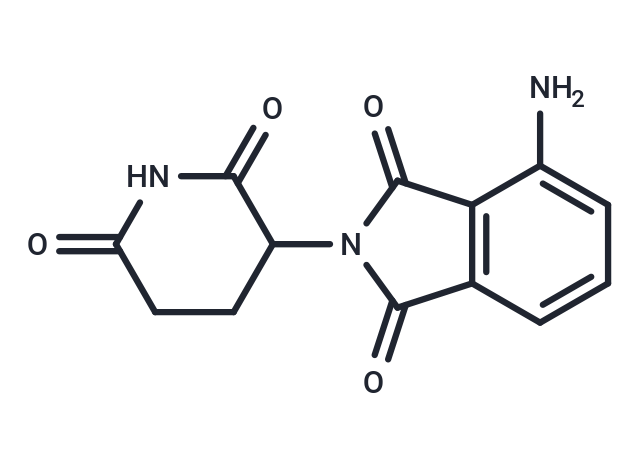
| Description | Pomalidomide (CC-4047) is an anti-angiogenic and immunomodulatory agent. Pomalidomide is a ligand for the ubiquitin E3 ligase cereblon (CRBN) and is commonly used in the synthesis of PROTAC products. |
| Targets & IC50 | TNF-α:13 nM (PBMCs) |
| In vitro | METHODS: Multiple myeloma cells RPMI8226 and OPM2 were treated with Pomalidomide (0.01-50 µM) for 48 h. Cell viability was measured by MTT assay. RESULTS: Pomalidomide significantly decreased the cell viability of RPMI8226 and OPM2 cells at 48 h with IC50 values of 8 µM and 10 µM, respectively.[1] METHODS: Multiple myeloma cells H929, U266 and MM.1s were treated with Pomalidomide (0.05-1 µM) and ACY-241 (3 µM) for 4 days and apoptosis was detected by Flow cytometry. RESULTS: Apoptosis was significantly increased when the two drugs were combined relative to either single drug. [2] |
| In vivo | METHODS: To assess the potential value in cerebral ischemia, Pomalidomide (50 mg/kg, 1% carboxy methyl cellulose) was administered intraperitoneally once daily for 21 days to transgenic mice chronically overexpressing the TNF-α surface-active protein (SP)-C promoter (SP-C/TNF-α mice). RESULTS: Pomalidomide significantly reduced serum TNF-α and IL-5 levels. [3] |
| Synonyms | CC-4047 |
| Kinase Assay | TNF-α inhibitory activity is measured in lipopolysacharide (LPS) stimulated PBMC. Pomalidomide is added to human PBMCs 1 hour prior to the addition of LPS (1 μg/mL) and incubation continued for an additional 18-20 hours. Supernatants are then harvested, and the concentration of TNF-α in the supernatants is determined by ELISA. The concentration of Pomalidomide that IC50 is calculated by nonlinear regression analysis [1]. |
| Cell Research | In vitro effects of either CC-5013 or CC-4047 as single agent or in combination with rituximab were evaluated by flow cytometric analysis. Lymphoma cell lines (1 × 10^6 cells) were exposed to either CC-5013 (5 μg/mL), CC-4047 (5 μg/mL), or vehicle control (DMRIE-C, 0.01%) alone or in combination with rituximab at a final concentration of 10 μg/mL. Following a period of incubation of 24 or 48 hours, apoptosis was assessed by staining-treated cells with FITC-labeled Annexin V and propidium iodine. All samples were analyzed by multicolor flow cytometric analysis using a fluorescence-activated cell sorter/FACStar Plus flow cytometer. Cells were scored as apoptotic if they were Annexin V–positive and propidium iodine–negative/positive (early and late apoptosis, respectively) [2]. |
| Animal Research | These studies were carried out using a disseminated lymphoma-bearing SCID mouse xenograft model. Raji cells were harvested from confluent cultures and only suspensions with >90% viable cells were used for animal inoculation. Subsequently, on day 0, SCID mice received 1 ×10^6 Raji cells via i.v. Untreated SCID mice inoculated by i.v. injection develop symptomatic central nervous system, pulmonary, and liver metastasis that result in death from massive tumor burden and central nervous system involvement after 17 to 21 days after inoculation. A second lymphoma mouse model was used to address the significance of NK cell expansion in the biological interactions observed between rituximab and IMiDs. The second mouse lymphoma xenograft consisted of SCID mice depleted of NK cells bearing Raji cells implanted via tail vein injection as described above [2]. |
| Molecular Weight | 273.244 |
| Formula | C13H11N3O4 |
| Cas No. | 19171-19-8 |
| Smiles | NC1=CC=CC2=C1C(=O)N(C1CCC(=O)NC1=O)C2=O |
| Relative Density. | 1.570 g/cm3 (Predicted) |
| Storage | Powder: -20°C for 3 years | In solvent: -80°C for 1 year Shipping with blue ice/Shipping at ambient temperature. | |||||||||||||||||||||||||||||||||||
| Solubility Information | H2O: < 1 mg/mL (insoluble or slightly soluble) DMSO: 50.00 mg/mL (182.99 mM), Sonication is recommended.  Ethanol: < 1 mg/mL (insoluble or slightly soluble) | |||||||||||||||||||||||||||||||||||
| In Vivo Formulation | 10% DMSO+40% PEG300+5% Tween 80+45% Saline: 5.40 mg/mL (19.76 mM), Suspension. Please add the solvents sequentially, clarifying the solution as much as possible before adding the next one. Dissolve by heating and/or sonication if necessary. Working solution is recommended to be prepared and used immediately. The formulation provided above is for reference purposes only. In vivo formulations may vary and should be modified based on specific experimental conditions. | |||||||||||||||||||||||||||||||||||
Solution Preparation Table | ||||||||||||||||||||||||||||||||||||
DMSO
Note : The dilution table applies only to solid products. For liquid products, please calculate the stock solution based on the stated concentration and/or density. | ||||||||||||||||||||||||||||||||||||
 For example, if the intended dosage is 10 mg/kg for animals weighing 20 g , with a dosing volume of 100 μL per animal, and a total of 10 animals are to be administered, using a formulation of
  10% DMSO+ 40% PEG300+ 5% Tween 80+ 45% Saline/PBS/ddH2O , the resulting working solution concentration would be 2 mg/mL.
Dissolve 2 mg of the compound in 100 μL DMSO to obtain a stock solution at a concentration of 20 mg/mL . If the required concentration exceeds the compound's known solubility, please contact us for technical support before proceeding.
1) Add 100 μL of the DMSO stock solution to 400 µL PEG300 and mix thoroughly until the solution becomes clear.
2) Add 50 µL Tween 80 and mix well until fully clarified.
3) Add 450 µL Saline,PBS or ddH2O and mix thoroughly until a homogeneous solution is obtained.
| Size | Quantity | Unit Price | Amount | Operation |
|---|
 Feedback
 Hello! How can I help you today?
Copyright © 2015-2026 TargetMol Chemicals Inc. All Rights Reserved.
