Shopping Cart
Remove All
  • TargetMol
    Your shopping cart is currently empty

Methylthiouracil (Synonyms: NSC-9378, NSC-193526, MTU)

Catalog No. T0304 Copy Product Info
Purity: 99.89%
😃Good
Methylthiouracil is a thiourea-class antithyroid agent that inhibits the synthesis of thyroid hormones and is commonly used to treat hyperthyroidism. Studies have shown that Methylthiouracil can also suppress the production of TNF-α and IL-6, as well as inhibit the activation of NF-κB and ERK1/2. It can be used to induce hyperlipidemia and neurological disorder models.

Methylthiouracil

Copy Product Info
😃Good
Catalog No. T0304
Synonyms NSC-9378, NSC-193526, MTU

Methylthiouracil is a thiourea-class antithyroid agent that inhibits the synthesis of thyroid hormones and is commonly used to treat hyperthyroidism. Studies have shown that Methylthiouracil can also suppress the production of TNF-α and IL-6, as well as inhibit the activation of NF-κB and ERK1/2. It can be used to induce hyperlipidemia and neurological disorder models.

Methylthiouracil
Cas No. 56-04-2
Pack SizePriceUSA StockGlobal StockQuantity
25 mg$40In StockIn Stock
50 mg$50In StockIn Stock
100 mg$74In StockIn Stock
200 mg$129In Stock-
1 mL x 10 mM (in DMSO)$50In StockIn Stock
For In stock only · Estimated delivery: USA Stock (1-2 days) Global Stock (5-7 days)
Add to Cart
Add to Quotation
For research use only—not for human use. No sales to individuals. Use as intended only.
Questions
TargetMol
View More

Batch Information

Select Batch
Purity:99.89%
Appearance:Solid
Color:White
Contact us for more batch information

Resource Download

Product Introduction

Bioactivity
Description
Methylthiouracil is a thiourea-class antithyroid agent that inhibits the synthesis of thyroid hormones and is commonly used to treat hyperthyroidism. Studies have shown that Methylthiouracil can also suppress the production of TNF-α and IL-6, as well as inhibit the activation of NF-κB and ERK1/2. It can be used to induce hyperlipidemia and neurological disorder models.
In vitro
Methylthiouracil acts to decrease the formation of stored thyroid hormone, as thyroglobulin in the thyroid gland. Methylthiouracil is also used in combination with radioactive iodine.
Disease Modeling Protocol
Hyperlipidemia model
  • Modeling Mechanism:

    Methylthiouracil inhibits thyroid function, lowers thyroid hormone levels, and thus reduces cholesterol catabolism (thyroid hormones promote the conversion of cholesterol into bile acids in the liver). In conjunction with a high-fat diet (high cholesterol + high saturated fat + bile acids), it further promotes cholesterol absorption and synthesis, collectively increasing serum total cholesterol (TC), triglycerides (TG), and low-density lipoprotein cholesterol (LDL-C). Simultaneously, it activates the renin-angiotensin system (RAS), inducing vascular smooth muscle cell (VSMC) proliferation and lipid deposition, mimicking the pathological process of clinical diet-related hyperlipidemia and early atherosclerosis.

  • Related Products:

    Methylthiouracil (T0304)

  • Modeling Method:

    Experimental Subject:

    Rat, Wistar-Kyoto (WKY), Male, Body weight 150–190 g

    Dosage and Administration Route:

    ① Core Modelling (Combined Induction):
    - High-fat diet: containing 10% lard+4% cholesterol+0.5% taurocholate+85.5% basal diet, ad libitum feeding;
    - Drug intervention: Methylthiouracil at 80 mg/kg/day, dissolved in sterile physiological saline and administered via gastric lavage;
    ② Control treatment: Control group administered standard feed+equal volume saline solution via gastric lavage, with all other conditions identical;
    ③ Intervention validation group (optional):
    - Lipid-lowering/vascular protection intervention: Rosiglitazone, 4 mg/kg/day, administered via gastric lavage, commencing one month post-modelling and continuing for five months;

    Dosing Frequency and Duration Model:

    Once daily for 6 months

  • Validation:

    1. Biochemical indicators: - Blood lipid levels: After 6 weeks of modeling, serum TC reached 4.66±0.56 mmol/L, TG reached 2.15±0.30 mmol/L, and LDL-C reached 1.93±0.21 mmol/L (significantly higher than the control group, p<0.01); - Local RAS: The concentration of angiotensin II (ANG II) in aortic tissue reached 4.72±0.91 ng/mg (compared to 2.45±0.10 ng/mg in the control group, p<0.01); 2. Molecular indicators: - Vascular receptors: The expression of angiotensin II type 1 receptor (AT₁R) mRNA and protein in aortic tissue was upregulated, and the expression of type 2 receptor (AT₂R) was synchronously increased (p<0.01); 3. Pathological indicators: - Vascular injury: HE staining showed lipid deposition in the aortic intima and VSMC. Proliferates and migrates to the intima, without typical atherosclerotic plaques (early lesions); Oil Red O staining shows the formation of lipid streaks in the intima; 4. Cell markers: - VSMC proliferation: ANG II-induced VSMC proliferation (MTT absorbance 0.51±0.02) was significantly higher than that of the control group (0.25±0.01, p<0.01).

*Precautions:

*References:Ren L,et,al. Vasculoprotective effects of rosiglitazone through modulating renin-angiotensin system in vivo and vitro. Cardiovasc Diabetol. 2011 Jan 26;10:10.

SynonymsNSC-9378, NSC-193526, MTU
Chemical Properties
Molecular Weight142.18
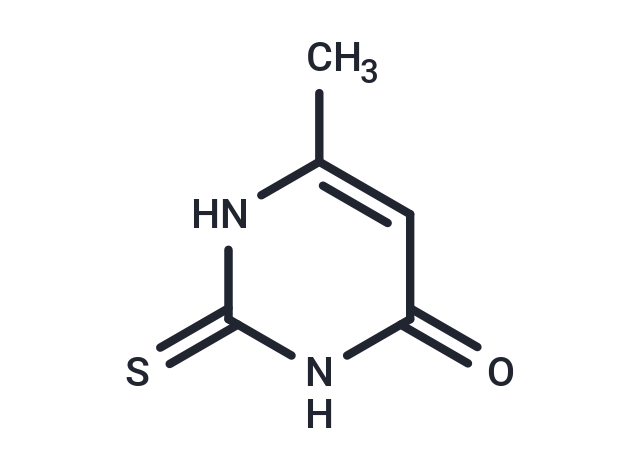
FormulaC5H6N2OS
Cas No.56-04-2
SmilesCC1=CC(=O)NC(=S)N1
Relative Density.1.36 g/cm3
Storage & Solubility Information
StoragePowder: -20°C for 3 years | In solvent: -80°C for 1 year | Shipping with blue ice/Shipping at ambient temperature.
Solubility Information
Ethanol: < 1 mg/mL (insoluble or slightly soluble)
DMSO: 27 mg/mL (189.9 mM), Sonication is recommended.
In Vivo Formulation
10% DMSO+40% PEG300+5% Tween 80+45% Saline: 2 mg/mL (14.07 mM), Sonication is recommended.
Please add the solvents sequentially, clarifying the solution as much as possible before adding the next one. Dissolve by heating and/or sonication if necessary. Working solution is recommended to be prepared and used immediately. The formulation provided above is for reference purposes only. In vivo formulations may vary and should be modified based on specific experimental conditions.
Solution Preparation Table
DMSO
1mg5mg10mg50mg
1 mM7.0333 mL35.1667 mL70.3334 mL351.6669 mL
5 mM1.4067 mL7.0333 mL14.0667 mL70.3334 mL
10 mM0.7033 mL3.5167 mL7.0333 mL35.1667 mL
20 mM0.3517 mL1.7583 mL3.5167 mL17.5833 mL
50 mM0.1407 mL0.7033 mL1.4067 mL7.0333 mL
100 mM0.0703 mL0.3517 mL0.7033 mL3.5167 mL
Note : The dilution table applies only to solid products. For liquid products, please calculate the stock solution based on the stated concentration and/or density.

Calculator

  • Molarity Calculator
  • Dilution Calculator
  • Reconstitution Calculator
  • Molecular Weight Calculator

In Vivo Formulation Calculator (Clear solution)

Please enter your animal experiment information in the following box and click Calculate to obtain the stock solution preparation method and in vivo formula preparation method:
TargetMol | Animal experiments For example, if the intended dosage is 10 mg/kg for animals weighing 20 g , with a dosing volume of 100 μL per animal, TargetMol | Animal experiments and a total of 10 animals are to be administered, using a formulation of TargetMol | reagent 10% DMSO+ 40% PEG300+ 5% Tween 80+ 45% Saline/PBS/ddH2O , the resulting working solution concentration would be 2 mg/mL.

Stock Solution Preparation:

Dissolve 2 mg of the compound in 100 μL DMSOTargetMol | reagent to obtain a stock solution at a concentration of 20 mg/mL . If the required concentration exceeds the compound's known solubility, please contact us for technical support before proceeding.

Preparation of the In Vivo Formulation:

1) Add 100 μL of the DMSOTargetMol | reagent stock solution to 400 μL PEG300TargetMol | reagent and mix thoroughly until the solution becomes clear.

2) Add 50 μL Tween 80 and mix well until fully clarified.

3) Add 450 μL Saline,PBS or ddH2OTargetMol | reagent and mix thoroughly until a homogeneous solution is obtained.

This example is provided solely to demonstrate the use of the In Vivo Formulation Calculator and does not constitute a recommended formulation for any specific compound. Please select an appropriate dissolution and formulation strategy based on your experimental model and route of administration.
All co-solvents required for this protocol, includingDMSO, PEG300/PEG400, Tween 80, SBE-β-CD, and Corn oil, are available for purchase on the TargetMol website.
1 Enter information below:
mg/kg
g
μL
2 Enter the in vivo formulation:
% DMSO
%
% Tween 80
% Saline/PBS/ddH2O

Dose Conversion

You can also refer to dose conversion for different animals. More Dose Conversion

Tech Support

Please see Inhibitor Handling Instructions for more frequently ask questions. Topics include: how to prepare stock solutions, how to store products, and cautions on cell-based assays & animal experiments, etc

Keywords

Related Tags: buy Methylthiouracil | purchase Methylthiouracil | Methylthiouracil cost | order Methylthiouracil | Methylthiouracil chemical structure | Methylthiouracil in vitro | Methylthiouracil formula | Methylthiouracil molecular weight