


Shopping Cart
Remove All Your shopping cart is currently empty

Synonyms:
| Pack Size | Price | USA Stock | Global Stock | Quantity |
|---|---|---|---|---|
| 5 mg | $47 | In Stock | In Stock | |
| 10 mg | $67 | In Stock | In Stock | |
| 25 mg | $112 | In Stock | In Stock | |
| 50 mg | $166 | In Stock | In Stock | |
| 100 mg | $246 | - | In Stock | |
| 1 mL x 10 mM (in DMSO) | $55 | In Stock | In Stock |
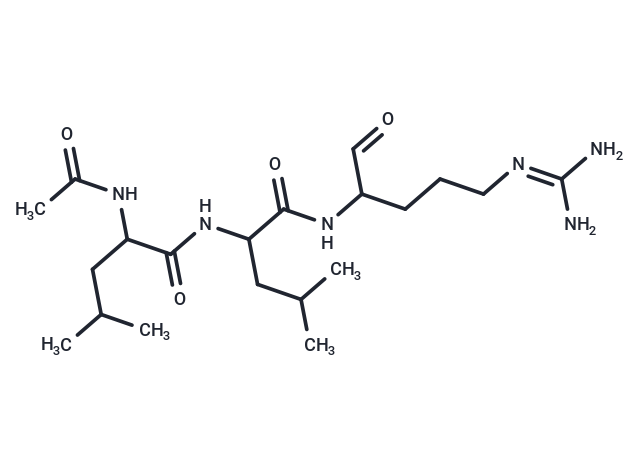
| Description | Leupeptin hemisulfate is a protease inhibitor with cell membrane-permeable, reversible, competitive, and oral activities. Leupeptin hemisulfate inhibits the activity of Cathepsin B, Cathepsin H, and Cathepsin L, and blocks fusion of amphipathic lysosomes. Leupeptin hemisulfate also has anti-inflammatory activity. |
| Targets & IC50 | Human coronavirus strain 229E:0.4 µg/mL, SARS-CoV-2 (Vero cells):42.34 µM (EC50), Huh7 cells (SARS-CoV-2):39.29 µM (EC50) |
| In vitro | METHODS: SARS-CoV-2 infected Vero cells were treated with Leupeptin hemisulfate (0.06-200 µM) for 72 h, and the viral RNA level was detected by RT-PCR. RESULTS: Leupeptin hemisulfate inhibited SARS-CoV-2 RNA levels in Vero cells with an EC50 value of 42.34 µM. [1] METHODS: SARS-CoV-2 pseudovirus-infected Huh7 cells were treated with Leupeptin hemisulfate (0.1-100 µM) for 24 h. Pseudovirus infection was detected by luciferase activity assay. RESULTS: Leupeptin hemisulfate inhibited pseudovirus infection in Vero cells with an EC50 value of 39.29 µM. [2] |
| In vivo | METHODS: To determine macrophage autophagic flux, Leupeptin hemisulfate (9-40 mg/kg in 0.5 mL PBS) was administered to C57BL/6NCrl mice by single intraperitoneal injection. RESULTS: Leupeptin hemisulfate treatment resulted in the highest accumulation of LC3b in the liver and the lowest in the spleen. LC3a, ATG8/LC3b homologs, and the LC3b-interacting protein p62 were degraded with kinetics similar to those of LC3b. [3] METHODS: To examine whether cold activates autophagic flux, Leupeptin hemisulfate (40 mg/kg) was administered intraperitoneally to C57B6 mice in a single injection, and then the mice were cold-exposed at 4 ℃ for 1 h. The mice were then exposed to cold for 1 h. RESULTS: LC3-II flux in brown fat was increased >2-fold in cold-exposed mice. [4] |
| Kinase Assay | Determination of BET Protein Binding Affinities to I-BET726: For determination of binding affinities to BET protein bromodomains, I-BET726 is titrated against truncates containing both BD1 and BD2 of BRD2 (10 nM), BRD3 (10 nM), and BRD4 (10 nM) in 50 mM HEPES pH7.5, 150 mM NaCl, 5% Glycerol, 1 mM DTT and 1 mM CHAPS in the presence of an Alexa 647 derivative (50 nM) of fluorescent ligand. After equilibrating for 1 h, the bromodomain protein: ligand interaction is detected using Time Resolved Fluorescence Resonance Energy Transfer (TR-FRET) following the addition of 1.5 nM europium chelate labeled anti-6His antibody. Plates are read using an Envision Plate reader (λEX = 337 nm, λEM = 615 nm, λEM = 665 nm; dual dichroic = 400 nm & 630 nm). These data are fitted to a four parameter IC50 model using Graphit data analysis software. |
| Molecular Weight | 475.59 |
| Formula | C20H38N6O4·1/2H2SO4 |
| Cas No. | 103476-89-7 |
| Smiles | CC(C)CC(NC(C)=O)C(=O)NC(CC(C)C)C(=O)NC(CCC\N=C(\N)N)C=O |
| Relative Density. | no data available |
| Sequence Short | Ac-LLR-CHO |
| Storage | Keep away from moisture,Store at low temperature Powder: -20°C for 3 years | In solvent: -80°C for 1 year Shipping with blue ice/Shipping at ambient temperature. | |||||||||||||||||||||||||||||||||||
| Solubility Information | H2O: 87 mg/mL (182.93 mM), Sonication is recommended. DMSO: 60 mg/mL (126.16 mM), Sonication is recommended.  Ethanol: 88 mg/mL (185.03 mM), Sonication is recommended. | |||||||||||||||||||||||||||||||||||
Solution Preparation Table | ||||||||||||||||||||||||||||||||||||
DMSO/H2O/Ethanol
Note : The dilution table applies only to solid products. For liquid products, please calculate the stock solution based on the stated concentration and/or density. | ||||||||||||||||||||||||||||||||||||
 For example, if the intended dosage is 10 mg/kg for animals weighing 20 g , with a dosing volume of 100 μL per animal, and a total of 10 animals are to be administered, using a formulation of
  10% DMSO+ 40% PEG300+ 5% Tween 80+ 45% Saline/PBS/ddH2O , the resulting working solution concentration would be 2 mg/mL.
Dissolve 2 mg of the compound in 100 μL DMSO to obtain a stock solution at a concentration of 20 mg/mL . If the required concentration exceeds the compound's known solubility, please contact us for technical support before proceeding.
1) Add 100 μL of the DMSO stock solution to 400 µL PEG300 and mix thoroughly until the solution becomes clear.
2) Add 50 µL Tween 80 and mix well until fully clarified.
3) Add 450 µL Saline,PBS or ddH2O and mix thoroughly until a homogeneous solution is obtained.
| Size | Quantity | Unit Price | Amount | Operation |
|---|
 Feedback
 Hello! How can I help you today?
Copyright © 2015-2026 TargetMol Chemicals Inc. All Rights Reserved.
