


Shopping Cart
Remove All Your shopping cart is currently empty


Synonyms: HP 873
| Pack Size | Price | USA Stock | Global Stock | Quantity |
|---|---|---|---|---|
| 25 mg | $40 | In Stock | In Stock | |
| 50 mg | $56 | In Stock | In Stock | |
| 100 mg | $98 | In Stock | In Stock | |
| 200 mg | $143 | In Stock | In Stock | |
| 1 mL x 10 mM (in DMSO) | $47 | In Stock | In Stock |
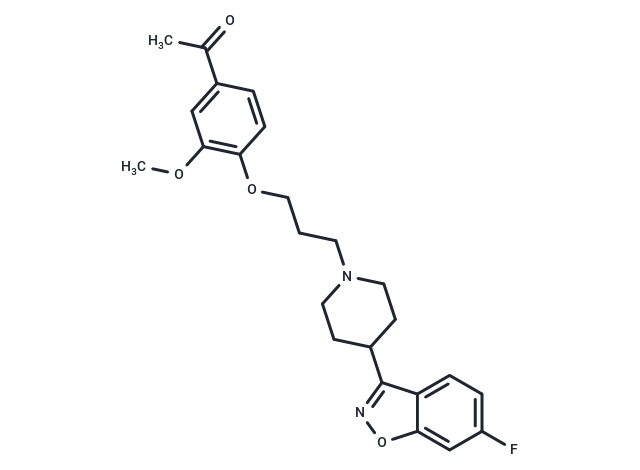
| Description | Iloperidone (HP 873) is an atypical antipsychotic agent that is used for treatment of schizophrenia. |
| Targets & IC50 | D4 receptor:25 nM (Ki), D2 receptor (rat):54 nM (Ki), 5-HT2C receptor (human):42.8 nM (Ki), D1 receptor (human):216 nM (Ki), 5-HT1A receptor (rat):168 nM (Ki), D3 receptor:7.1 nM (Ki), 5-HT7 receptor (rat):21.6 nM (Ki), 5-HT2A receptor (human):5.6 nM (Ki), D5 receptor (human):319 nM (Ki), D1 receptor (rat):546 nM (Ki), 5-HT6 receptor (rat):42.7 μM (Ki), 5-HT2 receptor (rat):3.1 nM (Ki) |
| In vitro | Iloperidone displays high affinity (Ki < 10 nM) for norepinephrine alpha(1)-adrenoceptors, dopamine D(3) and serotonin 5-HT(2A) receptors. [1] Iloperidone displays higher affinity for the dopamine D3 receptor (Ki = 7.1 nM) than for the dopamine D4 receptor (Ki = 25 nM). Iloperidone displays high affinity for the 5-HT6 and 5-HT7 receptors (Ki = 42.7 nM and 21.6 nM, respectively), and is found to have higher affinity for the 5-HT2A (Ki = 5.6 nM) than for the 5-HT2C receptor (Ki = 42.8 nM). [2] Iloperidone significantly increases dopa accumulation, an index of dopamine turnover in response to D2 receptor blockade, at doses from 0.3 mg/kg to 10 mg/kg i.p. in the striatum and from 1 mg/kg to 10 mg/kg in the nucleus accumbens. [3] |
| In vivo | Iloperidone exerts behavioral effects in pharmacological rats models of disrupted sensorimotor gating consistent with "atypical" antipsychotics, mediated by antagonism of dopaminergic and noradrenergic receptors. Iloperidone (1 and 3 mg/kg) prevents the PPI-disruptive effects of treatment with 1 mg/kg PCP. Iloperidone (0.3 mg/kg) prevents cirazoline-induced PPI deficits, independent of its effects on startle magnitude. [4] Iloperidone (10 mg/kg) and Melperone (10 mg/kg) produce an equivalent or a smaller increase in DA release in the nucleus accumbens (NAC) of rats, respectively, compared to the mPFC, whereas none of them increase acetylcholine (ACh) release in the NAC. [5] |
| Synonyms | HP 873 |
| Kinase Assay | Immunoblotting for the mTOR kinase assay: HEK293 cells are plated at 2-2.5×10⁵ cells/well of a 12-well plate and serum-starved for 24 hours in DMEM. Cells are treated with increasing concentrations of Rapamycin (0.05-50 nM) for 15 minutes at 37 °C. Serum is added to a final concentration of 20% for 30 minutes at 37 °C. Cells are lysed, and cell lysates are separated by SDS-PAGE. Resolved proteins are transferred to a polyvinylidene difluoride membrane and immunoblotted with a phosphospecific primary antibody against Thr-389 of p70 S6 kinase. Data are analyzed using ImageQuant and KaleidaGr |
| Molecular Weight | 426.48 |
| Formula | C24H27FN2O4 |
| Cas No. | 133454-47-4 |
| Smiles | FC=1C=C2C(C(=NO2)C3CCN(CCCOC4=C(OC)C=C(C(C)=O)C=C4)CC3)=CC1 |
| Relative Density. | 1.204 g/cm3 (Predicted) |
| Storage | Powder: -20°C for 3 years | In solvent: -80°C for 1 year Shipping with blue ice/Shipping at ambient temperature. | ||||||||||||||||||||||||||||||||||||||||
| Solubility Information | Ethanol: 4 mg/mL (9.38 mM), Sonication is recommended. H2O: < 1 mg/mL (insoluble or slightly soluble) DMSO: 50.5 mg/mL (118.41 mM), Sonication is recommended.  | ||||||||||||||||||||||||||||||||||||||||
| In Vivo Formulation | 10% DMSO+40% PEG300+5% Tween 80+45% Saline: 2 mg/mL (4.69 mM), Sonication is recommended. 10% DMSO+90% Saline: 5.05 mg/mL (11.84 mM), Suspension. Please add the solvents sequentially, clarifying the solution as much as possible before adding the next one. Dissolve by heating and/or sonication if necessary. Working solution is recommended to be prepared and used immediately. The formulation provided above is for reference purposes only. In vivo formulations may vary and should be modified based on specific experimental conditions. | ||||||||||||||||||||||||||||||||||||||||
Solution Preparation Table | |||||||||||||||||||||||||||||||||||||||||
Ethanol/DMSO
DMSO
Note : The dilution table applies only to solid products. For liquid products, please calculate the stock solution based on the stated concentration and/or density. | |||||||||||||||||||||||||||||||||||||||||
 For example, if the intended dosage is 10 mg/kg for animals weighing 20 g , with a dosing volume of 100 μL per animal, and a total of 10 animals are to be administered, using a formulation of
  10% DMSO+ 40% PEG300+ 5% Tween 80+ 45% Saline/PBS/ddH2O , the resulting working solution concentration would be 2 mg/mL.
Dissolve 2 mg of the compound in 100 μL DMSO to obtain a stock solution at a concentration of 20 mg/mL . If the required concentration exceeds the compound's known solubility, please contact us for technical support before proceeding.
1) Add 100 μL of the DMSO stock solution to 400 µL PEG300 and mix thoroughly until the solution becomes clear.
2) Add 50 µL Tween 80 and mix well until fully clarified.
3) Add 450 µL Saline,PBS or ddH2O and mix thoroughly until a homogeneous solution is obtained.
| Size | Quantity | Unit Price | Amount | Operation |
|---|
 Feedback
 Hello! How can I help you today?
Copyright © 2015-2026 TargetMol Chemicals Inc. All Rights Reserved.
