


Shopping Cart
Remove All Your shopping cart is currently empty


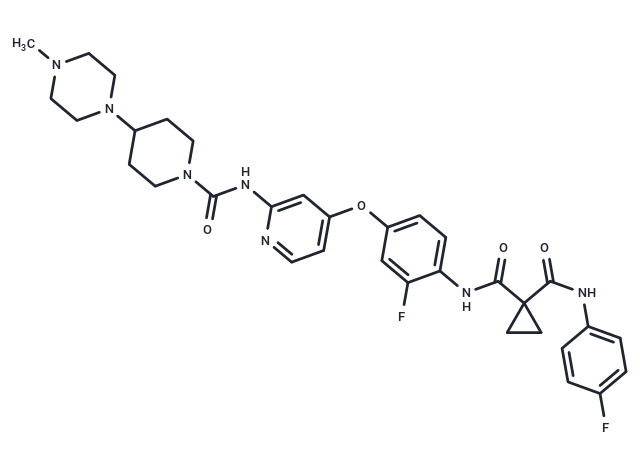
Synonyms: E-7050
| Pack Size | Price | USA Stock | Global Stock | Quantity |
|---|---|---|---|---|
| 1 mg | $30 | In Stock | In Stock | |
| 2 mg | $38 | In Stock | In Stock | |
| 5 mg | $61 | In Stock | In Stock | |
| 10 mg | $93 | In Stock | In Stock | |
| 25 mg | $152 | In Stock | In Stock | |
| 50 mg | $207 | In Stock | In Stock | |
| 100 mg | $369 | In Stock | In Stock | |
| 1 mL x 10 mM (in DMSO) | $88 | In Stock | In Stock |
| Description | Golvatinib (E-7050) is an orally bioavailable dual kinase inhibitor of c-Met (hepatocyte growth factor receptor) and VEGFR-2 (vascular endothelial growth factor receptor-2) tyrosine kinases with potential antineoplastic activity. c-Met/VEGFR kinase inhibitor E7050 binds to and inhibits the activities of both c-Met and VEGFR-2, which may inhibit tumor cell growth and survival of tumor cells that overexpress these receptor tyrosine kinases. c-Met and VEGFR-2 are upregulated in a variety of tumor cell types and play important roles in tumor cell growth, migration and angiogenesis. |
| Targets & IC50 | c-Met:14 nM, VEGFR2:16 nM |
| In vitro | In vitro studies indicate that E7050 potently inhibits phosphorylation of both c-Met and VEGFR-2. E7050 also potently represses the growth of both c-met amplified tumor cells and endothelial cells stimulated with either HGF or VEGF. [1] E7050 circumvents resistance to all of the reversible, irreversible, and mutant-selective EGFR-TKIs induced by exogenous and/or endogenous HGF in EGFR mutant lung cancer cell lines, by blocking the Met/Gab1/PI3K/Akt pathway in vitro. E7050 also prevents the emergence of gefitinib-resistant HCC827 cells induced by continuous exposure to HGF. [2] |
| In vivo | In vivo studies using E7050 shows inhibition of the phosphorylation of c-Met and VEGFR-2 in tumors, and strong inhibition of tumor growth and tumor angiogenesis in xenograft models. Treatment of some tumor lines containing c-met amplifications with high doses of E7050 (50–200 mg/kg) induces tumor regression and disappearance. In a peritoneal dissemination model, E7050 shows an antitumor effect against peritoneal tumors as well as a significant prolongation of lifespan in treated mice. [1] In another xenograft model research, tumors produced by HGF-transfected Ma-1 (Ma-1/HGF) cells are more angiogenic than vector control tumors and shows resistance to ZD1839. E7050 alone inhibits angiogenesis and retards growth of Ma-1/HGF tumors. E7050 combined with ZD1839 induces marked regression of tumor growth. [3] |
| Synonyms | E-7050 |
| Kinase Assay | Western blot analysis: The phosphorylation status of c-Met and VEGFR-2 is detected by Western blot analysis. For c-Met, MKN45 cells are incubated with a serial dilution of E7050 in complete medium at 37 °C for 2 h. For VEGFR-2, HUVEC are starved with human endothelial serum free medium containing 0.5% FBS for 24 h. Subsequently HUVEC are incubated with a serial dilution of E7050 for 1 h and then incubated with 20 ng/mL of human VEGF for 5 min. Cells are lysed by lysis buffer (50 mM HEPES [pH 7.4], 150 mM NaCl, 10% glycerol, 1% Triton X-100, 1.5 mM MgCl2, 1 mM EDTA [pH 8.0], 100 mM NaF, 1 mM phenylmethylsulfonyl fluoride 1 mM sodium orthovanadate, 10 μg/mL aprotinin, 50 μg/mL leupeptin, and 1 μg/mL pepstatin A). The resected tumor samples are homogenized with lysis buffer containing 25 mM β-glycerophosphate and 0.5% (v/v) phosphatase inhibitor cocktail 2 at 4 °C. Cellular debris is removed by centrifugation at 17 860 g for 20 min at 4 °C. Aliquots of the supernatants containing 5-20 μg of protein are subjected to SDS-PAGE under reducing conditions. The proteins are then transferred onto PVDF membranes, blocked with TBS containing 0.05% Tween-20 and either 5% skim milk or 5% BSA. The membranes are probed with the following antibodies: anti-c-Met polyclonal antibody (C-28) and anti-VEGFR-2 polyclonal antibody (C-20); mouse anti-phosphotyrosine clone 4 g10; and anti-VEGFR-2 polyclonal antibody, anti-phospho-VEGFR-2 (Tyr996) polyclonal antibody, and anti-phospho-c-Met (Tyr1234/1235) polyclonal antibody. Detection is performed using a Super Signal enhanced chemiluminescence kit. Immunoreactive bands are visualized by chemiluminescence with an Image Master-VDS-CL detection system. The intensity of each band is measured by using an image analyzer. |
| Cell Research | Cells (1–3 × 10³ cells/100 μL/well) are seeded on 96-well culture plates with various concentrations of E7050 and cultured for 3 days. Then, 10 μL of WST-8 reagent is added to each well, and absorbance is measured at 450 nm compared with a reference measurement at 660 nm using a MTP-500 microplate reader. HUVEC (2 × 10³ cells/well) are cultured for 3 days in medium containing HGF (30 ng/mL), VEGF (20 ng/mL), or basic fibroblast growth factor (bFGF) (20 ng/mL) together with serially diluted E7050.(Only for Reference) |
| Molecular Weight | 633.69 |
| Formula | C33H37F2N7O4 |
| Cas No. | 928037-13-2 |
| Smiles | CN1CCN(CC1)C1CCN(CC1)C(=O)Nc1cc(Oc2ccc(NC(=O)C3(CC3)C(=O)Nc3ccc(F)cc3)c(F)c2)ccn1 |
| Relative Density. | 1.408 g/cm3 |
| Storage | Powder: -20°C for 3 years | In solvent: -80°C for 1 year Shipping with blue ice/Shipping at ambient temperature. | |||||||||||||||||||||||||||||||||||
| Solubility Information | H2O: < 1 mg/mL (insoluble or slightly soluble) Ethanol: < 1 mg/mL (insoluble or slightly soluble) DMSO: 100 mg/mL (157.81 mM)  | |||||||||||||||||||||||||||||||||||
| In Vivo Formulation | 10% DMSO+40% PEG300+5% Tween 80+45% Saline: 4 mg/mL (6.31 mM), Sonication is recommended. Please add the solvents sequentially, clarifying the solution as much as possible before adding the next one. Dissolve by heating and/or sonication if necessary. Working solution is recommended to be prepared and used immediately. The formulation provided above is for reference purposes only. In vivo formulations may vary and should be modified based on specific experimental conditions. | |||||||||||||||||||||||||||||||||||
Solution Preparation Table | ||||||||||||||||||||||||||||||||||||
DMSO
Note : The dilution table applies only to solid products. For liquid products, please calculate the stock solution based on the stated concentration and/or density. | ||||||||||||||||||||||||||||||||||||
 For example, if the intended dosage is 10 mg/kg for animals weighing 20 g , with a dosing volume of 100 μL per animal, and a total of 10 animals are to be administered, using a formulation of
  10% DMSO+ 40% PEG300+ 5% Tween 80+ 45% Saline/PBS/ddH2O , the resulting working solution concentration would be 2 mg/mL.
Dissolve 2 mg of the compound in 100 μL DMSO to obtain a stock solution at a concentration of 20 mg/mL . If the required concentration exceeds the compound's known solubility, please contact us for technical support before proceeding.
1) Add 100 μL of the DMSO stock solution to 400 µL PEG300 and mix thoroughly until the solution becomes clear.
2) Add 50 µL Tween 80 and mix well until fully clarified.
3) Add 450 µL Saline,PBS or ddH2O and mix thoroughly until a homogeneous solution is obtained.
| Size | Quantity | Unit Price | Amount | Operation |
|---|
 Feedback
 Hello! How can I help you today?
Copyright © 2015-2026 TargetMol Chemicals Inc. All Rights Reserved.
