


Shopping Cart
Remove All Your shopping cart is currently empty

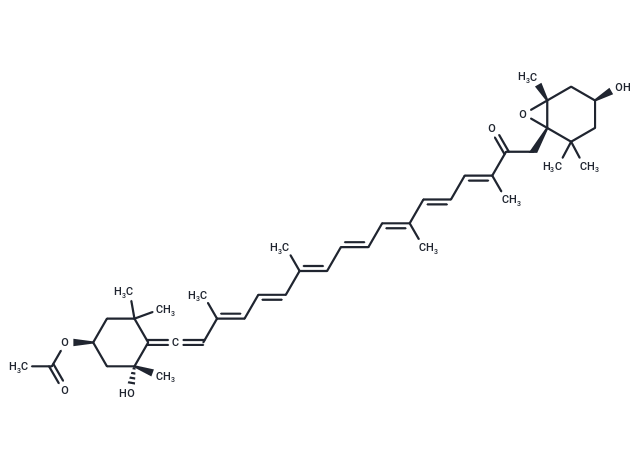
Synonyms: all-trans-Fucoxanthin
| Pack Size | Price | USA Stock | Global Stock | Quantity |
|---|---|---|---|---|
| 1 mg | $30 | In Stock | In Stock | |
| 2 mg | $41 | In Stock | In Stock | |
| 5 mg | $67 | In Stock | In Stock | |
| 10 mg | $108 | In Stock | In Stock | |
| 25 mg | $256 | In Stock | In Stock | |
| 50 mg | $455 | - | In Stock | |
| 100 mg | $672 | Inquiry | Inquiry | |
| 500 mg | $1,430 | Inquiry | Inquiry | |
| 1 mL x 10 mM (in DMSO) | $98 | In Stock | In Stock |
| Description | Fucoxanthin (all-trans-Fucoxanthin) is a marine carotenoid (natural product), a multifunctional bioactive molecule with oral activity and cell permeability. It exhibits anti-obesity, anti-diabetic, anti-inflammatory, antioxidant, and anticancer activities, and is used in metabolic and tumor research. |
| Targets & IC50 | AChE:81.2 μM, MAO-A (human):197.41 ± 2.20 μM, MAO-B (human):211.12 ± 1.17 μM, D3 receptor:16.87 ± 3.41 μM (EC50), BChE:1.97 mM |
| In vitro | Methods: The MTT assay was used to verify the in vitro activity of Fucoxanthin. Cells were incubated for 72 hours at concentrations of 1, 10, 20, and 50 μM, applied to breast cancer cell lines MCF7, SKBR3, MDA-MB-231, and non-tumorigenic breast cell line MCF12A. Subsequently, combination experiments with cisplatin and doxorubicin were conducted using the same incubation and detection procedures. Results: Fucoxanthin exhibited dose-dependent cytotoxicity against all tested cell lines. Combination with doxorubicin enhanced the killing effect on SKBR3 and MDA-MB-231 cells, with 10 μM Fucoxanthin combined with 1 μM doxorubicin showing the most significant effect on MDA-MB-231. [1] Methods: MTT assay, QCV assay, scratch migration assay, and Matrigel invasion assay were performed in multiple human cancer cells (U2OS, MCF7, DLD-1, A549, H1299, SKOV3) and normal fibroblasts (MRC5, TIG-3). Cells were treated with 0–2.5 μM Fucoxanthin (for cytotoxicity) or ≤5 μM (for migration/invasion) for 48 h. Results: It showed selective toxicity against cancer cells and significantly inhibited migration and invasion capabilities. [2] Methods: Antioxidant activity was measured by DPPH, ABTS free radical scavenging, and FRAP assays, with Fucoxanthin incubation concentrations of 30-150 μM; DPPH was incubated in the dark for 30 min. For ACE inhibition experiments, rabbit lung ACE was used with incubation concentrations of 300-1500 μM Fucoxanthin, incubated at 37℃ for 30 min. Enzyme kinetic analysis was performed with different concentrations of HHL and Fucoxanthin. Results: It showed dose-dependent antioxidant activity. It exhibited mixed non-competitive inhibition against ACE, with IC50 of 822.64±17.69 μM and Ki of 600 μM. [3] |
| In vivo | Methods: In a streptozotocin (STZ)-induced diabetic Sprague-Dawley (SD) rat model, Fucoxanthin was administered by oral gavage at a dose of 200 mg/kg/day (dissolved in distilled water) for 12 consecutive weeks. Results: Fucoxanthin effectively improved renal function, alleviated glomerulosclerosis, reversed the decrease in renal Sirt1 and Nrf2 protein levels, and reduced oxidative stress indicators. [4] |
| Synonyms | all-trans-Fucoxanthin |
| Molecular Weight | 658.91 |
| Formula | C42H58O6 |
| Cas No. | 3351-86-8 |
| Smiles | CC(=O)O[C@H]1CC(C)(C)C(=C=C\C(C)=C\C=C\C(\C)=C\C=C\C=C(/C)\C=C\C=C(/C)C(=O)C[C@@]23O[C@]2(C)C[C@@H](O)CC3(C)C)[C@](C)(O)C1 |
| Relative Density. | 1.09 g/cm3 |
| Storage | Keep away from direct sunlight,Keep away from moisture Powder: -20°C for 3 years | In solvent: -80°C for 1 year Shipping with blue ice/Shipping at ambient temperature. | |||||||||||||||||||||||||||||||||||
| Solubility Information | DMSO: 140 mg/mL (212.47 mM), Sonication is recommended.  H2O: Insoluble | |||||||||||||||||||||||||||||||||||
Solution Preparation Table | ||||||||||||||||||||||||||||||||||||
DMSO
Note : The dilution table applies only to solid products. For liquid products, please calculate the stock solution based on the stated concentration and/or density. | ||||||||||||||||||||||||||||||||||||
 For example, if the intended dosage is 10 mg/kg for animals weighing 20 g , with a dosing volume of 100 μL per animal, and a total of 10 animals are to be administered, using a formulation of
  10% DMSO+ 40% PEG300+ 5% Tween 80+ 45% Saline/PBS/ddH2O , the resulting working solution concentration would be 2 mg/mL.
Dissolve 2 mg of the compound in 100 μL DMSO to obtain a stock solution at a concentration of 20 mg/mL . If the required concentration exceeds the compound's known solubility, please contact us for technical support before proceeding.
1) Add 100 μL of the DMSO stock solution to 400 µL PEG300 and mix thoroughly until the solution becomes clear.
2) Add 50 µL Tween 80 and mix well until fully clarified.
3) Add 450 µL Saline,PBS or ddH2O and mix thoroughly until a homogeneous solution is obtained.
| Size | Quantity | Unit Price | Amount | Operation |
|---|
 Feedback
 Hello! How can I help you today?
Copyright © 2015-2026 TargetMol Chemicals Inc. All Rights Reserved.
