


Shopping Cart
Remove All Your shopping cart is currently empty


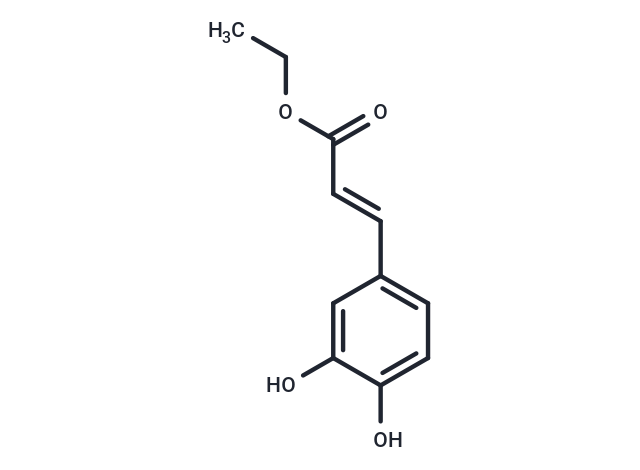
Synonyms: ETHYL 3,4-DIHYDROXYCINNAMATE
| Pack Size | Price | USA Stock | Global Stock | Quantity |
|---|---|---|---|---|
| 10 mg | $41 | In Stock | In Stock | |
| 25 mg | $74 | In Stock | In Stock | |
| 50 mg | $124 | In Stock | In Stock | |
| 100 mg | $198 | In Stock | In Stock | |
| 1 mL x 10 mM (in DMSO) | $29 | In Stock | In Stock |
| Description | Ethyl Caffeate (ETHYL 3,4-DIHYDROXYCINNAMATE) suppressed the differentiation of naive CD4+ T cells into Th1 in vitro. Furthermore, Ethyl Caffeate intensely blocked the transcriptional expression in interferon-γ-related signaling, including IFN-γ, T-bet, STAT1, and STAT4. |
| In vitro | In vivo, ETHYL CAFFEATE(ECF) treatment reduced the severity of collagen-induced arthritis (CIA), inhibited IFN-γ and IL-6 secretion, and?decreased the proportion of CD11b+Gr-1+ splenic neutrophil.?Meanwhile, ECF treatment significantly inhibited the IFN-γ expression in CD4+T cell without obviously influencing the development of Th17 cells and T regulatory cells. |
| In vivo | Shikui X , Aixue Z , Zengjun G , et al. Ethyl Caffeate Ameliorates Collagen-Induced Arthritis by Suppressing Th1 Immune Response[J]. Journal of Immunology Research, 2017, 2017:1-11. |
| Synonyms | ETHYL 3,4-DIHYDROXYCINNAMATE |
| Kinase Assay | The proliferation of splenocytes or T cells in response to ConA, LPS, and anti-CD3/28 was measured by CCK-8 Kit.?Briefly, BALB/c splenocyte suspension (5?×?105 cells/well) was cultured with ConA (5?μg/ml), LPS (10?μg/ml), and anti-CD3 (5?μg/ml;?145-2C11) in the presence of ECF at indicated concentrations.?The cultures were incubated for 48?h, 20?μl of CCK-8 was then added to each well before the end of culture, and OD value was read at 450?nm.?The MTT method was used to measure the cytotoxicity of the sample.?Splenocytes (5?×?105 cells/well) were cultured in triplicates in the absence or presence of ECF in a 96-well flat-bottomed plate (Costar) for 48?h.?MTT (5?mg/ml) was pulsed for 4?h prior to the end of the culture.?Upon removal of MTT/medium, 150?μl of DMSO was added to each well, and the plate was agitated on an oscillator for 5?min to dissolve the precipitate.?The assay plate was read at 570?nm using a microplate reader. |
| Cell Research | Collagen was dissolved in 0.1 M acetic acid at 4°C overnight.?Male DBA/1 mice were immunized at the tail base with 125?μg of collagen emulsified in complete Freund's adjuvant (CFA) containing Mycobacterium tuberculosis strain H37Rv.?Each mouse was then boosted with the same amount of collagen plus CFA 21 days later (taken as day 0). Starting from day 9 for 10 consecutive days, the mice were administered daily with ECF (50?mg/kg) or methotrexate (2?mg/kg) |
| Molecular Weight | 208.211 |
| Formula | C11H12O4 |
| Cas No. | 102-37-4 |
| Smiles | O=C(OCC)/C=C/C1=CC=C(O)C(O)=C1 |
| Relative Density. | 1.271g/cm3 |
| Storage | Powder: -20°C for 3 years | In solvent: -80°C for 1 year Shipping with blue ice/Shipping at ambient temperature. | |||||||||||||||||||||||||||||||||||
| Solubility Information | DMSO: 250.00 mg/mL (1200.71 mM), Sonication is recommended.  | |||||||||||||||||||||||||||||||||||
| In Vivo Formulation | 10% DMSO+40% PEG300+5% Tween 80+45% Saline: 10.00 mg/mL (48.03 mM), Solution. 10% DMSO+90% Saline: < 10 mg/mL (48.03 mM), Lower concentrations may be soluble, but exact solubility limit is unknown. Please add the solvents sequentially, clarifying the solution as much as possible before adding the next one. Dissolve by heating and/or sonication if necessary. Working solution is recommended to be prepared and used immediately. The formulation provided above is for reference purposes only. In vivo formulations may vary and should be modified based on specific experimental conditions. | |||||||||||||||||||||||||||||||||||
Solution Preparation Table | ||||||||||||||||||||||||||||||||||||
DMSO
Note : The dilution table applies only to solid products. For liquid products, please calculate the stock solution based on the stated concentration and/or density. | ||||||||||||||||||||||||||||||||||||
 For example, if the intended dosage is 10 mg/kg for animals weighing 20 g , with a dosing volume of 100 μL per animal, and a total of 10 animals are to be administered, using a formulation of
  10% DMSO+ 40% PEG300+ 5% Tween 80+ 45% Saline/PBS/ddH2O , the resulting working solution concentration would be 2 mg/mL.
Dissolve 2 mg of the compound in 100 μL DMSO to obtain a stock solution at a concentration of 20 mg/mL . If the required concentration exceeds the compound's known solubility, please contact us for technical support before proceeding.
1) Add 100 μL of the DMSO stock solution to 400 µL PEG300 and mix thoroughly until the solution becomes clear.
2) Add 50 µL Tween 80 and mix well until fully clarified.
3) Add 450 µL Saline,PBS or ddH2O and mix thoroughly until a homogeneous solution is obtained.
| Size | Quantity | Unit Price | Amount | Operation |
|---|
 Feedback
 Hello! How can I help you today?
Copyright © 2015-2026 TargetMol Chemicals Inc. All Rights Reserved.
