


Shopping Cart
Remove All Your shopping cart is currently empty

Synonyms: TKI258, Dovitinib Lactate, Dovitinib (TKI258) Lactate
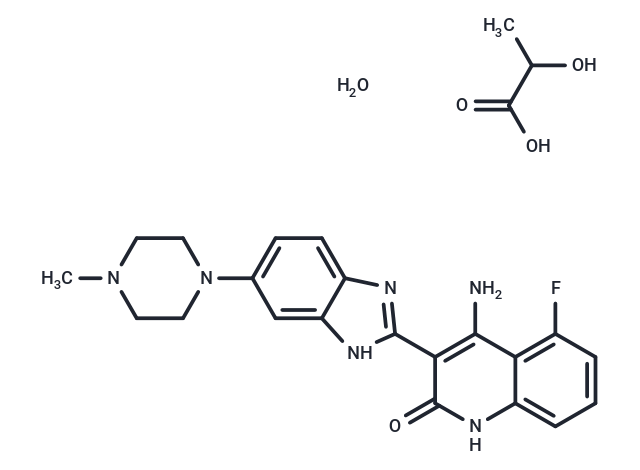
| Pack Size | Price | USA Stock | Global Stock | Quantity |
|---|---|---|---|---|
| 5 mg | $50 | In Stock | In Stock | |
| 10 mg | $76 | In Stock | In Stock | |
| 25 mg | $143 | In Stock | In Stock | |
| 50 mg | $243 | In Stock | In Stock | |
| 100 mg | $405 | In Stock | In Stock | |
| 200 mg | $589 | - | In Stock | |
| 1 mL x 10 mM (in DMSO) | $50 | In Stock | In Stock |
| Description | Dovitinib lactate hydrate (TKI258) is the Lactate of Dovitinib, which is a multitargeted RTK inhibitor, mostly for class III (FLT3/c-Kit) with IC50 of 1 nM/2 nM, also potent to class IV (FGFR1/3) and class V (VEGFR1-4) RTKs with IC50 of 8-13 nM, less potent to InsR, EGFR, c-Met, EphA2, Tie2, IGFR1 and HER2. Phase 4. |
| Targets & IC50 | PDGFRα:27 nM, FGFR3:9 nM, PDGFRβ:210 nM, FLT3:1 nM, FGFR1:8 nM, c-Kit:2 nM, VEGFR1:1 nM, VEGFR3:8 nM, VEGFR2:13 nM |
| In vitro | Dovitinib potently inhibits the FGF-stimulated growth of WT and F384L-FGFR3-expressing B9 cells with an IC50 of 25 nM and inhibits proliferation of B9 cells expressing various activated FGFR3 mutants, showing minimal sensitivity differences with IC50 ranging from 70 to 90 nM. IL-6-dependent B9 cells containing vector only (B9-MINV cells) are resistant to Dovitinib at concentrations up to 1 μM. Dovitinib inhibits proliferation of KMS11 (FGFR3-Y373C), OPM2 (FGFR3-K650E), and KMS18 (FGFR3-G384D) cells with IC50 of 90 nM (KMS11 and OPM2) and 550 nM, respectively. It also inhibits FGF-mediated ERK1/2 phosphorylation and induces cytotoxicity in FGFR3-expressing primary MM cells, with BMSCs conferring modest resistance (44.6% growth inhibition at 500 nM Dovitinib on stroma vs. 71.6% without BMSCs). In M-NFS-60 cells, Dovitinib has an EC50 of 220 nM. In SK-HEP1 cells, Dovitinib reduces cell number in a dose-dependent manner, induces G2/M phase arrest, inhibits anchorage-independent growth, and blocks bFGF-induced cell motility, with an IC50 of ~1.7 μM. It significantly reduces basal phosphorylation levels of FGFR-1, FRS2-α, and ERK1/2 but not Akt in both SK-HEP1 and 21-0208 cells and inhibits bFGF-induced phosphorylation of FGFR-1, FRS2-α, and ERK1/2 but not Akt in 21-0208 cells. |
| In vivo | Dovitinib induces both cytostatic and cytotoxic responses in vivo resulting in regression of FGFR3-expressing tumors.[1] Dovitinib shows a dose- and exposure-dependent inhibition of target receptor tyrosine kinases (RTKs) expressed in tumor xenografts. Dovitinib potently inhibits tumor growth of six HCC lines. Inhibition of angiogenesis correlated with inactivation of FGFR/PDGFRβ/VEGFR2 signaling pathways. In an orthotopic model, Dovitinib potently inhibits primary tumor growth and lung metastasis and significantly prolonged mouse survival. [2] Administration of Dovitinib results in significant tumor growth inhibition and tumor regressions, including large, established tumors (500-1,000 mm3). [3] |
| Synonyms | TKI258, Dovitinib Lactate, Dovitinib (TKI258) Lactate |
| Kinase Assay | In vitro kinase assays: The inhibitory concentration of 50% (IC50) values for the inhibition of RTKs by Dovitinib are determined in a time-resolved fluorescence (TRF) or radioactive format, measuring the inhibition by Dovitinib of phosphate transfer to a substrate by the respective enzyme. The kinase domains of FGFR3, FGFR1, PDGFRβ, and VEGFR1-3 are assayed in 50 mM HEPES (N-2-hydroxyethylpiperazine-N′-2-ethanesulfonic acid), pH 7.0, 2 mM MgCl2, 10 mM MnCl2 1 mM NaF, 1 mM dithiothreitol (DTT), 1 mg/mL bovine serum albumin (BSA), 0.25 μM biotinylated peptide substrate (GGGGQDGKDYIVLPI), and 1 to 30 μM adenosine triphosphate (ATP) depending on the Km for the respective enzyme. ATP concentrations are at or just below Km. For c-KIT and FLT3 reactions the pH is raised to 7.5 with 0.2 to 8 μM ATP in the presence of 0.25 to 1 μM biotinylated peptide substrate (GGLFDDPSYVNVQNL). Reactions are incubated at room temperature for 1 to 4 hours and the phosphorylated peptide captured on streptavidin-coated microtiter plates containing stop reaction buffer (25 mM EDTA [ethylenediaminetetraacetic acid], 50 mM HEPES, pH 7.5). Phosphorylated peptide is measured with the DELFIA TRF system using a Europium-labeled antiphosphotyrosine antibody PT66. The concentration of Dovitinib for IC50 is calculated using nonlinear regression with XL-Fit data analysis software version 4.1 (IDBS). Inhibition of colony-stimulating factor-1 receptor (CSF-1R), PDGFRα, insulin receptor (InsR), and insulin-like growth factor receptor 1 (IGFR1) kinase activity is determined at ATP concentrations close the Km for ATP. |
| Cell Research | Cell viability is assessed by 3-(4,5-dimethylthiazol)-2,5-diphenyl tetrazolium (MTT) dye absorbance. Cells are seeded in 96-well plates at a density of 5 × 10³ (B9 cells) or 2 × 10⁴ (MM cell lines) cells per well. Cells are incubated with 30 ng/mL aFGF and 100 μg/mL heparin or 1% IL-6 where indicated and increasing concentrations of Dovitinib. For each concentration of Dovitinib, 10 μL aliquots of drug or DMSO diluted in culture medium is added. For drug combination studies, cells are incubated with 0.5 μM dexamethasone, 100 nM Dovitinib, or both simultaneously where indicated. To evaluate the effect of Dovitinib on growth of MM cells adherent to BMSCs, 104 KMS11 cells are cultured on BMSC-coated 96-well plates in the presence or absence of Dovitinib. Plates are incubated for 48 to 96 hours. For assessment of macrophage colony-stimulating factor (M-CSF)-mediated growth, 5 × 10³ M-NFS-60 cells/well are incubated with serial dilutions of Dovitinib with 10 ng/mL M-CSF and without granulocyte-macrophage colony-stimulating factor (GM-CSF). After 72 hours cell viability is determined using Cell Titer-Glo Assay. Each experimental condition is performed in triplicate. (Only for Reference) |
| Molecular Weight | 482.51 |
| Formula | C24H27FN6O4 |
| Cas No. | 915769-50-5 |
| Smiles | O.CC(O)C(O)=O.CN1CCN(CC1)c1ccc2nc([nH]c2c1)-c1c(N)c2c(F)cccc2[nH]c1=O |
| Relative Density. | no data available |
| Storage | Powder: -20°C for 3 years | In solvent: -80°C for 1 year Shipping with blue ice/Shipping at ambient temperature. | |||||||||||||||||||||||||||||||||||||||||||||
| Solubility Information | H2O: 61 mg/mL (126.42 mM), Sonication is recommended. Ethanol: 1 mg/mL (2.07 mM), Heating is recommended. DMSO: 19.23 mg/mL (39.85 mM), Sonication is recommended.  | |||||||||||||||||||||||||||||||||||||||||||||
Solution Preparation Table | ||||||||||||||||||||||||||||||||||||||||||||||
Ethanol/DMSO/H2O
DMSO/H2O
H2O
Note : The dilution table applies only to solid products. For liquid products, please calculate the stock solution based on the stated concentration and/or density. | ||||||||||||||||||||||||||||||||||||||||||||||
 For example, if the intended dosage is 10 mg/kg for animals weighing 20 g , with a dosing volume of 100 μL per animal, and a total of 10 animals are to be administered, using a formulation of
  10% DMSO+ 40% PEG300+ 5% Tween 80+ 45% Saline/PBS/ddH2O , the resulting working solution concentration would be 2 mg/mL.
Dissolve 2 mg of the compound in 100 μL DMSO to obtain a stock solution at a concentration of 20 mg/mL . If the required concentration exceeds the compound's known solubility, please contact us for technical support before proceeding.
1) Add 100 μL of the DMSO stock solution to 400 µL PEG300 and mix thoroughly until the solution becomes clear.
2) Add 50 µL Tween 80 and mix well until fully clarified.
3) Add 450 µL Saline,PBS or ddH2O and mix thoroughly until a homogeneous solution is obtained.
| Size | Quantity | Unit Price | Amount | Operation |
|---|
 Feedback
 Hello! How can I help you today?
Copyright © 2015-2026 TargetMol Chemicals Inc. All Rights Reserved.
