


Shopping Cart
Remove All Your shopping cart is currently empty


Synonyms: Decumbin, Cyanein, BFA, Ascotoxin
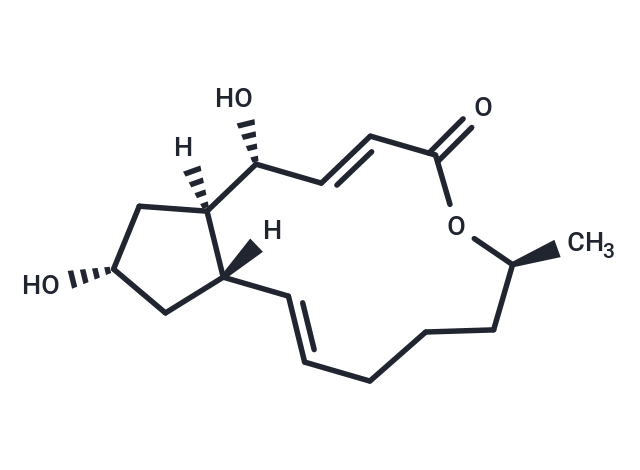

| Pack Size | Price | USA Stock | Global Stock | Quantity |
|---|---|---|---|---|
| 2 mg | $34 | In Stock | In Stock | |
| 5 mg | $48 | In Stock | In Stock | |
| 10 mg | $58 | In Stock | In Stock | |
| 50 mg | $198 | In Stock | In Stock | |
| 100 mg | $360 | In Stock | In Stock | |
| 1 mL x 10 mM (in DMSO) | $48 | In Stock | In Stock |
| Description | Brefeldin A (Cyanein) belongs to the class of macrolide antibiotics and is an ATPase inhibitor (IC50=0.2 μM). Brefeldin A can induce tumor cell differentiation and apoptosis, and also possesses autophagy inhibitory activity. |
| Targets & IC50 | ATPase (HCT 116 cells):0.2 μM, A549 cells proliferation:101.2 nM, HeLa cells proliferation:171.9 nM, HepG2 cells proliferation:239.1 nM |
| In vitro | METHODS: Tumor cells HL60, K562 and HT-29 were treated with Brefeldin A (2 μM) for 72 h. DNA fragments were detected by DNA filter elution assay. RESULTS: Brefeldin A induced DNA fragmentation with different kinetics. intact DNA fragments were observed in HL60 cells within 15 h, whereas 48-72 h was required for K562 and HT-29 cells. [1] METHODS: Human breast cancer cells MDA-MB-231 were treated with Brefeldin A (0.05-1 μg/mL) for 24 h, and the expression levels of target proteins were detected by Western Blot. RESULTS: PARP cleavage, a hallmark event of cell death, could be detected in Brefeldin A-treated suspension MDA-MB-231 cells. [2] |
| In vivo | In HF4.9 and HF28RA cells, Brefeldin A (25 ng/mL) completely inhibits cell growth. Similarly, in HF1A3 cells, Brefeldin A (75 ng/mL) fully inhibits cell growth. |
| Synonyms | Decumbin, Cyanein, BFA, Ascotoxin |
| Kinase Assay | ELISA-based active site binding assay: Samples (lysed cells or tissue homogenates) are treated for 1 h at room temperature with the biotinylated active site probe PR-584 (5-15 μM). Samples are denatured by addition of SDS (0.9% final) and heating to 100 °C for 5 min. The denatured samples are transferred to a 96-well or 384-well filter plat, mixed with streptavidin-sepharose beads (2.5-5 μL packed beads/well), and incubated for 1 h at room temperature on a plate shaker. The beads are washed 5 times with 100-200 μL /well of ELISA buffer (PBS, 1% bovine serum albumin, 0.1% Tween-20) by vacuum filtration. The beads are incubated overnight at 4 °C on a plate shaker with the following antibodies recognizing the six catalytic subunits diluted into ELISA buffer: β5, β1, and β2 diluted 1:3000, LMP7 and LMP2 diluted 1:5000, and MECL-1 diluted 1:1000. The beads are washed 5 times with 100-200 μL /well of ELISA buffer and incubated with HRP-conjugated secondary antibody diluted 1:5000 in ELISA buffer and incubated 2 h at room temperature on a plate shaker. The beads are washed 5 times with 100-200 μL /well of ELISA buffer and developed for chemiluminsecence signal using the supersignal ELISA pico substrate following the manufacturer's instructions. Luminescence is measured on a plate reader and converted to ng of proteasome or μg/ml of lysate by comparison with 20S proteasome or untreated cell lysate standard curves. For proteasome inhibitor studies, active site probe binding values are expressed as the percent of binding relative to DMSO treated cells. |
| Cell Research | HF1A3, HF4.9 cell viability upon the treatments is tested using double staining of cells with YO-PRO 1/PI and SYTO16/PI probes. To access cell proliferation, cells are treated with 0–100 ng/mL Brefeldin A in complete medium for 20 hours before adding 1 μCi/mL [methyl-3H]-thymidine for additional 4 hours at 37 °C. The incorporated radioactive thymidine is quantified by scintillation counting with Microbeta counter. To examine long-term effects of Brefeldin A treatment, cells are seeded at initial concentration 105 cells/mL and treated with 0-75 ng/mL Brefeldin A for up to 5 days. At the time indicated, a sample of cells is removed and viable cell number is assessed by standard Trypan Blue exclusion assay.(Only for Reference) |
| Molecular Weight | 280.36 |
| Formula | C16H24O4 |
| Cas No. | 20350-15-6 |
| Smiles | [H][C@@]12C[C@H](O)C[C@@]1([H])[C@H](O)\C=C\C(=O)O[C@@H](C)CCC\C=C\2 |
| Relative Density. | 1.108 g/cm3 (Predicted) |
| Storage | Store at low temperature,Keep away from moisture,Store under nitrogen Powder: -20°C for 3 years | In solvent: -80°C for 1 year Shipping with blue ice/Shipping at ambient temperature. | ||||||||||||||||||||||||||||||||||||||||
| Solubility Information | Ethanol: 2.81 mg/mL (10.02 mM), Sonication is recommended. DMSO: 128.75 mg/mL (459.23 mM), Sonication is recommended.  | ||||||||||||||||||||||||||||||||||||||||
| In Vivo Formulation | 10% DMSO+40% PEG300+5% Tween 80+45% Saline: 4 mg/mL (14.27 mM), Sonication is recommended. Please add the solvents sequentially, clarifying the solution as much as possible before adding the next one. Dissolve by heating and/or sonication if necessary. Working solution is recommended to be prepared and used immediately. The formulation provided above is for reference purposes only. In vivo formulations may vary and should be modified based on specific experimental conditions. | ||||||||||||||||||||||||||||||||||||||||
Solution Preparation Table | |||||||||||||||||||||||||||||||||||||||||
Ethanol/DMSO
DMSO
Note : The dilution table applies only to solid products. For liquid products, please calculate the stock solution based on the stated concentration and/or density. | |||||||||||||||||||||||||||||||||||||||||
 For example, if the intended dosage is 10 mg/kg for animals weighing 20 g , with a dosing volume of 100 μL per animal, and a total of 10 animals are to be administered, using a formulation of
  10% DMSO+ 40% PEG300+ 5% Tween 80+ 45% Saline/PBS/ddH2O , the resulting working solution concentration would be 2 mg/mL.
Dissolve 2 mg of the compound in 100 μL DMSO to obtain a stock solution at a concentration of 20 mg/mL . If the required concentration exceeds the compound's known solubility, please contact us for technical support before proceeding.
1) Add 100 μL of the DMSO stock solution to 400 µL PEG300 and mix thoroughly until the solution becomes clear.
2) Add 50 µL Tween 80 and mix well until fully clarified.
3) Add 450 µL Saline,PBS or ddH2O and mix thoroughly until a homogeneous solution is obtained.
| Size | Quantity | Unit Price | Amount | Operation |
|---|
 Feedback
 Hello! How can I help you today?
Copyright © 2015-2026 TargetMol Chemicals Inc. All Rights Reserved.
