


Shopping Cart
Remove All Your shopping cart is currently empty


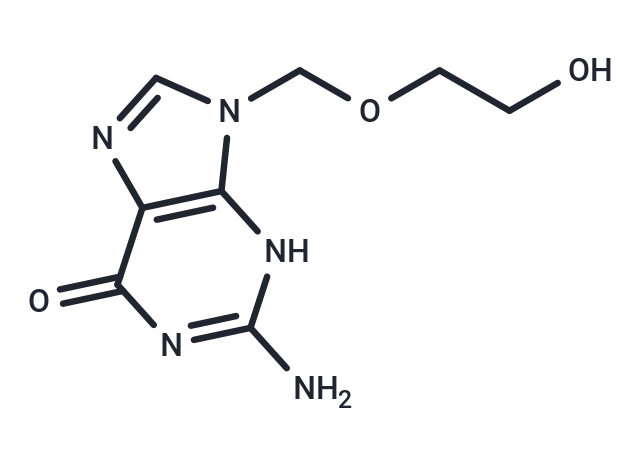
Synonyms: Acycloguanosine, Aciclovir
| Pack Size | Price | USA Stock | Global Stock | Quantity |
|---|---|---|---|---|
| 25 mg | $39 | In Stock | In Stock | |
| 50 mg | $51 | In Stock | In Stock | |
| 100 mg | $80 | In Stock | In Stock | |
| 200 mg | $104 | In Stock | In Stock | |
| 500 mg | $131 | In Stock | In Stock | |
| 1 mL x 10 mM (in DMSO) | $50 | In Stock | In Stock |
| Description | Acyclovir (Aciclovir) is a guanine analog and orally active antiviral agent characterized by a narrow antiviral spectrum, high selectivity, and low toxicity. Acyclovir exhibits activity against HSV-1 (IC50 = 0.85 μM), HSV-2 (IC50 = 0.86 μM), and varicella-zoster virus. Acyclovir can be used for herpesvirus treatment research. |
| Targets & IC50 | HSV1:0.85 μM (IC50), HSV2:0.86 μM (IC50) |
| In vitro | Methods: Flow cytometry was used to analyze the cell cycle distribution of Jurkat cells treated with 10 and 100 μM acyclovir at 24, 48, and 72 hours. Results: Acyclovir induced S-phase arrest in Jurkat cells, and the sub-G1 apoptotic peak was significantly elevated at 72 hours. [4] Methods: Cell viability of Jurkat, U937, and K562 leukemia cells treated with 3–100 μM acyclovir for 24, 48, and 72 hours was assessed using the trypan blue staining Methods. Results: Acyclovir inhibited Jurkat cell viability in a dose- and time-dependent manner, while its inhibitory effect on U937 and K562 cells was weaker. [4] |
| In vivo | Methods: Female Danish Landrace pigs (n=6, weight 37–48 kg) received a single intravenous bolus injection of Acyclovir (10 mg/kg). Monitoring was conducted for 8 hours post-administration, with sampling every 30 minutes. Results: Plasma drug concentrations peaked rapidly, but CNS distribution was slow and limited. [1] Methods: Four healthy Asian elephant calves received a single intravenous bolus of Acyclovir (15 mg/kg). Blood samples were collected pre-dose and at 0, 0.25, 0.5, 0.75, 1, 1.5, 2, 3, 4, 5, 6, 12, 24, 36, and 48 h post-administration. Plasma drug concentrations were measured by LC-MS/MS. Results: At 12 h post-administration, plasma concentrations remained above the IC50 for HSV-1/2 and EHV-1. [2] Methods: Male Sprague-Dawley rats received epidural Acyclovir (0.3 mg, 0.6 mg, 0.9 mg) (dissolved in 100 μL) or intravenous Acyclovir (3 mg, 6 mg, 9 mg) (dissolved in 2 mL saline). Blood and cerebrospinal fluid (CSF) samples were collected 1 hour post-administration. Results: CSF concentrations in the epidural group were significantly higher than those in the IV group (P<0.05), while plasma concentrations were significantly lower than those in the IV group (P<0.05).[3] |
| Synonyms | Acycloguanosine, Aciclovir |
| Kinase Assay | Total AMPK activity is measured using the method of Dagher et al. AMPK activity is quantified in the resuspended pellet as incorporation of?32P from [γ-32P]ATP (10 GBq/mmol) into a synthetic peptide with the specific target sequence for AMPK, the SAMS peptide. Radioactivity is measured using a liquid scintillation counter. Protein content in the solution containing the resupended (NH4)2SO4 pellet is determined using the Bradford method. |
| Molecular Weight | 225.2 |
| Formula | C8H11N5O3 |
| Cas No. | 59277-89-3 |
| Smiles | NC1=NC(=O)C2=C(N1)N(COCCO)C=N2 |
| Relative Density. | 1.77 |
| Storage | Powder: -20°C for 3 years | In solvent: -80°C for 1 year Shipping with blue ice/Shipping at ambient temperature. | |||||||||||||||||||||||||||||||||||
| Solubility Information | DMSO: 42.92 mg/mL (190.59 mM), Sonication is recommended.  Ethanol: < 1 mg/mL (insoluble or slightly soluble) | |||||||||||||||||||||||||||||||||||
| In Vivo Formulation | 10% DMSO+40% PEG300+5% Tween 80+45% Saline: 2 mg/mL (8.88 mM), Sonication is recommended. Please add the solvents sequentially, clarifying the solution as much as possible before adding the next one. Dissolve by heating and/or sonication if necessary. Working solution is recommended to be prepared and used immediately. The formulation provided above is for reference purposes only. In vivo formulations may vary and should be modified based on specific experimental conditions. | |||||||||||||||||||||||||||||||||||
Solution Preparation Table | ||||||||||||||||||||||||||||||||||||
DMSO
Note : The dilution table applies only to solid products. For liquid products, please calculate the stock solution based on the stated concentration and/or density. | ||||||||||||||||||||||||||||||||||||
 For example, if the intended dosage is 10 mg/kg for animals weighing 20 g , with a dosing volume of 100 μL per animal, and a total of 10 animals are to be administered, using a formulation of
  10% DMSO+ 40% PEG300+ 5% Tween 80+ 45% Saline/PBS/ddH2O , the resulting working solution concentration would be 2 mg/mL.
Dissolve 2 mg of the compound in 100 μL DMSO to obtain a stock solution at a concentration of 20 mg/mL . If the required concentration exceeds the compound's known solubility, please contact us for technical support before proceeding.
1) Add 100 μL of the DMSO stock solution to 400 µL PEG300 and mix thoroughly until the solution becomes clear.
2) Add 50 µL Tween 80 and mix well until fully clarified.
3) Add 450 µL Saline,PBS or ddH2O and mix thoroughly until a homogeneous solution is obtained.
| Size | Quantity | Unit Price | Amount | Operation |
|---|
 Feedback
 Hello! How can I help you today?
Copyright © 2015-2026 TargetMol Chemicals Inc. All Rights Reserved.
