


Shopping Cart
Remove All Your shopping cart is currently empty


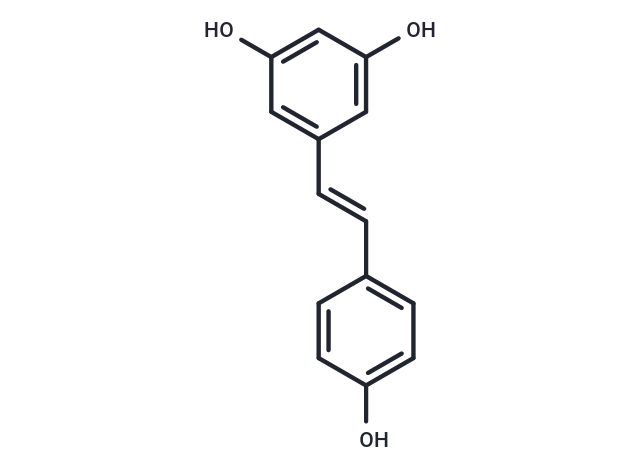
Synonyms: trans-Resveratrol, SRT 501
| Pack Size | Price | USA Stock | Global Stock | Quantity |
|---|---|---|---|---|
| 100 mg | $36 | In Stock | In Stock | |
| 200 mg | $50 | In Stock | In Stock | |
| 500 mg | $76 | In Stock | In Stock | |
| 1 mL x 10 mM (in DMSO) | $50 | In Stock | In Stock |
| Description | Resveratrol (SRT 501) is a polyphenolic natural product, a plant antitoxin with antioxidant and chemopreventive activities. Resveratrol has a wide range of targets including COX, SIRT, LOC, etc. Resveratrol induces autophagy and apoptosis. |
| Targets & IC50 | DNA polymerase α:3.3 μM (cell free), COX-1:1.1 μM (cell free), DNA polymerase α:3.3 μM (cell free), COX-2:1.3 μM (cell free), DNA polymerase δ:5 μM (cell free), DNA polymerase δ:5 μM (cell free), IKKβ:1 μM, Adenylyl cyclase:0.8 nM |
| In vitro | METHODS: Mouse mammary carcinoma cells 4T1 were treated with Resveratrol (50-250 μM) for 72 h. Cell viability was measured by CCK-8. RESULTS: Resveratrol dose-dependently inhibited the viability of 4T1 cells with an IC50 of 93 μM. [1] METHODS: Human breast cancer cells MCF-7 were treated with Resveratrol (1-100 μM) for 24 h, and the intracellular ATP content was detected by luciferin-luciferase assay. RESULTS: Resveratrol decreased the cellular ATP content. It was reduced by about 16% at 1 μM Resveratrol and 50% at 100 μM Resveratrol. [2] |
| In vivo | METHODS: To assay anti-tumor activity in vivo, Resveratrol (50-100 mg/kg, 5% ethanol and 25% polyethyleneglycol 400 in distilled water) was intraperitoneally injected into BALB/c (nu/nu) mice harboring the human ovarian teratoma PA-1 once daily for four weeks. RESULTS: Resveratrol inhibited the growth of PA-1 cell xenografts and eEF1A2 expression. [3] METHODS: To study the effects on depressed mice, Resveratrol (10-30 mg/kg) was administered intraperitoneally once daily for 21 days to C57BL/6 mice, a model of depression. RESULTS: Resveratrol significantly increased the levels of the prefrontal cortex neurotransmitters DA and 5-HT, and increased the expression of NPY in the brain, which antagonized depression. [4] |
| Synonyms | trans-Resveratrol, SRT 501 |
| Cell Research | HAECs were treated with RSV in the presence of isobutylmethylxanthine (IBMX). The reaction was stopped by adding ice-cold 6% trichloroacetic acid and the supernatant fractions of the cellular lysates were extracted, dried and acetylated. Cyclic GMP levels were determined by an enzyme immunoassay kit and results standardized by protein levels [5]. |
| Animal Research | Eight-week male apoE-/- mice (C57BL/6 background) were used in the study. Mice were housed in photobiologic light-exposure chambers with a 12:12-h light:dark cycle, and eat food ad libitum. Mice were randomly divided into two groups: one group receiving a high cholesterol diet (HCD, 21% fat, 19.5% casein, and 1.5% cholesterol), the other receiving HCD supplemented with RSV (200 mg/100 g diet). All mice were fed for 8 weeks. To identify the potential role of PKA, some mice were treated with PKA specific inhibitor (KT5720, 1.2 mg/kg) via intraperitoneal injection once a day at the last 4 weeks. The animal experiments were conducted according to the institutional guidelines of Guangdong Provincial People's Hospital [5]. |
| Molecular Weight | 228.24 |
| Formula | C14H12O3 |
| Cas No. | 501-36-0 |
| Smiles | C(=C/C1=CC=C(O)C=C1)\C2=CC(O)=CC(O)=C2 |
| Relative Density. | 1.359 g/cm3 |
| Storage | Powder: -20°C for 3 years | In solvent: -80°C for 1 year Shipping with blue ice/Shipping at ambient temperature. | |||||||||||||||||||||||||||||||||||
| Solubility Information | DMSO: 131.3 mg/mL (575.27 mM), Sonication is recommended.  H2O: < 1 mg/mL (insoluble or slightly soluble) Ethanol: < 1 mg/mL (insoluble or slightly soluble) | |||||||||||||||||||||||||||||||||||
| In Vivo Formulation | 10% DMSO+40% PEG300+5% Tween 80+45% Saline: 4.2 mg/mL (18.4 mM), Solution. Please add the solvents sequentially, clarifying the solution as much as possible before adding the next one. Dissolve by heating and/or sonication if necessary. Working solution is recommended to be prepared and used immediately. The formulation provided above is for reference purposes only. In vivo formulations may vary and should be modified based on specific experimental conditions. | |||||||||||||||||||||||||||||||||||
Solution Preparation Table | ||||||||||||||||||||||||||||||||||||
DMSO
Note : The dilution table applies only to solid products. For liquid products, please calculate the stock solution based on the stated concentration and/or density. | ||||||||||||||||||||||||||||||||||||
 For example, if the intended dosage is 10 mg/kg for animals weighing 20 g , with a dosing volume of 100 μL per animal, and a total of 10 animals are to be administered, using a formulation of
  10% DMSO+ 40% PEG300+ 5% Tween 80+ 45% Saline/PBS/ddH2O , the resulting working solution concentration would be 2 mg/mL.
Dissolve 2 mg of the compound in 100 μL DMSO to obtain a stock solution at a concentration of 20 mg/mL . If the required concentration exceeds the compound's known solubility, please contact us for technical support before proceeding.
1) Add 100 μL of the DMSO stock solution to 400 µL PEG300 and mix thoroughly until the solution becomes clear.
2) Add 50 µL Tween 80 and mix well until fully clarified.
3) Add 450 µL Saline,PBS or ddH2O and mix thoroughly until a homogeneous solution is obtained.
| Size | Quantity | Unit Price | Amount | Operation |
|---|
 Feedback
 Hello! How can I help you today?
Copyright © 2015-2026 TargetMol Chemicals Inc. All Rights Reserved.
