


Shopping Cart
Remove All Your shopping cart is currently empty

Synonyms: 4-O-Methylhonokiol
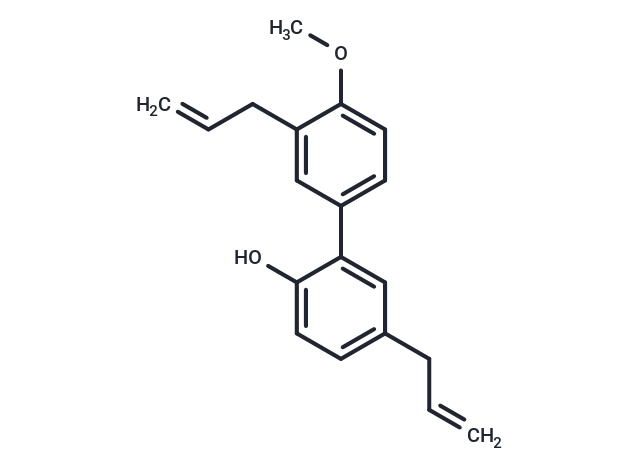

| Pack Size | Price | USA Stock | Global Stock | Quantity |
|---|---|---|---|---|
| 1 mg | $52 | - | In Stock | |
| 5 mg | $123 | In Stock | In Stock | |
| 10 mg | $197 | In Stock | In Stock | |
| 25 mg | $373 | - | In Stock | |
| 50 mg | $556 | - | In Stock | |
| 100 mg | $798 | - | In Stock | |
| 500 mg | $1,650 | - | In Stock | |
| 1 mL x 10 mM (in DMSO) | $133 | - | In Stock |
| Description | 4-O-Methyl honokiol (4-O-Methylhonokiol) is a lignan-like compound obtained from Magnolia officinalis and Magnolia officinalis. It is a PPARγ agonist with antiangiogenic, anticancer, anti-inflammatory, and neuroprotective properties, and it can inhibit the activity of NF-κB, which can be used in cancer research. |
| In vitro | 4-O-Methyl honokiol (20 μM) increases the expression, transcription, DNA binding activities, and nuclear translocation of PPARγ in both prostate PC-3 and LNCap cells.[1] 4-O-Methyl honokiol (0-30 μM) inhibits LNCaP and PC-3 cancer cell growth, causes G0/G1 phase arrest, and induces apoptotic cell death, and such effects can be reversed by PPARγ antagonist. 4-O-Methyl honokiol inhibits NF-κB activity and cancer cell growth, but such effects as well as its activation of PPARγ can be abolished by knockdown of p21.[1] 4-O-methyl honokiol (0.5, 1, and 2 μM) reduces LPS-induced release of NO, PGE2, ROS, TNF-α, and IL-1β in cultured astrocytes, and amyloidogenesis in cultured astrocytes and microglial BV-2 cells.[2] |
| In vivo | 4-O-Methyl honokiol (40 or 80 mg/kg; i.p.; every day for 4 weeks) inhibits the growth of SW620 and PC3 tumors in the SW620 and PC3 xenograft model. 4-O-Methyl honokiol significantly increases the expression of p21 and PPARγ in the tumor tissues.[1] 4-O-Methyl honokiol (0.5 or 1 mg/kg; every day for 3 weeks) significantly ameliorates LPS-induced memory impairment and inhibits LPS-induced iNOS and COX-2 expression in mice. 4-O-Methyl honokiol also shows inhibitory activities against the Aβ1-42 accumulation and activates astrocytes and microglia in LPS-injected mice brains.[2] |
| Synonyms | 4-O-Methylhonokiol |
| Cell Research | Cells (5 × 10^4 cells per well) are plated onto 24-well plates. The cell growth inhibitory effect of 4-O-Methyl honokiol is evaluated in cells treated with 4-O-Methyl honokiol (0-30 μM) for 0-72 h, using an excluded trypan blue assay [1]. |
| Animal Research | Six-week-old male BALB/c athymic nude mice are used in the assay. SW620 and PC3 cells are injected s.c. (1 × 10^7 cells in 0.1 mL PBS per animal) into the lower right flanks of mice. After 20 days, when the tumors have reached an average volume of 300-400 mm3 or about 50 mm3, the tumor-bearing nude mice are i.p. injected with 4-O-Methyl honokiol (40 and 80 mg/kg dissolved in 0.1% DMSO) twice per week for 3 weeks. Cisplatin (10 mg/kg) is also i.p. injected once a week as a positive control. The group treated with 0.1% DMSO is designated as the control. The tumor volumes are measured with vernier calipers and calculated by the following formula: (A × B^2)/2, where A is the larger and B is the smaller of the two dimensions [1]. |
| Molecular Weight | 280.36 |
| Formula | C19H20O2 |
| Cas No. | 68592-15-4 |
| Smiles | COc1ccc(cc1CC=C)-c1cc(CC=C)ccc1O |
| Relative Density. | 1.054g/cm3 |
| Storage | Store at low temperature Pure form: -20°C for 3 years | In solvent: -80°C for 1 year Shipping with blue ice/Shipping at ambient temperature. | |||||||||||||||||||||||||||||||||||
| Solubility Information | DMSO: 80 mg/mL (285.35 mM), Sonication is recommended. | |||||||||||||||||||||||||||||||||||
| In Vivo Formulation | 10% DMSO+90% Saline: 10 mg/mL (35.67 mM), Suspension. Please add the solvents sequentially, clarifying the solution as much as possible before adding the next one. Dissolve by heating and/or sonication if necessary. Working solution is recommended to be prepared and used immediately. The formulation provided above is for reference purposes only. In vivo formulations may vary and should be modified based on specific experimental conditions. | |||||||||||||||||||||||||||||||||||
Solution Preparation Table | ||||||||||||||||||||||||||||||||||||
DMSO
Note : The dilution table applies only to solid products. For liquid products, please calculate the stock solution based on the stated concentration and/or density. | ||||||||||||||||||||||||||||||||||||
 For example, if the intended dosage is 10 mg/kg for animals weighing 20 g , with a dosing volume of 100 μL per animal, and a total of 10 animals are to be administered, using a formulation of
  10% DMSO+ 40% PEG300+ 5% Tween 80+ 45% Saline/PBS/ddH2O , the resulting working solution concentration would be 2 mg/mL.
Dissolve 2 mg of the compound in 100 μL DMSO to obtain a stock solution at a concentration of 20 mg/mL . If the required concentration exceeds the compound's known solubility, please contact us for technical support before proceeding.
1) Add 100 μL of the DMSO stock solution to 400 µL PEG300 and mix thoroughly until the solution becomes clear.
2) Add 50 µL Tween 80 and mix well until fully clarified.
3) Add 450 µL Saline,PBS or ddH2O and mix thoroughly until a homogeneous solution is obtained.
| Size | Quantity | Unit Price | Amount | Operation |
|---|
 Feedback
 Hello! How can I help you today?
Copyright © 2015-2026 TargetMol Chemicals Inc. All Rights Reserved.
