


Shopping Cart
Remove All Your shopping cart is currently empty


Synonyms: SL-11001, NSC-26326, Beta-Lapachone, ARQ-501
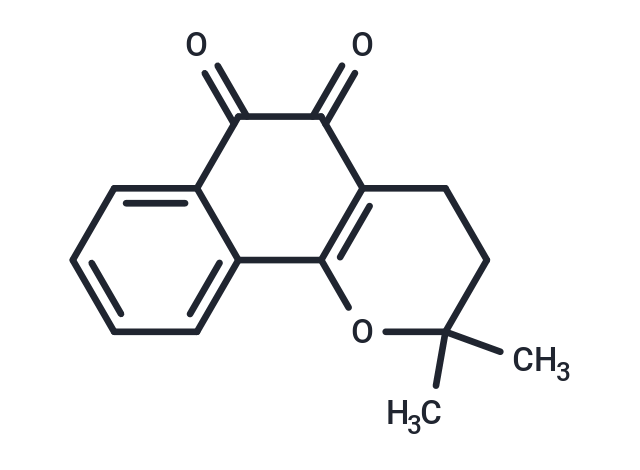

| Pack Size | Price | USA Stock | Global Stock | Quantity |
|---|---|---|---|---|
| 5 mg | $40 | In Stock | In Stock | |
| 10 mg | $55 | In Stock | In Stock | |
| 25 mg | $98 | In Stock | In Stock | |
| 50 mg | $195 | In Stock | In Stock | |
| 100 mg | $322 | In Stock | In Stock | |
| 200 mg | $485 | In Stock | In Stock | |
| 1 mL x 10 mM (in DMSO) | $46 | In Stock | In Stock |
| Description | β-Lapachone (ARQ-501) is a specific DNA topoisomerase I inhibitor, and no inhibitory activities against DNA topoisomerase II or ligase. |
| Targets & IC50 | IDO1:0.44 μM |
| In vitro | Beta-Lapachone inhibits DNA relaxation induced by DNA topoisomerase I in a dose-dependent manner. [1] Treatment of beta-lapachone (100 nM or greater) results in >95% inhibition of Topo I DNA unwinding activity compared to the DMSO control. beta-lapachone (1-5 μM) causes a block in G0/G1 of the cell cycle and induces apoptosis by locking Topo I onto DNA and blocking replication fork movement in HL-60 and three human prostate cancer (DU-145, PC-3, and LNCaP) cells. [2] Beta-Lapachone facilitates the migration of mouse 3T3 fibroblasts and human endothelial EAhy926 cells through different MAPK signaling pathways, and thus accelerates scrape-wound healing in vitro. [3] In addition, beta-Lapachone inhibits purified recombinant IDO1 activity through uncompetitive inhibition with IC50 of 0.44 μM, and beta-lapachone also exhibits superior retention of intracellular IDO1 inhibitory activity with an IC50 of 1.0 μM, partially dependent on biotransformation by NQO1. [4] Beta-lapachone induces programmed necrosis of NQO1+ cancer cells by NQO1-dependent reactive oxygen species (ROS) formation and PARP1 hyperactivation. [5] |
| In vivo | Beta-lapachone treatment (50 mg/kg) leads to potent inhibition of in vivo tumor growth in a xenograft mouse model of human ovarian cancer, and the combination of beta-lapachone and taxol produces a synergistic induction of apoptosis. [6] In normal and diabetic (db/db) mice, treatment of beta-lapachone results in a faster healing process than vehicle only. [3] |
| Synonyms | SL-11001, NSC-26326, Beta-Lapachone, ARQ-501 |
| Kinase Assay | Topoisomerase I Catalytic Actioity Assay [1]: Topoisomerase I Catalytic Actioity Assay: The enzymatic activity is analyzed by the DNA unwinding assay. DNA topoisomerase I, from TopoGEN (1 unit, which is defined as the amount of enzyme that converts 0.5 μg of superhelical DNA to the relaxed state in 30 minutes at 37 °C), is incubated with 0.5 μg of 6x174 RF DNA, in the presence or absence of Beta-Lapachone, in 20 μL of relaxation buffer (50 mM Tris (pH 7.5). 50 mM KCI, 10 mM MgCl2, 0.5 mM dithiothreitol, 0.5 mM EDTA, 30 μg/mL bovine serum albumin) for 30 minutes at 37 °C. Reactions are stopped by adding 1% SDS and proteinase K (50 μg/mL). After an additional 1-hour incubation at 37 °C, the products are separated by electrophoresis in 1% agarose gel in TAE buffer (0.04 M tris acetate, 0.001 M EDTA). The gel is stained with ethidium bromide after electrophoresis. The photographic negative is scanned with an NIH image analysis system. |
| Cell Research | IC50 calculations for each cell line are determined by DNA amount (IS) and anchorage-dependent colony formation (CF) assays. For the CF assay, cells are seeded at 500 viable cells/well in 6-well plates and incubated overnight, then treated with equal volumes of media containing beta-lapachone at final concentrations ranging from 0.005 to 50 μM in half-log increments (controls were treated with 0.25% DMSO, equivalent to the highest dose of beta-lapachonc used) for 4 hour or for continuous 12-hour exposures. Plates (3 wells/condition) are stained with crystal violet, and colonies of >50 normal-appearing cells are enumerated. IC50 values for various cells are calculated using drug doses with numbers of colonies surrounding 50% of control. For DNA assays, plates are harvested for IC50 determinations 8 days after treatment using a CytoFluor 2350 fluorescence measurement system. Six-well samplings are included in the calculation of DNA fluor units for each dose. A graph of beta-lapachone dose versus percentage control DNA in fluor units is used to calculate each IC50. All experiments are repeated at least twice, each in duplicate. (Only for Reference) |
| Molecular Weight | 242.27 |
| Formula | C15H14O3 |
| Cas No. | 4707-32-8 |
| Smiles | CC1(C)CCC2=C(O1)c1ccccc1C(=O)C2=O |
| Relative Density. | 1.25g/cm3 |
| Storage | Keep away from direct sunlight Powder: -20°C for 3 years | In solvent: -80°C for 1 year Shipping with blue ice/Shipping at ambient temperature. | ||||||||||||||||||||||||||||||||||||||||
| Solubility Information | Ethanol: 12.1 mg/mL (49.94 mM), Sonication is recommended. DMSO: 41.67 mg/mL (172 mM), Sonication is recommended.  | ||||||||||||||||||||||||||||||||||||||||
| In Vivo Formulation | 10% DMSO+40% PEG300+5% Tween 80+45% Saline: 5 mg/mL (20.64 mM), Solution. 10% DMSO+90% Saline: < 4.17 mg/mL (17.21 mM), Lower concentrations may be soluble, but exact solubility limit is unknown. Please add the solvents sequentially, clarifying the solution as much as possible before adding the next one. Dissolve by heating and/or sonication if necessary. Working solution is recommended to be prepared and used immediately. The formulation provided above is for reference purposes only. In vivo formulations may vary and should be modified based on specific experimental conditions. | ||||||||||||||||||||||||||||||||||||||||
Solution Preparation Table | |||||||||||||||||||||||||||||||||||||||||
Ethanol/DMSO
DMSO
Note : The dilution table applies only to solid products. For liquid products, please calculate the stock solution based on the stated concentration and/or density. | |||||||||||||||||||||||||||||||||||||||||
 For example, if the intended dosage is 10 mg/kg for animals weighing 20 g , with a dosing volume of 100 μL per animal, and a total of 10 animals are to be administered, using a formulation of
  10% DMSO+ 40% PEG300+ 5% Tween 80+ 45% Saline/PBS/ddH2O , the resulting working solution concentration would be 2 mg/mL.
Dissolve 2 mg of the compound in 100 μL DMSO to obtain a stock solution at a concentration of 20 mg/mL . If the required concentration exceeds the compound's known solubility, please contact us for technical support before proceeding.
1) Add 100 μL of the DMSO stock solution to 400 µL PEG300 and mix thoroughly until the solution becomes clear.
2) Add 50 µL Tween 80 and mix well until fully clarified.
3) Add 450 µL Saline,PBS or ddH2O and mix thoroughly until a homogeneous solution is obtained.
| Size | Quantity | Unit Price | Amount | Operation |
|---|
 Feedback
 Hello! How can I help you today?
Copyright © 2015-2026 TargetMol Chemicals Inc. All Rights Reserved.
