


Shopping Cart
Remove All Your shopping cart is currently empty

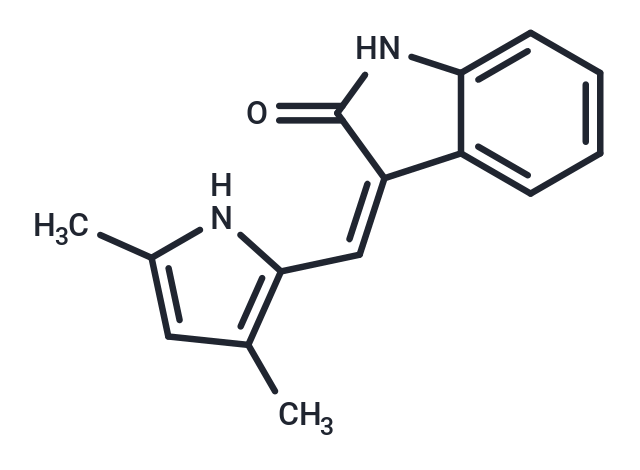
Synonyms: SU5416
| Pack Size | Price | USA Stock | Global Stock | Quantity |
|---|---|---|---|---|
| 10 mg | $32 | In Stock | In Stock | |
| 25 mg | $50 | In Stock | In Stock | |
| 50 mg | $76 | In Stock | In Stock | |
| 100 mg | $119 | In Stock | In Stock | |
| 200 mg | $187 | - | In Stock | |
| 500 mg | $367 | - | In Stock | |
| 1 mL x 10 mM (in DMSO) | $39 | In Stock | In Stock |
| Description | (Z)-Semaxinib (SU5416) is a potent and selective VEGFR(Flk-1/KDR) inhibitor (IC50: 1.23 μM), 20-fold more selective for VEGFR over PDGFRβ, no inhibition for FGFR, InsR, and EGFR. (Z)-Semaxinib is a quinolone derivative with potential antineoplastic activity. |
| Targets & IC50 | VEGFR2/Flk1:1.23 μM |
| In vitro | In tests conducted on ten tumor cell lines, Semaxanib significantly inhibited subcutaneous growth in eight of them (A431, Calu-6, C6, LNCAP, EPH4-VEGF, 3T3HER2, 488 g2M2, and SF763T cells) with an average mortality rate of 2.5%. The compound demonstrated a dose-dependent suppression of in vivo A375 tumor growth. Administered at 25 mg/kg/day, Semaxanib exhibited potent anti-angiogenic activity, significantly reducing the overall functional vascular density of the tumor microvasculature. Furthermore, Semaxanib (i.p.) inhibited more than 85% of subcutaneous tumor growth without any detectable toxicity. |
| In vivo | Semaxanib demonstrates dose-dependent inhibition of VEGF (IC50: 0.04 μM) and FGF (IC50: 50 μM) induced mitosis. It does not affect the growth of C6 glioma, Calu 6 lung cancer, A375 melanoma, A431 squamous cell carcinoma, and SF767T glioblastoma cells in vitro (IC50s > 20 μM). Additionally, Semaxanib inhibits VEGF-dependent phosphorylation of the Flk-1 receptor in NIH 3T3 cells overexpressing Flk-1 (IC50: 1.04 μM) and inhibits PDGF-dependent autophosphorylation in NIH 3T3 cells (IC50: 20.3 μM). |
| Synonyms | SU5416 |
| Kinase Assay | Biochemical kinase assays: Solubilized membranes from 3T3 Flk-1 cells are added to polystyrene ELISA plates that had been precoated with a monoclonal antibody that recognizes Flk-1. After an overnight incubation with lysate at 4 ℃, serial dilutions of SU5416 are added to the immunolocalized receptor. To induce autophosphorylation of the receptor, various concentrations of ATP are added to the ELISA plate wells containing serially diluted solutions of SU5416. The autophosphorylation is allowed to proceed for 60 min at room temperature and then stopped with EDTA. The amount of phosphotyrosine present on the Flk-1 receptors in the individual wells is determined by incubating the immunolocalized receptor with a biotinylated monoclonal antibody directed against phosphotyrosine. After removal of the unbound anti-phosphotyrosine antibody, avidin-conjugated horseradish pero-idase H is added to the wells. A stabilized form of 3,3 9,5,5 9-tetramethyl benzidine dihydrochloride and Water2 is added to the wells. The color readout of the assay is allowed to develop for 30 min, and the reaction is stopped with H2SO4. |
| Cell Research | HUVECs are plated in 96-well, flat-bottomed plates (1×10⁴ cells/100 μL/well) in F-12K media containing 0.5% heat-inactivated FBS and cultured at 37 ℃ for 24 h to quiesce the cells. Serial dilutions of compounds prepared in medium containing 1% DMSO are then added for 2 h, followed by the addition of mitogenic concentrations of either VEGF at 5 ng/mL or 20 ng/mL or acidic fibroblast growth factor at 0.25–5 ng/mL in media. The final concentration of DMSO in the assay is 0.25%. After 24 h, either [3H]thymidine (1 μCi/well) or BrdUrd is added, and the cell monolayers are incubated for another 24 h. The uptake of either [3H]thymidine or BrdUrd into cells is quantitated using a liquid scintillation counter or a BrdUrd ELISA, respectively.(Only for Reference) |
| Molecular Weight | 238.28 |
| Formula | C15H14N2O |
| Cas No. | 194413-58-6 |
| Smiles | C(=C\1/C=2C(NC1=O)=CC=CC2)\C=3NC(C)=CC3C |
| Relative Density. | 1.256 g/cm3 |
| Storage | Powder: -20°C for 3 years | In solvent: -80°C for 1 year Shipping with blue ice/Shipping at ambient temperature. | ||||||||||||||||||||||||||||||||||||||||
| Solubility Information | H2O: < 1 mg/mL (insoluble or slightly soluble) DMSO: 28.6 mg/mL (120.03 mM), Sonication is recommended.  Ethanol: 2 mg/mL (8.39 mM), Sonication is recommended. | ||||||||||||||||||||||||||||||||||||||||
| In Vivo Formulation | 10% DMSO+90% Saline: < 2.86 mg/mL (12 mM), Lower concentrations may be soluble, but exact solubility limit is unknown. 10% DMSO+40% PEG300+5% Tween 80+45% Saline: 2.86 mg/mL (12 mM), Solution. Please add the solvents sequentially, clarifying the solution as much as possible before adding the next one. Dissolve by heating and/or sonication if necessary. Working solution is recommended to be prepared and used immediately. The formulation provided above is for reference purposes only. In vivo formulations may vary and should be modified based on specific experimental conditions. | ||||||||||||||||||||||||||||||||||||||||
Solution Preparation Table | |||||||||||||||||||||||||||||||||||||||||
Ethanol/DMSO
DMSO
Note : The dilution table applies only to solid products. For liquid products, please calculate the stock solution based on the stated concentration and/or density. | |||||||||||||||||||||||||||||||||||||||||
 For example, if the intended dosage is 10 mg/kg for animals weighing 20 g , with a dosing volume of 100 μL per animal, and a total of 10 animals are to be administered, using a formulation of
  10% DMSO+ 40% PEG300+ 5% Tween 80+ 45% Saline/PBS/ddH2O , the resulting working solution concentration would be 2 mg/mL.
Dissolve 2 mg of the compound in 100 μL DMSO to obtain a stock solution at a concentration of 20 mg/mL . If the required concentration exceeds the compound's known solubility, please contact us for technical support before proceeding.
1) Add 100 μL of the DMSO stock solution to 400 µL PEG300 and mix thoroughly until the solution becomes clear.
2) Add 50 µL Tween 80 and mix well until fully clarified.
3) Add 450 µL Saline,PBS or ddH2O and mix thoroughly until a homogeneous solution is obtained.
| Size | Quantity | Unit Price | Amount | Operation |
|---|
 Feedback
 Hello! How can I help you today?
Copyright © 2015-2026 TargetMol Chemicals Inc. All Rights Reserved.
