


Shopping Cart
Remove All Your shopping cart is currently empty


Synonyms: ZK-222584 dihydrochloride, Vatalanib 2HCl, Vatalanib (PTK787) 2HCl, PTK787 dihydrochloride, CGP-797870 dihydrochloride, CGP-79787 dihydrochloride
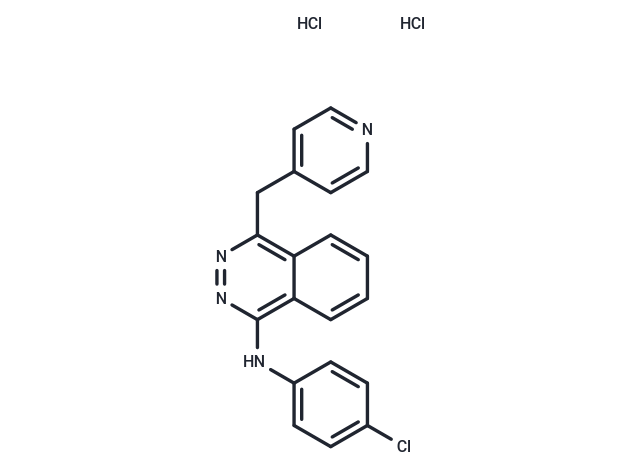
| Pack Size | Price | USA Stock | Global Stock | Quantity |
|---|---|---|---|---|
| 10 mg | $40 | In Stock | In Stock | |
| 25 mg | $52 | In Stock | In Stock | |
| 50 mg | $64 | In Stock | In Stock | |
| 100 mg | $79 | In Stock | In Stock | |
| 200 mg | $116 | In Stock | In Stock |
| Description | Vatalanib dihydrochloride (PTK787 dihydrochloride)(IC50=37 nM) is an inhibitor of VEGFR2/KDR. It exhibits less effective against VEGFR1/Flt-1 and 18-fold against VEGFR3/Flt-4. |
| Targets & IC50 | VEGFR3/FLT4:660 nM, VEGFR1/FLT1:77 nM, VEGFR2/KDR:37 nM, VEGFR2/Flk1:270 nM, PDGFRβ:580 nM |
| In vitro | Vatalanib inhibits Flk, c-Kit and PDGFRβ with IC50 of 270 nM, 730 nM and 580 nM, respectively. Moreover, Vatalanib shows the anti-proliferation effect by inhibiting thymidine incorporation induced by VEGF in HUVECs with and IC50 of 7.1 nM, and dose-dependently suppresses VEGF-induced survival and migration of endothelial cells in the same dose range without cytotoxic or antiproliferative effect on cells that do not express VEGF receptors. [1] A recent study shows that Vatalanib significantly inhibits the growth of hepatocellular carcinoma cells and enhances the IFN/5-FU induced apoptosis by increasing proteins levels of Bax and reduced Bcl-xL and Bcl-2. [2] |
| In vivo | Vatalanib induces dose-dependent inhibition of the angiogenic response to VEGF and PDGF in both a growth factor implant model and a tumor cell-driven angiogenesis model after once-daily oral dosing (25-100 mg/kg). Within this dose range, Vatalanib also inhibits growth and metastases of various human carcinomas in nude mice without significantly affecting circulating blood cells or bone marrow leukocytes. [1] |
| Synonyms | ZK-222584 dihydrochloride, Vatalanib 2HCl, Vatalanib (PTK787) 2HCl, PTK787 dihydrochloride, CGP-797870 dihydrochloride, CGP-79787 dihydrochloride |
| Kinase Assay | VEGF Receptor Tyrosine Kinase Assays : The in vitro kinase assays are performed in 96-well plates as a filter binding assay, using the recombinant GST-fused kinase domains expressed in baculovirus and purified over glutathione-Sepharose. γ-[33P]ATP is used as the phosphate donor, and poly-(Glu:Tyr 4:1) peptide is used as the acceptor. Recombinant GST-fusion proteins are diluted in 20 mM Tris·HCl (pH 7.5) containing 1–3 mM MnCl2, 3–10 mM MgCl2, 0.25 mg/mL polyethylene glycol 20000, and 1 mM DTT, according to their specific activity. Each GST-fused kinase is incubated under optimized buffer conditions [20 mM Tris-HCl buffer (pH 7.5), 1–3 mM MnCl2, 3–10 mM MgCl2, 3–8 μg/mL poly-(Glu:Tyr 4:1), 0.25 mg/mL polyethylene glycol 20000, 8 μM ATP, 10 μM sodium vanadate, 1 mM DTT, and 0.2 μCi[γ-33P]ATP in a total volume of 30 μL in the presence or absence of a test substance for 10 minutes at ambient temperature. The reaction is stopped by adding 10 μL of 250 mM EDTA. Using a 96-well filter system, half the volume (20 μL) is transferred onto a Immobilon-polyvinylidene difluoride membrane. The membrane is then washed extensively in 0.5% H3PO4 and then soaked in ethanol. After drying, Microscint cocktail is added, and scintillation counting is performed. IC50s for PTK787/ZK 222584 or SU5416 in these as well as all assays described below are calculated by linear regression analysis of the percentage inhibition. |
| Cell Research | As a test of the ability of PTK787/ZK 222584 to inhibit a functional response to VEGF, an endothelial cell proliferation assay, based on BrdUrd incorporation is used. Subconfluent HUVECs are seeded into 96-well plates coated with 1.5% gelatin and then incubated at 37 °C and 5% CO2 in growth medium. After 24 hours, growth medium is replaced by basal medium containing 1.5% FCS and a constant concentration of VEGF (50 ng/mL), bFGF (0.5 ng/mL), or FCS (5%), in the presence or absence of PTK787/ZK 222584. As a control, wells without growth factor are also included. After 24 hours of incubation, BrdUrd labeling solution is added, and cells incubated an additional 24 hours before fixation, blocking, and addition of peroxidase-labeled anti-BrdUrd antibody. Bound antibody is then detected using 3,3′5,5′-tetramethylbenzidine substrate, which results in a colored reaction product that is quantified spectrophotometrically at 450 nm. (Only for Reference) |
| Molecular Weight | 419.73 |
| Formula | C20H15ClN4·2HCl |
| Cas No. | 212141-51-0 |
| Smiles | Cl.Cl.Clc1ccc(Nc2nnc(Cc3ccncc3)c3ccccc23)cc1 |
| Relative Density. | no data available |
| Storage | Powder: -20°C for 3 years | In solvent: -80°C for 1 year Shipping with blue ice/Shipping at ambient temperature. | |||||||||||||||||||||||||||||||||||||||||||||
| Solubility Information | DMSO: 79 mg/mL (188.22 mM), Sonication is recommended. H2O: 10 mg/mL (23.82 mM), Sonication is recommended. Ethanol: 6 mg/mL (14.29 mM), Sonication is recommended. | |||||||||||||||||||||||||||||||||||||||||||||
Solution Preparation Table | ||||||||||||||||||||||||||||||||||||||||||||||
Ethanol/H2O/DMSO
H2O/DMSO
DMSO
Note : The dilution table applies only to solid products. For liquid products, please calculate the stock solution based on the stated concentration and/or density. | ||||||||||||||||||||||||||||||||||||||||||||||
 For example, if the intended dosage is 10 mg/kg for animals weighing 20 g , with a dosing volume of 100 μL per animal, and a total of 10 animals are to be administered, using a formulation of
  10% DMSO+ 40% PEG300+ 5% Tween 80+ 45% Saline/PBS/ddH2O , the resulting working solution concentration would be 2 mg/mL.
Dissolve 2 mg of the compound in 100 μL DMSO to obtain a stock solution at a concentration of 20 mg/mL . If the required concentration exceeds the compound's known solubility, please contact us for technical support before proceeding.
1) Add 100 μL of the DMSO stock solution to 400 µL PEG300 and mix thoroughly until the solution becomes clear.
2) Add 50 µL Tween 80 and mix well until fully clarified.
3) Add 450 µL Saline,PBS or ddH2O and mix thoroughly until a homogeneous solution is obtained.
| Size | Quantity | Unit Price | Amount | Operation |
|---|
 Feedback
 Hello! How can I help you today?
Copyright © 2015-2026 TargetMol Chemicals Inc. All Rights Reserved.
