


Shopping Cart
Remove All Your shopping cart is currently empty


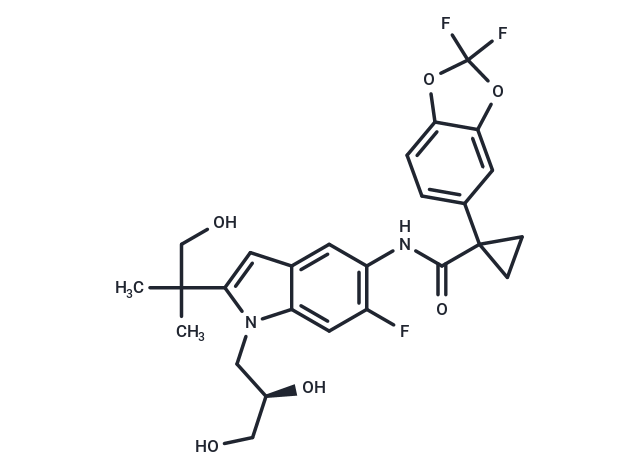
Synonyms: VX661
| Pack Size | Price | USA Stock | Global Stock | Quantity |
|---|---|---|---|---|
| 1 mg | $34 | In Stock | In Stock | |
| 2 mg | $48 | In Stock | In Stock | |
| 5 mg | $75 | In Stock | In Stock | |
| 10 mg | $125 | In Stock | In Stock | |
| 25 mg | $223 | In Stock | In Stock | |
| 50 mg | $360 | In Stock | In Stock | |
| 100 mg | $531 | In Stock | In Stock | |
| 1 mL x 10 mM (in DMSO) | $90 | In Stock | In Stock |
| Description | Tezacaftor (VX-661) is a cystic fibrosis transmembrane conductance regulator (CFTR) corrector. Tezacaftor increases the number of functional CFTR proteins by promoting the proper folding and transport of mutant CFTR proteins to the cell surface, thereby restoring chloride channel function. Tezacaftor is commonly used in cystic fibrosis research. |
| Targets & IC50 | DEGS:3 µM |
| In vitro | Methods: Peripheral blood was collected from cystic fibrosis patients before treatment with Elexacaftor/Tezacaftor/Ivacaftor, 1 month after treatment initiation, and 6 months after treatment initiation. Peripheral blood mononuclear cells were isolated and co-incubated with GFP-expressing Pseudomonas aeruginosa PAO1 strain for 30 minutes, followed by assessment of intracellular viable bacteria count. Results: Pre-treatment CF patients exhibited significantly lower intracellular viable bacteria counts in monocytes compared to healthy controls, indicating phagocytic dysfunction. At 1 month and 6 months post-treatment, intracellular viable bacteria counts increased significantly (by 2-fold and 2.5-fold, respectively), demonstrating marked improvement in phagocytic function. [1] Methods: Differentiated CF human bronchial epithelial cells (HBEC) with the F508del-CFTR homozygous genotype were treated with the ETI combination (Elexacaftor (3 μM) + Tezacaftor (3 μM) + Ivacaftor (1 μM)), dissolved in DMSO, added to the basolateral medium. The control consisted of an equal volume of DMSO. Treatment lasted 72 hours. with drug solution replaced every 24 hours. μOCT measurements assessed mucus clearance time (MCT), airway surface liquid depth (ASL), and perichylial liquid depth (PCL). Results: ETI treatment efficacy: After 72 hours of ETI treatment, CF HBECs exhibited significant recovery in ASL, PCL, and MCT, approaching non-CF levels. [2] |
| In vivo | The F508del mutation channel can avoid degradation and be transported to the cell membrane under the action of VX-661. |
| Synonyms | VX661 |
| Molecular Weight | 520.5 |
| Formula | C26H27F3N2O6 |
| Cas No. | 1152311-62-0 |
| Smiles | CC(C)(CO)c1cc2cc(NC(=O)C3(CC3)c3ccc4OC(F)(F)Oc4c3)c(F)cc2n1C[C@@H](O)CO |
| Relative Density. | 1.49 g/cm3 (Predicted) |
| Storage | Store at low temperature Powder: -20°C for 3 years | In solvent: -80°C for 1 year Shipping with blue ice/Shipping at ambient temperature. | |||||||||||||||||||||||||||||||||||
| Solubility Information | Ethanol: < 1 mg/mL (insoluble or slightly soluble) H2O: < 1 mg/mL (insoluble or slightly soluble) DMSO: 245 mg/mL (470.7 mM), Sonication is recommended.  | |||||||||||||||||||||||||||||||||||
| In Vivo Formulation | 10% DMSO+40% PEG300+5% Tween 80+45% Saline: 5 mg/mL (9.61 mM), Sonication is recommended. Please add the solvents sequentially, clarifying the solution as much as possible before adding the next one. Dissolve by heating and/or sonication if necessary. Working solution is recommended to be prepared and used immediately. The formulation provided above is for reference purposes only. In vivo formulations may vary and should be modified based on specific experimental conditions. | |||||||||||||||||||||||||||||||||||
Solution Preparation Table | ||||||||||||||||||||||||||||||||||||
DMSO
Note : The dilution table applies only to solid products. For liquid products, please calculate the stock solution based on the stated concentration and/or density. | ||||||||||||||||||||||||||||||||||||
 For example, if the intended dosage is 10 mg/kg for animals weighing 20 g , with a dosing volume of 100 μL per animal, and a total of 10 animals are to be administered, using a formulation of
  10% DMSO+ 40% PEG300+ 5% Tween 80+ 45% Saline/PBS/ddH2O , the resulting working solution concentration would be 2 mg/mL.
Dissolve 2 mg of the compound in 100 μL DMSO to obtain a stock solution at a concentration of 20 mg/mL . If the required concentration exceeds the compound's known solubility, please contact us for technical support before proceeding.
1) Add 100 μL of the DMSO stock solution to 400 µL PEG300 and mix thoroughly until the solution becomes clear.
2) Add 50 µL Tween 80 and mix well until fully clarified.
3) Add 450 µL Saline,PBS or ddH2O and mix thoroughly until a homogeneous solution is obtained.
| Size | Quantity | Unit Price | Amount | Operation |
|---|
 Feedback
 Hello! How can I help you today?
Copyright © 2015-2026 TargetMol Chemicals Inc. All Rights Reserved.
