


Shopping Cart
Remove All Your shopping cart is currently empty


Synonyms: XL-647, KD-019, EXEL-7647
| Pack Size | Price | USA Stock | Global Stock | Quantity |
|---|---|---|---|---|
| 1 mg | $109 | In Stock | In Stock | |
| 2 mg | $158 | In Stock | In Stock | |
| 5 mg | $249 | In Stock | In Stock | |
| 10 mg | $482 | In Stock | In Stock | |
| 25 mg | $789 | In Stock | In Stock | |
| 50 mg | $1,080 | In Stock | In Stock | |
| 1 mL x 10 mM (in DMSO) | $269 | In Stock | In Stock |
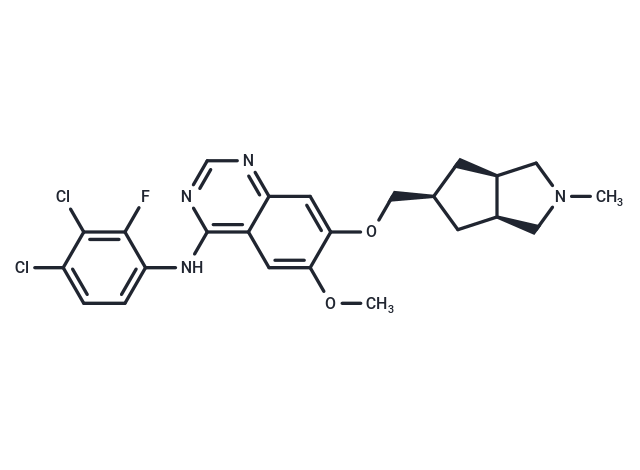
| Description | Tesevatinib (XL-647) is an oral, multi-targeted tyrosine kinase inhibitor with IC50 values of 0.3, 16, 1.5, 8.7, and 1.4 nM for EGFR, ErbB2, KDR, Flt4, and EphB4. |
| Targets & IC50 | KDR:1.5 nM, FLT4:8.7 nM, EGFR:0.3 nM, ErbB2:16 nM |
| In vitro | Tesevatinib (XL-647) potently inhibits the EGF/ErbB2, VEGF, and ephrin RTK families with IC50 values of 0.3, 16, 1.5, 8.7, and 1.4 nM for EGFR, ErbB2, KDR, and EphB4. [1] |
| In vivo | METHODS: To study the in vivo effects of Tesevatinib (XL-647) on T790M mutant EGFR, H1975 human tumor xenografts were established in female severe combined immunodeficient mice and administered Tesevatinib (XL-647) orally once daily (doses: 10, 30 and 100 mg/kg, 14 days) RESULTS Tesevatinib (XL-647) significantly inhibited tumor growth in a dose-dependent manner, with tumor growth inhibition rates of 33%, 66% and 92% respectively.[1] METHODS: Tesevatinib (XL-647) (7.5, 15 mg/kg, ip, daily) was treated in the well-characterized bpk mouse model of ARPKD, and efficacy and toxicity were evaluated in neonatal mice during postnatal development. RESULTS In vivo pharmacological inhibition of multiple kinase cascades by tesevatinib (XL-647) reduced phosphorylation of key mediators of cystogenesis: EGFR, ErbB2, c-Src, and KDR; decreased kinase activity resulted in significant reductions in renal and biliary disease in both the bpk and PCK models of ARPKD. Disease amelioration by tesevatinib (XL-647) was not associated with any overt toxicity. [2] |
| Synonyms | XL-647, KD-019, EXEL-7647 |
| Cell Research | Growth inhibition of H1975 and A431 cells by increasing concentrations of Tesevatinib is determined by seeding 5000 cells per well in 96-well plates. The following day, cells are washed once with low-serum RPMI 1640 (0.1% fetal bovine serum, 1% nonessential amino acids, and 1% penicillin/streptomycin), after which 90 μL of the low-serum RPMI 1640 is added. Tesevatinib is diluted to 10 times the test concentrations and 10 μL are added to triplicate wells for a 72-h incubation. Cell viability is determined. |
| Animal Research | Tumor-bearing mice are given either Tesevatinib, erlotinib, or gefitinib at 100 mg/kg and tumors are harvested 1 to 72 h later. Half an hour before the respective time point, EGF (50 μg/mouse) is given via i.v. bolus injection with tumors dissected 30 min later and tumor extracts are prepared by homogenization in 10 volumes of ice-cold lysis buffer. Lysates are clarified by centrifugation and EGFR tyrosine phosphorylation levels are determined by ELISA. |
| Molecular Weight | 491.39 |
| Formula | C24H25Cl2FN4O2 |
| Cas No. | 781613-23-8 |
| Smiles | COc1cc2c(Nc3ccc(Cl)c(Cl)c3F)ncnc2cc1OC[C@H]1C[C@H]2CN(C)C[C@H]2C1 |
| Relative Density. | 1.356 g/cm3 |
| Storage | Store at low temperature Powder: -20°C for 3 years | In solvent: -80°C for 1 year Shipping with blue ice/Shipping at ambient temperature. | ||||||||||||||||||||||||||||||
| Solubility Information | DMSO: 45 mg/mL (91.58 mM), Sonication is recommended.  | ||||||||||||||||||||||||||||||
| In Vivo Formulation | 10% DMSO+40% PEG300+5% Tween 80+45% Saline: 2 mg/mL (4.07 mM), Sonication is recommended. Please add the solvents sequentially, clarifying the solution as much as possible before adding the next one. Dissolve by heating and/or sonication if necessary. Working solution is recommended to be prepared and used immediately. The formulation provided above is for reference purposes only. In vivo formulations may vary and should be modified based on specific experimental conditions. | ||||||||||||||||||||||||||||||
Solution Preparation Table | |||||||||||||||||||||||||||||||
DMSO
Note : The dilution table applies only to solid products. For liquid products, please calculate the stock solution based on the stated concentration and/or density. | |||||||||||||||||||||||||||||||
 For example, if the intended dosage is 10 mg/kg for animals weighing 20 g , with a dosing volume of 100 μL per animal, and a total of 10 animals are to be administered, using a formulation of
  10% DMSO+ 40% PEG300+ 5% Tween 80+ 45% Saline/PBS/ddH2O , the resulting working solution concentration would be 2 mg/mL.
Dissolve 2 mg of the compound in 100 μL DMSO to obtain a stock solution at a concentration of 20 mg/mL . If the required concentration exceeds the compound's known solubility, please contact us for technical support before proceeding.
1) Add 100 μL of the DMSO stock solution to 400 µL PEG300 and mix thoroughly until the solution becomes clear.
2) Add 50 µL Tween 80 and mix well until fully clarified.
3) Add 450 µL Saline,PBS or ddH2O and mix thoroughly until a homogeneous solution is obtained.
| Size | Quantity | Unit Price | Amount | Operation |
|---|
 Feedback
 Hello! How can I help you today?
Copyright © 2015-2026 TargetMol Chemicals Inc. All Rights Reserved.
