


Shopping Cart
Remove All Your shopping cart is currently empty


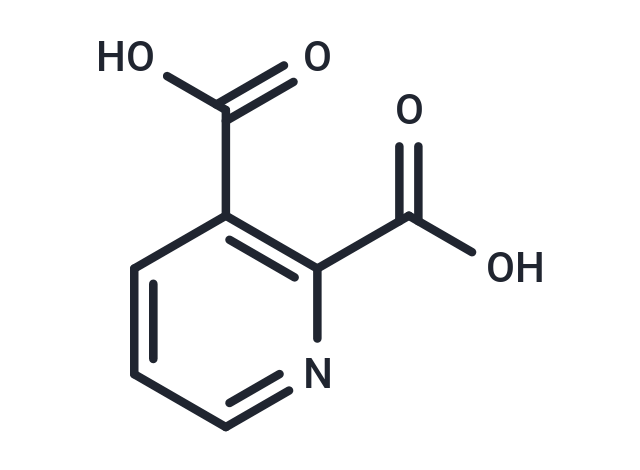
Synonyms: QUIN, pyridine-2,3-dicarboxylic acid
| Pack Size | Price | USA Stock | Global Stock | Quantity |
|---|---|---|---|---|
| 1 g | $30 | In Stock | In Stock | |
| 1 mL x 10 mM (in DMSO) | $29 | In Stock | In Stock |
| Description | Quinolinic acid (QUIN) is an endogenous N-methyl-D-aspartate (NMDA) receptor agonist synthesized from L-tryptophan via the kynurenine pathway. |
| In vitro | QUIN has an uptake system, its neuronal degradation enzyme is rapidly saturated, and the rest of the extracellular QUIN can continue stimulating the NMDA receptor. QUIN (10?μM) prevents of glutamate-induced excitotoxicity in primary cultures of rat cerebellar granule neurons, nevertheless mature organotypic cultures of rat corticostriatal system or caudate nucleus chronically exposed to 100?nM QUIN for up to 7 weeks show focal degeneration characterized by the presence of vacuoles in neuropil, swollen dendrites, occasional swollen post-synaptic elements, and degenerated neurons. In vitro QUIN treatment of human primary fetal neurons leads to a substantial increase of tau phosphorylation at multiple positions. The increase in QUIN-induced phosphorylation of tau is attributed to a decrease in the expression and activity of the major tau phosphatases. QUIN can inhibit B monoamine oxidase (MAO-B) in human brain synaptosomal mitochondria and also can be a potent inhibitor of phosphoenolpyruvate carboxykinase (EC 4.1.1.32) from rat liver cytoplasm, an important enzyme in the gluconeogenesis pathway that converts oxaloacetate to phosphoenolpyruvate. QUIN can increase free radical production by inducing NOS activity in astrocytes and neurons, leading to oxidative stress, increasing both poly(ADP-ribose) polymerase (PARP) activity and extracellular lactate dehydrogenase (LDH) activity [1]. |
| In vivo | Quinolinic acid (QUIN), a neuroactive metabolite of the kynurenine pathway, is normally presented in nanomolar concentrations in human brain and cerebrospinal fluid (CSF) and is often implicated in the pathogenesis of a variety of human neurological diseases. The concentration of QUIN varies among different brain regions, with the cerebral cortex containing approximately 1.8?nmol/g wet weight; almost 2-fold than that found in the hippocampus (1?nmol/g wet weight). Intraarterial administration of either micromolar or millimolar concentrations of QUIN results in only negligible accumulations of this metabolite in the brain, suggesting that the central nervous system (CNS) appears to be well protected by the blood-brain barrier (BBB) from peripheral QUIN. QUIN can also increase glutamate release and inhibit its reuptake by astrocytes, thus increasing its concentration in the microenvironments, causing neurotoxicity and also limiting glutamate to glutamine recycling in astrocytes by decreasing glutamine synthetase activity. Intrastriatal injection of QUIN provokes a decrease in cellular respiration and ATP levels [1]. |
| Synonyms | QUIN, pyridine-2,3-dicarboxylic acid |
| Molecular Weight | 167.12 |
| Formula | C7H5NO4 |
| Cas No. | 89-00-9 |
| Smiles | OC(=O)C1=C(N=CC=C1)C(O)=O |
| Relative Density. | 1.551 g/cm3 |
| Storage | Powder: -20°C for 3 years | In solvent: -80°C for 1 year Shipping with blue ice/Shipping at ambient temperature. | |||||||||||||||||||||||||||||||||||
| Solubility Information | DMSO: 250 mg/mL (1495.93 mM), Sonication is recommended.  | |||||||||||||||||||||||||||||||||||
| In Vivo Formulation | 10% DMSO+40% PEG300+5% Tween 80+45% Saline: 2 mg/mL (11.97 mM), Sonication is recommended. Please add the solvents sequentially, clarifying the solution as much as possible before adding the next one. Dissolve by heating and/or sonication if necessary. Working solution is recommended to be prepared and used immediately. The formulation provided above is for reference purposes only. In vivo formulations may vary and should be modified based on specific experimental conditions. | |||||||||||||||||||||||||||||||||||
Solution Preparation Table | ||||||||||||||||||||||||||||||||||||
DMSO
Note : The dilution table applies only to solid products. For liquid products, please calculate the stock solution based on the stated concentration and/or density. | ||||||||||||||||||||||||||||||||||||
 For example, if the intended dosage is 10 mg/kg for animals weighing 20 g , with a dosing volume of 100 μL per animal, and a total of 10 animals are to be administered, using a formulation of
  10% DMSO+ 40% PEG300+ 5% Tween 80+ 45% Saline/PBS/ddH2O , the resulting working solution concentration would be 2 mg/mL.
Dissolve 2 mg of the compound in 100 μL DMSO to obtain a stock solution at a concentration of 20 mg/mL . If the required concentration exceeds the compound's known solubility, please contact us for technical support before proceeding.
1) Add 100 μL of the DMSO stock solution to 400 µL PEG300 and mix thoroughly until the solution becomes clear.
2) Add 50 µL Tween 80 and mix well until fully clarified.
3) Add 450 µL Saline,PBS or ddH2O and mix thoroughly until a homogeneous solution is obtained.
| Size | Quantity | Unit Price | Amount | Operation |
|---|
 Feedback
 Hello! How can I help you today?
Copyright © 2015-2026 TargetMol Chemicals Inc. All Rights Reserved.
