


Shopping Cart
Remove All Your shopping cart is currently empty


Synonyms: Levodopa, 3,4-Dihydroxyphenylalanine
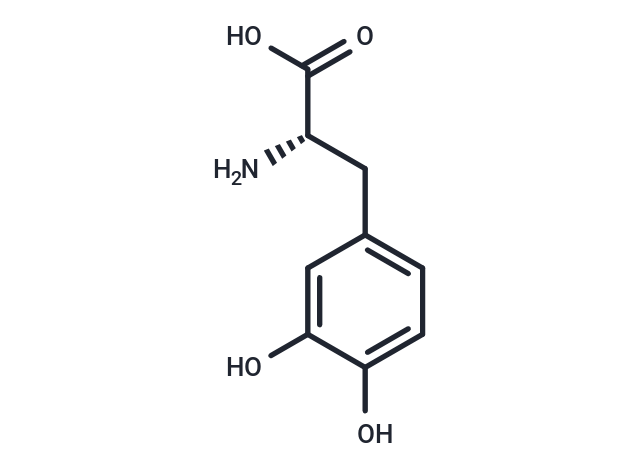
| Pack Size | Price | USA Stock | Global Stock | Quantity |
|---|---|---|---|---|
| 200 mg | $50 | In Stock | In Stock |
| Description | L-DOPA belongs to the category of dopamine precursors, serving as an orally active neurotransmitter metabolic precursor capable of crossing the blood-brain barrier and undergoing conversion to dopamine within the brain. The compound exhibits anti-hyperalgesic properties and finds application in Parkinson's disease research as well as in the induction of disease models. |
| In vitro | Methods: C6 gliosarcoma cells were used to evaluate the antitumor activity of carborane-based L-DOPA compounds through in vitro survival assays (incubation with 20 ppm ¹⁰B for 6 h), cytotoxicity assays (continuous exposure for 3 d to determine IC50), and boron uptake assays (1.5 mM boron reagent culture for 24 h). Results: The carborane-based L-DOPA compound showed a minimum survival fraction of 0.03 after 75 min of thermal neutron irradiation, an IC50 of 8.93×10⁻⁴ M, and a cellular boron uptake of 1.53 μg/10⁷ cells, demonstrating superior in vitro killing effect compared to BSH.[1] |
| In vivo | Methods: A rat model with unilateral 6-OHDA lesion of the nigrostriatal pathway was established. Rats were administered L-DOPA (50 mg/kg, intraperitoneal injection, combined with benserazide 12.5 mg/kg, twice daily for 5-15 days). D3 receptor expression was detected by in situ hybridization and autoradiography, and rotational behavior was observed. Additionally, an MPTP-induced Parkinsonian monkey model was used to observe abnormal movements following L-DOPA administration. Results: Repeated L-DOPA administration induced ectopic expression of D3 receptors in the denervated caudate-putamen. This expression paralleled the time course of enhanced rotational behavior (behavioral sensitization), accompanied by upregulation of prodynorphin mRNA and downregulation of preprotachykinin mRNA. Various abnormal movements were also induced in the monkey model. [2] Methods: Intact rats were injected with L-DOPA (50 mg/kg) to measure endocannabinoid concentrations in the basal ganglia. In lesioned rats, L-DOPA-induced oro-lingual spontaneous movements were induced and treated with the cannabinoid agonist R(+)-WIN55,212-2 (1 mg/kg). Results: L-DOPA increased endocannabinoid concentrations in the basal ganglia and induced progressively severe oro-lingual spontaneous movements, which were attenuated by the cannabinoid agonist. [3] Methods: A rat model with unilateral severe 6-OHDA-induced lesion was used. L-DOPA was administered orally (25 mg/kg, combined with carbidopa, twice daily) for 6 months. Striatal D2 receptor binding levels were detected using 125I-sulpride autoradiography. Results: Chronic L-DOPA administration reversed the upregulation of D2 receptors in the caudate-putamen (particularly in the dorsolateral and ventrolateral regions) of severely lesioned rats, confirming that it reaches biologically active concentrations in the basal ganglia. [4] |
| Synonyms | Levodopa, 3,4-Dihydroxyphenylalanine |
| Disease Modeling Protocol | Parkinson's Disease (PD) Complications of Movement Model
*Precautions: One hour after L-DOPA administration on day 49, the patient was euthanized by cervical dislocation, and the right striatum was rapidly dissected. |
| Kinase Assay | Briefly, transfected HEK-293 cells, incubated in charcoal-treated Dulbecco's modified Eagle's medium for 24 h, are washed once with Hanks' solution and resuspended in a buffer containing 100 mM NaCl, 1 mM MgCl2, 1 mM EDTA, 1 mM EGTA, 250 mMsucrose, 20 mM Tris-HCl, pH 7.4. Cells are lysed by freezing in liquid nitrogen. Dehydrogenase activity is measured in a final volume of 20 μL containing the appropriate concentration of bile acid, 30 nCi of [3H]cortisol, and unlabeled cortisol to a final concentrations of 50 nM. The reaction is started by mixing cell lysate with the reaction mixture. Alternatively, endoplasmic reticulum microsomes are prepared from transfected HEK-293 cells and incubated with reaction mixture containing various concentrations of cortisol and CDCA. Incubation proceeded for 20 min, and the conversion of cortisol to cortisone is determined by thin layer chromatography (TLC). Because of the inaccuracy of the TLC method at low conversion rates and the end-product inhibition of 11βHSD2 at conversion rates higher than 60-70%, only conversion rates between 10 and 60% are considered for calculation. The inhibitory constant IC50 is evaluated using the curve-fitting program. Results are expressed as means±S.E. and consist of at least four independent measurements. |
| Molecular Weight | 197.19 |
| Formula | C9H11NO4 |
| Cas No. | 59-92-7 |
| Smiles | N[C@@H](Cc1ccc(O)c(O)c1)C(O)=O |
| Relative Density. | 1.3075 g/cm3 (Estimated) |
| Storage | Powder: -20°C for 3 years Shipping with blue ice/Shipping at ambient temperature. | ||||||||||
| Solubility Information | DMSO: Insoluble H2O: 2.5 mM, Sonication is recommended. | ||||||||||
Solution Preparation Table | |||||||||||
H2O
Note : The dilution table applies only to solid products. For liquid products, please calculate the stock solution based on the stated concentration and/or density. | |||||||||||
 For example, if the intended dosage is 10 mg/kg for animals weighing 20 g , with a dosing volume of 100 μL per animal, and a total of 10 animals are to be administered, using a formulation of
  10% DMSO+ 40% PEG300+ 5% Tween 80+ 45% Saline/PBS/ddH2O , the resulting working solution concentration would be 2 mg/mL.
Dissolve 2 mg of the compound in 100 μL DMSO to obtain a stock solution at a concentration of 20 mg/mL . If the required concentration exceeds the compound's known solubility, please contact us for technical support before proceeding.
1) Add 100 μL of the DMSO stock solution to 400 µL PEG300 and mix thoroughly until the solution becomes clear.
2) Add 50 µL Tween 80 and mix well until fully clarified.
3) Add 450 µL Saline,PBS or ddH2O and mix thoroughly until a homogeneous solution is obtained.
| Size | Quantity | Unit Price | Amount | Operation |
|---|
 Feedback
 Hello! How can I help you today?
Copyright © 2015-2026 TargetMol Chemicals Inc. All Rights Reserved.
