


Shopping Cart
Remove All Your shopping cart is currently empty

Synonyms: Cuminic aldehyde, Cuminal
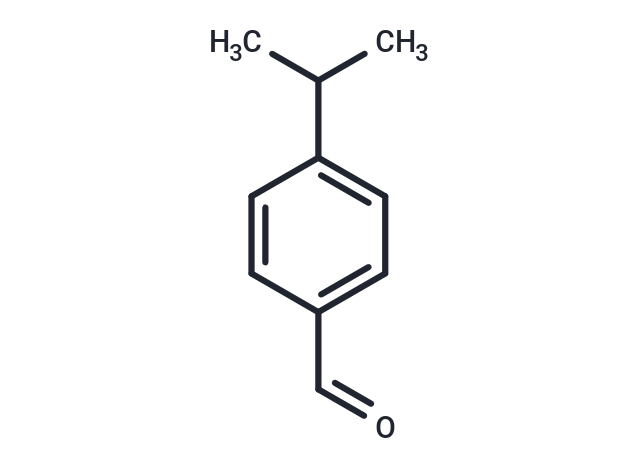
| Pack Size | Price | USA Stock | Global Stock | Quantity |
|---|---|---|---|---|
| 5 g | $31 | - | In Stock | |
| 1 mL x 10 mM (in DMSO) | $29 | In Stock | In Stock |
| Description | Cuminaldehyde (Cuminal) is a natural aldehyde with inhibitory effect on alpha-synuclein fibrillation and cytotoxicity. Cuminaldehyde shows anticancer activity,with a pleasant smell and contributes to the aroma of essential oils. |
| In vitro | Cuminaldehyde?suppressed growth and induced apoptosis, as proved by depletion of the mitochondrial membrane potential, activation of both caspase-3 and -9, and morphological features of apoptosis[1]. |
| In vivo | In vivo, cuminaldehyde diminished the tumor burden ,cuminaldehyde could be a drug for chemopreventive or anticancer therapy[1] |
| Synonyms | Cuminic aldehyde, Cuminal |
| Cell Research | Incubated the cells in the culture plate with 96 wells at the concentration of ten thousand cells per well.?After being incubated for 24 h, we treated the cells with cuminaldehyde at the concentration of 10, 20, 40, 80, or 160 μM for 12, 24, or 48 h. Determined cell viability using the Cell Proliferation Kit II (XTT) according to the supplier's instructions.?The value of absorbance was evaluated by a spectrophotometer (Tecan infinite M200, Tecan, M?nnedorf, Switzerland) using 492 nm wavelength with a reference of 650 nm wavelength[1]. |
| Animal Research | Human colorectal COLO 205 cells (5 × 10^6 cells in 200 μL of culture medium) were subcutaneously injected into the mice's flanks.?Treatment was started when the tumors reached about 75 mm^3.?Thirty-two mice were divided randomly into four groups (eight mice/group).?Cuminaldehyde-treated mice received intratumoral injection of 5, 10, or 20 mg/kg/day of cuminaldehyde in a 200 μL volume (the solutions were prepared from stock solution of cuminaldehyde in dimethyl sulfoxide and diluted into appropriate concentrations in PBS) daily.?The mice in the control group were treated with an equal volume of vehicle.?After transplantation, body weight as well as tumor size were monitored at weekly intervals.?Tumor size was measured using calipers, and tumor volume was calculated using the hemiellipsoid model formula[1] |
| Molecular Weight | 148.2 |
| Formula | C10H12O |
| Cas No. | 122-03-2 |
| Smiles | CC(C)c1ccc(C=O)cc1 |
| Relative Density. | 0.977 g/cm3 at 25℃ (lit.) |
| Storage | Powder: -20°C for 3 years | In solvent: -80°C for 1 year Shipping with blue ice/Shipping at ambient temperature. | |||||||||||||||||||||||||||||||||||
| Solubility Information | DMSO: 25 mg/mL (168.69 mM), Sonication is recommended.  | |||||||||||||||||||||||||||||||||||
| In Vivo Formulation | 10% DMSO+40% PEG300+5% Tween 80+45% Saline: 2 mg/mL (13.5 mM), Sonication is recommended. Please add the solvents sequentially, clarifying the solution as much as possible before adding the next one. Dissolve by heating and/or sonication if necessary. Working solution is recommended to be prepared and used immediately. The formulation provided above is for reference purposes only. In vivo formulations may vary and should be modified based on specific experimental conditions. | |||||||||||||||||||||||||||||||||||
Solution Preparation Table | ||||||||||||||||||||||||||||||||||||
DMSO
Note : The dilution table applies only to solid products. For liquid products, please calculate the stock solution based on the stated concentration and/or density. | ||||||||||||||||||||||||||||||||||||
 For example, if the intended dosage is 10 mg/kg for animals weighing 20 g , with a dosing volume of 100 μL per animal, and a total of 10 animals are to be administered, using a formulation of
  10% DMSO+ 40% PEG300+ 5% Tween 80+ 45% Saline/PBS/ddH2O , the resulting working solution concentration would be 2 mg/mL.
Dissolve 2 mg of the compound in 100 μL DMSO to obtain a stock solution at a concentration of 20 mg/mL . If the required concentration exceeds the compound's known solubility, please contact us for technical support before proceeding.
1) Add 100 μL of the DMSO stock solution to 400 µL PEG300 and mix thoroughly until the solution becomes clear.
2) Add 50 µL Tween 80 and mix well until fully clarified.
3) Add 450 µL Saline,PBS or ddH2O and mix thoroughly until a homogeneous solution is obtained.
| Size | Quantity | Unit Price | Amount | Operation |
|---|
 Feedback
 Hello! How can I help you today?
Copyright © 2015-2026 TargetMol Chemicals Inc. All Rights Reserved.
