


Shopping Cart
Remove All Your shopping cart is currently empty


Synonyms:
| Pack Size | Price | USA Stock | Global Stock | Quantity |
|---|---|---|---|---|
| 2 mg | $30 | In Stock | In Stock | |
| 5 mg | $46 | In Stock | In Stock | |
| 10 mg | $68 | In Stock | In Stock | |
| 25 mg | $98 | In Stock | In Stock | |
| 50 mg | $189 | In Stock | In Stock | |
| 100 mg | $306 | In Stock | In Stock | |
| 1 mL x 10 mM (in DMSO) | $53 | In Stock | In Stock |
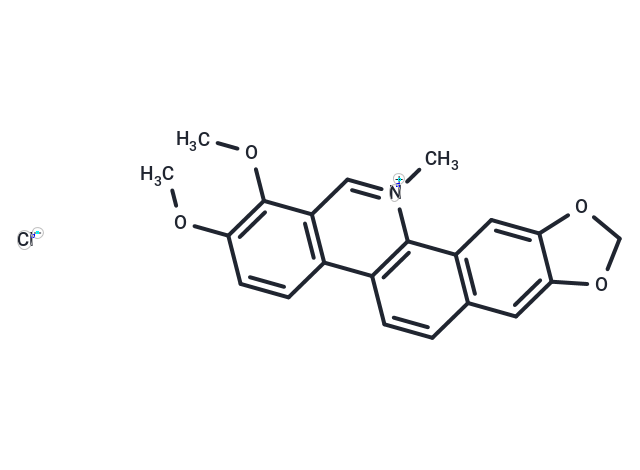
| Description | Chelerythrine Chloride is a cell-permeable inhibitor of protein kinase C, competitive with respect to the phosphate acceptor and non-competitive with respect to ATP. |
| Targets & IC50 | PKA:0.17 mM, BTK:0.1 mM, PKC:660 nM. |
| In vitro | Chelerythrine inhibits the BclXL-Bak BH3 peptide binding with IC50 of 1.5 μM. It displaced Bax, a BH3-containing protein, from BclXL. Mammalian cells treated with Chelerythrine undergoes apoptosis with characteristic features that suggest involvement of the mitochondrial pathway[1]. Chelerythrine treatment inhibits LPS-induced TNF-α level and NO production in LPS-induced murine peritoneal macrophages through selective inhibition of p38 mitogen-activated protein kinase (MAPK) and extracellular signal-regulated protein kinases 1 and 2 (ERK1/2) activation. In addition, the effects of chelerythrine on NO and cytokine TNF-α production can possibly be explained by the role of p38 MAPK and ERK1/2 in the regulation of inflammatory mediators expression[2]. Chelerythrine shows cytotoxic effect on the human monocytic leukaemia cells with LD50 value of 3.46 μM. Two hours after LPS stimulation, cells influenced by sanguinarine and Chelerythrine significantly decline the CCL-2 expression by a factors of 3.5 and 1.9[3]. Chelerythrine chloride significantly enhances the phosphorylation of ERK1/2 in a dose-dependent manner. In addition, chelerythrine chloride inhibits the phosphorylation of p38[4]. |
| In vivo | Chelerythrine exhibits substantial anti-inflammatory properties in vivo, notably in an experimentally induced endotoxic shock model in mice, by suppressing levels of LPS-induced tumor necrosis factor-alpha (TNF-α) and nitric oxide (NO) production in serum[2]. Additionally, chelerythrine chloride (5 mg/kg/day, i.p.) effectively induces apoptosis in RCC cells while maintaining a minimal toxicity profile in mice. Moreover, treatment with Chelerythrine Chloride results in a dose-dependent accumulation of p53[4]. |
| Cell Research | Chelerythrine is dissolved in DMSO. Cell viability is evaluated via MTT assay. Cells (2×10³?HEK-293 cells/well and 3×10³?SW-839 cells/well) in 100 μL medium are seeded into 96-well plates, and incubated for 12 h. Next, the medium in each well is replaced with medium containing various concentrations of Chelerythrine Chloride, and the cells are incubated at 37°C for an additional 24 and 48 h. Subsequently, 20 μL MTT (5 mg/mL) is added to each well. Following an additional incubation at 37°C for 4 h, the supernatant is removed, and 100 μL DMSO is added to each well. The absorbance values (read at 540 nm) are determined using the iMark? Microplate Absorbance Reader. The data are analyzed using Microplate Manager software (ver. 6.3; 1689520). |
| Molecular Weight | 383.83 |
| Formula | C21H18ClNO4 |
| Cas No. | 3895-92-9 |
| Smiles | [Cl-].COc1ccc2c(c[n+](C)c3c4cc5OCOc5cc4ccc23)c1OC |
| Relative Density. | 1.36g/cm3 |
| Storage | Keep away from direct sunlight Powder: -20°C for 3 years | In solvent: -80°C for 1 year Shipping with blue ice/Shipping at ambient temperature. | ||||||||||||||||||||
| Solubility Information | DMSO: 3.88 mg/mL (10.11 mM), Sonication is recommended. | ||||||||||||||||||||
Solution Preparation Table | |||||||||||||||||||||
DMSO
Note : The dilution table applies only to solid products. For liquid products, please calculate the stock solution based on the stated concentration and/or density. | |||||||||||||||||||||
 For example, if the intended dosage is 10 mg/kg for animals weighing 20 g , with a dosing volume of 100 μL per animal, and a total of 10 animals are to be administered, using a formulation of
  10% DMSO+ 40% PEG300+ 5% Tween 80+ 45% Saline/PBS/ddH2O , the resulting working solution concentration would be 2 mg/mL.
Dissolve 2 mg of the compound in 100 μL DMSO to obtain a stock solution at a concentration of 20 mg/mL . If the required concentration exceeds the compound's known solubility, please contact us for technical support before proceeding.
1) Add 100 μL of the DMSO stock solution to 400 µL PEG300 and mix thoroughly until the solution becomes clear.
2) Add 50 µL Tween 80 and mix well until fully clarified.
3) Add 450 µL Saline,PBS or ddH2O and mix thoroughly until a homogeneous solution is obtained.
| Size | Quantity | Unit Price | Amount | Operation |
|---|
 Feedback
 Hello! How can I help you today?
Copyright © 2015-2026 TargetMol Chemicals Inc. All Rights Reserved.
