


Shopping Cart
Remove All Your shopping cart is currently empty


Synonyms: XL184, Cabozantinib Malate, Cabozantinib
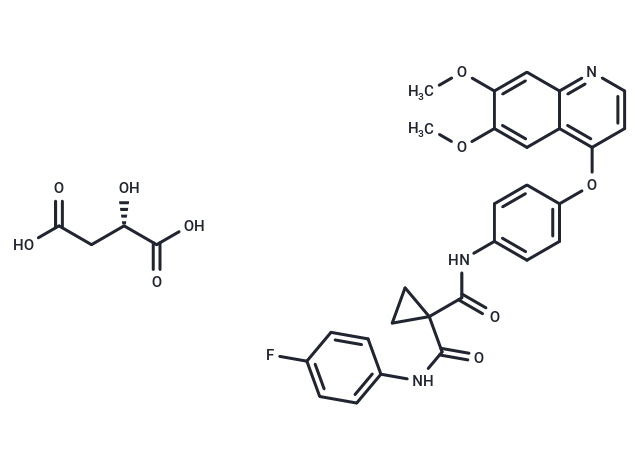
| Pack Size | Price | USA Stock | Global Stock | Quantity |
|---|---|---|---|---|
| 5 mg | $40 | In Stock | In Stock | |
| 10 mg | $56 | In Stock | In Stock | |
| 50 mg | $73 | In Stock | In Stock | |
| 100 mg | $98 | In Stock | In Stock | |
| 200 mg | $156 | In Stock | In Stock | |
| 500 mg | $313 | In Stock | In Stock | |
| 1 mL x 10 mM (in DMSO) | $56 | In Stock | In Stock |
| Description | Cabozantinib S-malate (XL184) is the s-malate salt form of cabozantinib, an orally bioavailable, small molecule receptor tyrosine kinase (RTK) inhibitor with potential antineoplastic activity. |
| Targets & IC50 | c-Met:1.3 nM, VEGFR2/KDR:0.035 nM |
| In vitro | Cabozantinib has weak inhibitory activity against RON and PDGFRβ with IC50 of 124 nM and 234 nM, respectivey, and has low activity against FGFR1 with IC50 of 5.294 μM. [1] Cabozantinib at low concentration (0.1-0.5 μM) is sufficient to induce marked inhibition of constitutive and inducible Met phosphorylation and its resultant downstream signaling in MPNST cells, and inhibit HGF-induced MPNST cell migration and invasion. Cabozantinib also induces marked inhibition of Met and VEGFR2 phosphorylation in cytokine-stimulated human umbilical vein endothelial cells (HUVECs). Although Cabozantinib has no significant effect on MPNST cell growth at 0.1 μM, Cabozantinib at 5-10 μM significantly inhibits the MPNST cell growth. [2] |
| In vivo | Cabozantinib treatment at 30 mg/kg in RIP-Tag2 mice with spontaneous pancreatic islet tumors disrupts 83% of the tumor vasculature, reduces pericytes and empty basement membrane sleeves, causes widespread intratumoral hypoxia and extensive tumor cell apoptosis, and slows regrowth of the tumor vasculature after drug withdrawal, more significantly compared with XL999 that blocks VEGFR but not c-Met, leading to only 43% reduction in vascularity, suggesting that concurrent inhibition of VEGFR and other functionally relevant receptor tyrosine kinases (RTK) amplifies angiogenesis inhibition. Cabozantinib also decreases invasiveness of primary tumors and reduces metastasis. [1] Cabozantinib at 30 mg/kg/day significantly abrogates human MPNST xenografts growth and metastasis in SCID mice. [2] Administration of Cabozantinib induces dose-dependent inhibition of tumor growth in breast, lung, and glioma tumor models, in association with decreased tumor and endothelial cell proliferation as well as increased apoptosis. A single oral dose of Cabozantinib is sufficient to induce sustained tumor growth inhibition in MDA-MB-231 tumor-bearing mice and C6 tumor-bearing rats at 100 mg/kg and 10 mg/kg, respectively. [3] |
| Synonyms | XL184, Cabozantinib Malate, Cabozantinib |
| Kinase Assay | The inhibition profile of cabozantinib against a broad panel of 270 human kinases is determined using luciferase-coupled chemiluminescence,?33P-phosphoryl transfer, or AlphaScreen technology. Recombinant human full-length, glutathione?S-transferase tag, or histidine tag fusion proteins are used, and half maximal inhibitory concentration (IC50) values are determined by measuring phosphorylation of peptide substrate poly (Glu, Tyr) at ATP concentrations at or below the?Km?for each respective kinase. The mechanism of kinase inhibition is evaluated using the AlphaScreen Assay by determining the IC50?values over a range of ATP concentrations. |
| Cell Research | Cells are exposed to various concentrations of Cabozantinib for 48 hours. Cell growth is determined by MTS assays using CellTiter96 Aqueous Non-Radioactive Cell Proliferation Assay kit. Absorbance is measured at a wavelength of 490 nm, and the absorbance values of treated cells are presented as a percentage of the absorbance of untreated cells. (Only for Reference) |
| Molecular Weight | 635.59 |
| Formula | C32H30FN3O10 |
| Cas No. | 1140909-48-3 |
| Smiles | O[C@@H](CC(O)=O)C(O)=O.COc1cc2nccc(Oc3ccc(NC(=O)C4(CC4)C(=O)Nc4ccc(F)cc4)cc3)c2cc1OC |
| Relative Density. | no data available |
| Storage | Powder: -20°C for 3 years | In solvent: -80°C for 1 year Shipping with blue ice/Shipping at ambient temperature. | |||||||||||||||||||||||||||||||||||
| Solubility Information | H2O: < 1 mg/mL (insoluble or slightly soluble) DMSO: 250 mg/mL (393.34 mM), Sonication is recommended.  Ethanol: < 1 mg/mL (insoluble or slightly soluble) | |||||||||||||||||||||||||||||||||||
| In Vivo Formulation | 10% DMSO+40% PEG300+5% Tween 80+45% Saline: 10 mg/mL (15.73 mM), Solution. 10% DMSO+90% Saline: < 10 mg/mL (15.73 mM), Lower concentrations may be soluble, but exact solubility limit is unknown. Please add the solvents sequentially, clarifying the solution as much as possible before adding the next one. Dissolve by heating and/or sonication if necessary. Working solution is recommended to be prepared and used immediately. The formulation provided above is for reference purposes only. In vivo formulations may vary and should be modified based on specific experimental conditions. | |||||||||||||||||||||||||||||||||||
Solution Preparation Table | ||||||||||||||||||||||||||||||||||||
DMSO
Note : The dilution table applies only to solid products. For liquid products, please calculate the stock solution based on the stated concentration and/or density. | ||||||||||||||||||||||||||||||||||||
 For example, if the intended dosage is 10 mg/kg for animals weighing 20 g , with a dosing volume of 100 μL per animal, and a total of 10 animals are to be administered, using a formulation of
  10% DMSO+ 40% PEG300+ 5% Tween 80+ 45% Saline/PBS/ddH2O , the resulting working solution concentration would be 2 mg/mL.
Dissolve 2 mg of the compound in 100 μL DMSO to obtain a stock solution at a concentration of 20 mg/mL . If the required concentration exceeds the compound's known solubility, please contact us for technical support before proceeding.
1) Add 100 μL of the DMSO stock solution to 400 µL PEG300 and mix thoroughly until the solution becomes clear.
2) Add 50 µL Tween 80 and mix well until fully clarified.
3) Add 450 µL Saline,PBS or ddH2O and mix thoroughly until a homogeneous solution is obtained.
| Size | Quantity | Unit Price | Amount | Operation |
|---|
 Feedback
 Hello! How can I help you today?
Copyright © 2015-2026 TargetMol Chemicals Inc. All Rights Reserved.
