


Shopping Cart
Remove All Your shopping cart is currently empty

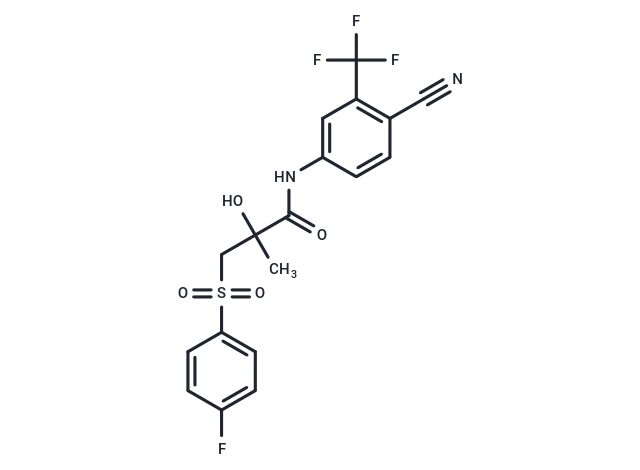
Synonyms: ICI-176334
| Pack Size | Price | USA Stock | Global Stock | Quantity |
|---|---|---|---|---|
| 50 mg | $32 | In Stock | In Stock | |
| 100 mg | $45 | In Stock | In Stock | |
| 500 mg | $68 | In Stock | In Stock | |
| 1 g | $85 | In Stock | In Stock | |
| 5 g | $197 | - | In Stock | |
| 1 mL x 10 mM (in DMSO) | $48 | In Stock | In Stock |
| Description | Bicalutamide (ICI-176334), a synthetic, nonsteroidal antiandrogen, competitively binds to cytosolic androgen receptors in target tissues, thereby inhibiting the receptor binding of androgens. |
| Targets & IC50 | Androgen receptor:0.16 μM |
| In vivo | Single bicalutamide reduces tumor growth by 79%, at defined submaximal doses. The ridaforolimus-bicalutamide combination exhibits improved and potent antitumor activity, almost completely abrogating tumor growth. The combination is also well tolerated, as evidenced by no significant changes in body weight over the course of treatment. Plasma PSA levels are again tightly linked to tumor growth in the combination-treated mice. [3] |
| Synonyms | ICI-176334 |
| Kinase Assay | Whole-cell competitive binding assays: Whole-cell competitive binding assays are performed in LNCaP/AR(codon-switch) (LNCaP/AR(cs)) (harbors a mixture of exogenous wild-type AR and endogenous mutant AR (T877A)) and cells propagated in Iscove's or RPMI media supplemented with 10% fetal bovine serum, or during the assay with 10% charcoal-stripped, dextran-treated fetal bovine serum (CSS). Cells are pre-incubated with 18F-FDHT, increasing concentrations (1pM to 1 μM) of cold Bicalutamide are added, and the assay is performed to measure specific uptake of 18F-FDHT (4). IC50 values are determined using a one site binding model with least squares curve fitting and R2 > 0.99. |
| Cell Research | Exponentially growing C4-2 cells are plated into two 96-well plates and incubated overnight at 37 ?C. Twenty-four hours later one plate is aspirated and stored at -80 ?C and the other treated with 10-fold serial concentrations of ridaforolimus (1000 nM to 0.0001 nM) or vehicle (ethanol). Following 72 hours culture at 37 ?C, the plates are assessed simultaneously for cell growth using the Cy qUANT Cell Proliferation Assay kit. Bicalutamide and Ridaforolimus combination proliferation assays are performed similarly except cell growth is determined as the change in cell number between vehicle control and compound treated cells after 72 hours in culture.(Only for Reference) |
| Molecular Weight | 430.37 |
| Formula | C18H14F4N2O4S |
| Cas No. | 90357-06-5 |
| Smiles | CC(O)(CS(=O)(=O)C1=CC=C(F)C=C1)C(=O)NC1=CC(=C(C=C1)C#N)C(F)(F)F |
| Relative Density. | 1.52 g/cm3 (Predicted) |
| Storage | Powder: -20°C for 3 years | In solvent: -80°C for 1 year Shipping with blue ice/Shipping at ambient temperature. | ||||||||||||||||||||||||||||||||||||||||
| Solubility Information | DMSO: 250 mg/mL (580.9 mM), Sonication is recommended.  Ethanol: 4.31 mg/mL (10.01 mM), Sonication is recommended. | ||||||||||||||||||||||||||||||||||||||||
| In Vivo Formulation | 10% DMSO+40% PEG300+5% Tween 80+45% Saline: 10 mg/mL (23.24 mM), Suspension. 10% DMSO+90% Saline: < 10 mg/mL (23.24 mM), Lower concentrations may be soluble, but exact solubility limit is unknown. Please add the solvents sequentially, clarifying the solution as much as possible before adding the next one. Dissolve by heating and/or sonication if necessary. Working solution is recommended to be prepared and used immediately. The formulation provided above is for reference purposes only. In vivo formulations may vary and should be modified based on specific experimental conditions. | ||||||||||||||||||||||||||||||||||||||||
Solution Preparation Table | |||||||||||||||||||||||||||||||||||||||||
Ethanol/DMSO
DMSO
Note : The dilution table applies only to solid products. For liquid products, please calculate the stock solution based on the stated concentration and/or density. | |||||||||||||||||||||||||||||||||||||||||
 For example, if the intended dosage is 10 mg/kg for animals weighing 20 g , with a dosing volume of 100 μL per animal, and a total of 10 animals are to be administered, using a formulation of
  10% DMSO+ 40% PEG300+ 5% Tween 80+ 45% Saline/PBS/ddH2O , the resulting working solution concentration would be 2 mg/mL.
Dissolve 2 mg of the compound in 100 μL DMSO to obtain a stock solution at a concentration of 20 mg/mL . If the required concentration exceeds the compound's known solubility, please contact us for technical support before proceeding.
1) Add 100 μL of the DMSO stock solution to 400 µL PEG300 and mix thoroughly until the solution becomes clear.
2) Add 50 µL Tween 80 and mix well until fully clarified.
3) Add 450 µL Saline,PBS or ddH2O and mix thoroughly until a homogeneous solution is obtained.
| Size | Quantity | Unit Price | Amount | Operation |
|---|
 Feedback
 Hello! How can I help you today?
Copyright © 2015-2026 TargetMol Chemicals Inc. All Rights Reserved.
