


Shopping Cart
Remove All Your shopping cart is currently empty


Synonyms: RG 7422, GNE 390, GDC-0980

| Pack Size | Price | USA Stock | Global Stock | Quantity |
|---|---|---|---|---|
| 2 mg | $38 | In Stock | In Stock | |
| 5 mg | $58 | In Stock | In Stock | |
| 10 mg | $88 | In Stock | In Stock | |
| 25 mg | $159 | In Stock | In Stock | |
| 50 mg | $258 | In Stock | In Stock | |
| 100 mg | $423 | In Stock | In Stock | |
| 1 mL x 10 mM (in DMSO) | $63 | In Stock | In Stock |
| Description | Apitolisib (RG 7422), an effective, class I PI3K inhibitor for PI3Kα(IC50=5 nM), PI3Kβ(IC50=27 nM), PI3Kδ(IC50=7 nM), PI3Kγ (IC50=14 nM), is used in trials study of solid cancers, breast cancer, prostate cancer, renal cell carcinoma, and endometrial carcinoma, among others. |
| Targets & IC50 | PI3Kβ:27 nM, p110δ:7 nM, p110γ:14 nM, p110α:5 nM, mTOR:17 nM (Ki) |
| In vitro | In PC3 (IC50=307 nM) and MCF7 cells (IC50=255 nM), GDC-0980 significantly inhibited cell proliferation. For class I PI3K and mTOR kinases, the selective inhibitory effect of GDC-0980 was significant for mTOR (Ki=17 nM), for PI3Kα (IC50=5 nM), β (IC50=27 nM), δ (IC50=7 nM), and γ (IC50=14 nM). |
| In vivo | In PC3 (IC50=307 nM) and MCF7 cells (IC50=255 nM), GDC-0980 significantly inhibited cell proliferation. For class I PI3K and mTOR kinases, the selective inhibitory effect of GDC-0980 was significant for mTOR (Ki=17 nM), for PI3Kα (IC50=5 nM), β (IC50=27 nM), δ (IC50=7 nM), and γ (IC50=14 nM). |
| Synonyms | RG 7422, GNE 390, GDC-0980 |
| Kinase Assay | Enzymatic activity: Enzymatic activity of the Class I PI3K isoforms is measured using a fluorescence polarization assay that monitors formation of the product 3,4,5-inositoltriphosphate molecule as it competes with fluorescently labeled PIP3 for binding to the GRP-1 pleckstrin homology domain protein. An increase in phosphatidyl inositide-3-phosphate product results in a decrease in fluorescence polarization signal as the labeled fluorophore is displaced from the GRP-1 protein binding site. Class I PI3K isoforms are expressed and purified as heterodimeric recombinant proteins. PI3K isoforms are assayed under initial rate conditions in the presence of 10 mM Tris (pH 7.5), 25 μM ATP, 9.75 μM PIP2, 5% glycerol, 4 mM MgCl2, 50 mM NaCl, 0.05% (v/v) Chaps, 1 mM dithiothreitol, 2% (v/v) DMSO at the following concentrations for each isoform: PI3Kα,β at 60 ng/mL; PI3Kγ at 8 ng/mL; PI3Kδ at 45 ng/mL. After assay for 30 minutes at 25°C, reactions are terminated with a final concentration of 9 mM EDTA, 4.5 nM TAMRA-PIP3, and 4.2 μg/mL GRP-1 detector protein before reading fluorescence polarization on an Envision plate reader. IC50s are calculated from the fit of the dose?response curves to a 4-parameter equation.Human recombinant mTOR(1360?2549) is expressed and purified from insect cells and assayed using a Lanthascreen fluorescence resonance energy transfer format in which phosphorylation of recombinant green fluorescent protein (GFP)-4-EBP1 is detected using a terbium-labeled antibody to phospho-threonine 37/46 of 4-EBP1. Reactions are initiated with ATP and conducted in the presence of 50 mM Hepes (pH 7.5), 0.25 nM mTOR, 400 nM GFP-4E-BP1, 8 μM ATP, 0.01% (v/v) Tween 20, 10 mM MnCl2, 1 mM EGTA, 1 mM dithiothreitol, and 1% (v/v) DMSO. Assays are conducted under initial rate conditions at room temperature for 30 minutes before terminating the reaction and detecting product in the presence of 2 nM Tb-anti-p4E-BP1 antibody and 10 mM EDTA.Dose?response curves are fit to an equation for competitive tight-binding inhibition and apparent Ki' s are calculated using the determined Km for ATP of 6.1 μM. |
| Cell Research | Antiproliferative cellular assays are conducted using PC3 and MCF7.1 human tumor cell lines. MCF7.1 is an in vivo selected line and originally derived from the parental human MCF7 breast cancer cell line. Cell lines are cultured in RPMI supplemented with 10% fetal bovine serum, 100 units/mL penicillin, and 100 μg/mL streptomycin, 10 mM HEPES, and 2 mM glutamine at 3°C under 5% CO2. MCF7.1 cells or PC3 cells are seeded in 384-well plates in media at 1000 cells/well or 3000 cells/well, respectively, and incubated overnight prior to the addition of GDC-0980 to a final DMSO concentration of 0.5% v/v. MCF7.1 cells and PC3 cells are incubated for 3 days and 4 days, respectively, prior to the addition of CellTiter-Glo reagen and reading of luminescence using an Analyst plate reader. For antiproliferative assays, a cytostatic agent such as aphidicolin and a cytotoxic agent such as staurosporine are included as controls. Dose?response curves are fit to a 4-parameter equation and relative IC50s are calculated using Assay Explorer software.(Only for Reference) |
| Molecular Weight | 498.6 |
| Formula | C23H30N8O3S |
| Cas No. | 1032754-93-0 |
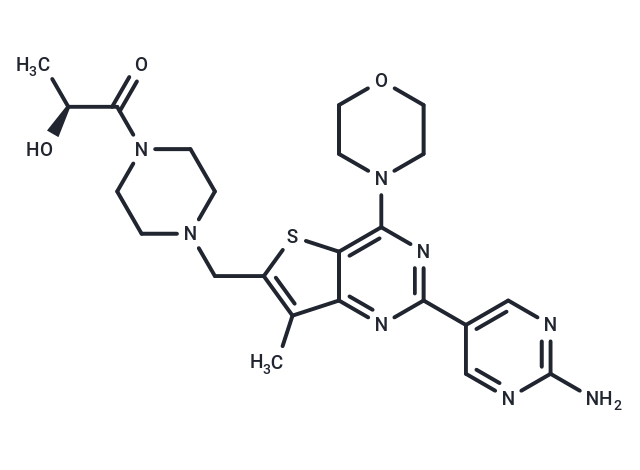
| Smiles | C[C@H](O)C(=O)N1CCN(Cc2sc3c(nc(nc3c2C)-c2cnc(N)nc2)N2CCOCC2)CC1 |
| Relative Density. | 1.399 g/cm3 |
| Storage | Powder: -20°C for 3 years | In solvent: -80°C for 1 year Shipping with blue ice/Shipping at ambient temperature. | |||||||||||||||||||||||||
| Solubility Information | Ethanol: < 1 mg/mL (insoluble or slightly soluble) DMSO: 13.9 mg/mL (27.88 mM), Sonication is recommended.  H2O: < 1 mg/mL (insoluble or slightly soluble) | |||||||||||||||||||||||||
| In Vivo Formulation | 10% DMSO+40% PEG300+5% Tween 80+45% Saline: 1 mg/mL (2.01 mM), Sonication is recommended. 10% DMSO+90% Saline: 1.39 mg/mL (2.79 mM), Solution. Please add the solvents sequentially, clarifying the solution as much as possible before adding the next one. Dissolve by heating and/or sonication if necessary. Working solution is recommended to be prepared and used immediately. The formulation provided above is for reference purposes only. In vivo formulations may vary and should be modified based on specific experimental conditions. | |||||||||||||||||||||||||
Solution Preparation Table | ||||||||||||||||||||||||||
DMSO
Note : The dilution table applies only to solid products. For liquid products, please calculate the stock solution based on the stated concentration and/or density. | ||||||||||||||||||||||||||
 For example, if the intended dosage is 10 mg/kg for animals weighing 20 g , with a dosing volume of 100 μL per animal, and a total of 10 animals are to be administered, using a formulation of
  10% DMSO+ 40% PEG300+ 5% Tween 80+ 45% Saline/PBS/ddH2O , the resulting working solution concentration would be 2 mg/mL.
Dissolve 2 mg of the compound in 100 μL DMSO to obtain a stock solution at a concentration of 20 mg/mL . If the required concentration exceeds the compound's known solubility, please contact us for technical support before proceeding.
1) Add 100 μL of the DMSO stock solution to 400 µL PEG300 and mix thoroughly until the solution becomes clear.
2) Add 50 µL Tween 80 and mix well until fully clarified.
3) Add 450 µL Saline,PBS or ddH2O and mix thoroughly until a homogeneous solution is obtained.
| Size | Quantity | Unit Price | Amount | Operation |
|---|
 Feedback
 Hello! How can I help you today?
Copyright © 2015-2026 TargetMol Chemicals Inc. All Rights Reserved.
