Shopping Cart
Remove All
  • TargetMol
    Your shopping cart is currently empty

Eupatilin

Copy Product Info
😃Good
Catalog No. T3362Cas No. 22368-21-4
Alias NSC 122413

Eupatilin (NSC-122413), a flavone derived from Artemisia princepsPampanini, is a PPARα agonist, with pharmacological activity.

Eupatilin

Eupatilin

Copy Product Info
😃Good
Purity: 99.54%
Catalog No. T3362Alias NSC 122413Cas No. 22368-21-4
Eupatilin (NSC-122413), a flavone derived from Artemisia princepsPampanini, is a PPARα agonist, with pharmacological activity.
Pack SizePriceUSA WarehouseGlobal WarehouseQuantity
10 mg$31In StockIn Stock
25 mg$64In StockIn Stock
50 mg$106In StockIn Stock
100 mg$169-In Stock
1 mL x 10 mM (in DMSO)$35In StockIn Stock
Add to Cart
Add to Quotation
In Stock Estimated shipping dateUSA Warehouse[1-2 days] Global Warehouse[5-7 days]
All TargetMol products are for research purposes only and cannot be used for human consumption. We do not provide products or services to individuals. Please comply with the intended use and do not use TargetMol products for any other purpose.
Questions
TargetMol
View More

Batch Information

Select Batch
Purity:99.54%
Color:White to Yellow
Contact us for more batch information

Resource Download

Product Introduction

Eupatilin AI Summary
Eupatilin exhibits a multifaceted bioactivity profile. It shows in vitro cytotoxic potency against various human tumor cell lines, including NCI-60 with a GI50 of 15000.0 nM, and specific antiproliferative activities against SNU638, SNU601, SNU484, AGS, and MKN1 cells with IC50 values of 50000.0 nM. Moreover, it induces significant apoptosis in U87MG cells and exerts antiproliferative effects on HL60 cells. The compound also demonstrates inhibitory activity against tubulin polymerization and colchicine binding to tubulin, suggesting potential impacts on cellular structure and function. In the context of receptor activity, Eupatilin acts as a delta opioid receptor antagonist (Ki = 12000.0 nM) and mu opioid receptor antagonist (Ki = 28000.0 nM), with a notable selectivity ratio favoring delta receptor binding. Additionally, it shows varying affinities for mu, delta, and kappa opioid receptors, while exhibiting low activity towards cannabinoid receptors CB1 and CB2. Beyond its oncological potential, Eupatilin displays antiviral capabilities against SARS-CoV-2, including inhibiting virus-induced cytotoxicity in Caco-2 and Vero-6 cells, and demonstrating activity against the viral protease 3CL-Pro. This compound also downregulates VEGF and HIF-1 alpha protein levels, inhibits Akt phosphorylation, and displays antiangiogenic activities, further contributing to its broad-spectrum biological effects. In immunological assessments, Eupatilin functions as an immunosuppressant by inhibiting T lymphocyte proliferation with an IC50 of 11700.0 nM. Furthermore, it shows high inhibitory activity against HDAC6 in enzymatic assays and significant AKT inhibition in mutant melanoma cells, highlighting its potential in targeted cancer therapies..
Note: Summary generated by AI. Data source: ChEMBL
Bioactivity
Description
Eupatilin (NSC-122413), a flavone derived from Artemisia princepsPampanini, is a PPARα agonist, with pharmacological activity.
SynonymsNSC 122413
Chemical Properties
Molecular Weight344.32
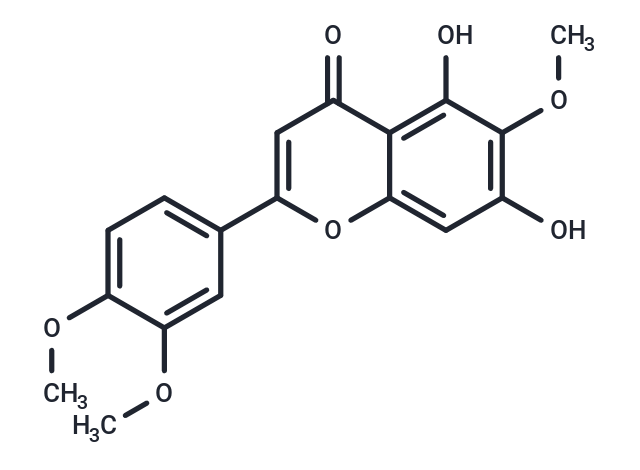
FormulaC18H16O7
Cas No.22368-21-4
SmilesCOc1ccc(cc1OC)-c1cc(=O)c2c(O)c(OC)c(O)cc2o1
Relative Density.1.387 g/cm3 (Predicted)
Storage & Solubility Information
StoragePowder: -20°C for 3 years | In solvent: -80°C for 1 year | Shipping with blue ice/Shipping at ambient temperature.
Solubility Information
DMSO: 62 mg/mL (180.07 mM), Sonication is recommended.
In Vivo Formulation
10% DMSO+40% PEG300+5% Tween 80+45% Saline: 2 mg/mL (5.81 mM), Sonication is recommended.
Please add the solvents sequentially, clarifying the solution as much as possible before adding the next one. Dissolve by heating and/or sonication if necessary. Working solution is recommended to be prepared and used immediately. The formulation provided above is for reference purposes only. In vivo formulations may vary and should be modified based on specific experimental conditions.
Solution Preparation Table
DMSO
1mg5mg10mg50mg
1 mM2.9043 mL14.5214 mL29.0428 mL145.2138 mL
5 mM0.5809 mL2.9043 mL5.8086 mL29.0428 mL
10 mM0.2904 mL1.4521 mL2.9043 mL14.5214 mL
20 mM0.1452 mL0.7261 mL1.4521 mL7.2607 mL
50 mM0.0581 mL0.2904 mL0.5809 mL2.9043 mL
100 mM0.0290 mL0.1452 mL0.2904 mL1.4521 mL

Calculator

  • Molarity Calculator
  • Dilution Calculator
  • Reconstitution Calculator
  • Molecular Weight Calculator

In Vivo Formulation Calculator (Clear solution)

Please enter your animal experiment information in the following box and click Calculate to obtain the stock solution preparation method and in vivo formula preparation method:
TargetMol | Animal experiments For example, if the intended dosage is 10 mg/kg for animals weighing 20 g , with a dosing volume of 100 μL per animal, TargetMol | Animal experiments and a total of 10 animals are to be administered, using a formulation of TargetMol | reagent 10% DMSO+ 40% PEG300+ 5% Tween 80+ 45% Saline/PBS/ddH2O , the resulting working solution concentration would be 2 mg/mL.

Stock Solution Preparation:

Dissolve 2 mg of the compound in 100 μL DMSOTargetMol | reagent to obtain a stock solution at a concentration of 20 mg/mL . If the required concentration exceeds the compound's known solubility, please contact us for technical support before proceeding.

Preparation of the In Vivo Formulation:

1) Add 100 μL of the DMSOTargetMol | reagent stock solution to 400 μL PEG300TargetMol | reagent and mix thoroughly until the solution becomes clear.

2) Add 50 μL Tween 80 and mix well until fully clarified.

3) Add 450 μL Saline,PBS or ddH2OTargetMol | reagent and mix thoroughly until a homogeneous solution is obtained.

This example is provided solely to demonstrate the use of the In Vivo Formulation Calculator and does not constitute a recommended formulation for any specific compound. Please select an appropriate dissolution and formulation strategy based on your experimental model and route of administration.
All co-solvents required for this protocol, includingDMSO, PEG300/PEG400, Tween 80, SBE-β-CD, and Corn oil, are available for purchase on the TargetMol website.
1 Enter information below:
mg/kg
g
μL
2 Enter the in vivo formulation:
% DMSO
%
% Tween 80
% Saline/PBS/ddH2O

Dose Conversion

You can also refer to dose conversion for different animals. More Dose Conversion

Tech Support

Please see Inhibitor Handling Instructions for more frequently ask questions. Topics include: how to prepare stock solutions, how to store products, and cautions on cell-based assays & animal experiments, etc

Keywords

Related Tags: buy Eupatilin | purchase Eupatilin | Eupatilin cost | order Eupatilin | Eupatilin chemical structure | Eupatilin formula | Eupatilin molecular weight