


Shopping Cart
Remove All
  • TargetMol
    Your shopping cart is currently empty

(-)-Epigallocatechin

Copy Product Info
🥰Excellent
Catalog No. T2987Cas No. 970-74-1
Alias l-Epigallocatechin, Epigallocatechin, EGC
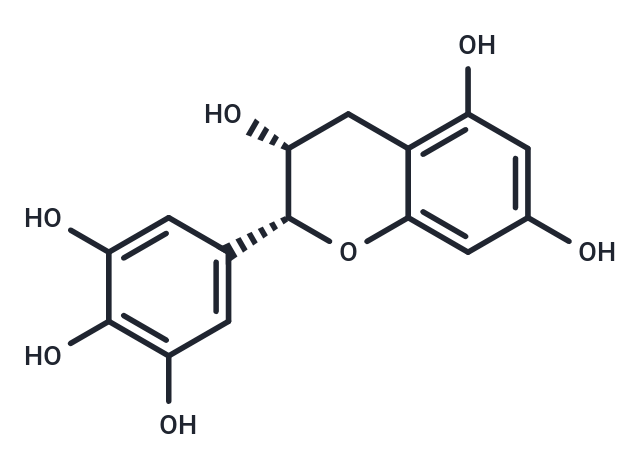
(-)-Epigallocatechin, the predominant flavonoid in green tea, possesses the unique ability to attach to unfolded native polypeptides, thereby inhibiting their transformation into amyloid fibrils.

(-)-Epigallocatechin

(-)-Epigallocatechin

Copy Product Info
🥰Excellent
Purity: 99.51%
Catalog No. T2987Alias l-Epigallocatechin, Epigallocatechin, EGCCas No. 970-74-1
(-)-Epigallocatechin, the predominant flavonoid in green tea, possesses the unique ability to attach to unfolded native polypeptides, thereby inhibiting their transformation into amyloid fibrils.
Pack SizePriceUSA WarehouseGlobal WarehouseQuantity
20 mg$50In StockIn Stock
1 mL x 10 mM (in DMSO)$50In StockIn Stock
Add to Cart
Add to Quotation
In Stock Estimated shipping dateUSA Warehouse[1-2 days] Global Warehouse[5-7 days]
All TargetMol products are for research purposes only and cannot be used for human consumption. We do not provide products or services to individuals. Please comply with the intended use and do not use TargetMol products for any other purpose.
Questions
TargetMol
View More

Batch Information

Select Batch
Purity:99.51%
Color:White
Contact us for more batch information

Resource Download

Product Introduction

(-)-Epigallocatechin AI Summary
(-)-Epigallocatechin exhibits a diverse range of bioactivities across various biological systems and assays. It demonstrates high bioactivity in vitro for Epstein-Barr Virus (EBV) activation in Raji cells induced by TPA at lower concentrations, with corresponding EBV activation percentages ranging from 19.3% to over 100.0% and maintaining cell viability above 80%. It is also an effective inhibitor of uninfected H9 lymphocytic cell growth with an IC50 of 1.8 μg/mL. In contrast, it shows weak or no significant antiplasmodial activity against chloroquine-sensitive Plasmodium falciparum NF54 when IC50 is greater than 150,000.0 nM. As an antibacterial agent, (-)-Epigallocatechin exhibits moderate activity with a MIC of 100 μM against Escherichia coli and a dissociation constant (Kd) of 34 μM in displacing fluorescent quercetin from Escherichia coli recombinant DNA gyrase B G24. It also shows notable antibacterial and antifungal activity against a variety of microorganisms, although the MIC values are generally high (greater than 128 µg/mL). The compound acts as an antagonist at human mu, delta, and kappa opioid receptors with Ke values of 300.0 nM, 1990.0 nM, and 250.0 nM, respectively. It exhibits selectivity for the mu opioid receptor over the kappa receptor. Furthermore, it shows antioxidant properties by scavenging superoxide (IC50 of 480.0 nM) and inhibiting xanthine oxidase, although less potently (IC50 > 100,000.0 nM). It moderately inhibits aldose reductase in rat lens homogenate, with 19.0% inhibition at 30 μM and an IC50 > 30,000.0 nM. (-)-Epigallocatechin also demonstrates bioactivity in cancer cell line inhibition, showing varying degrees of growth inhibition (GI50 values from nanomolar to high micromolar ranges) across multiple types of human tumor cell lines. Additionally, it has activity against Trypanosoma parasites, with IC50 values between 1.58 to 2.38 μg/mL. Other bioactivities include the inhibition of various enzymes (such as glutathione reductase and alcohol dehydrogenase from yeast) and DNA-interacting proteins (such as RAD52), among others, with respective potencies shown in different assays. (-)-Epigallocatechin has a low octanol-water partition coefficient (LogP of 0.13), indicating high hydrophilicity. It also modulates complement pathways, demonstrating antioxidant activities assessed by DPPH radical scavenging and liposomal models, and shows an IC50 of 12000000.0 nM in inhibiting proteasome chymotrypsin-like activity. Lastly, (-)-Epigallocatechin exhibits various specific bioactivities including cardioprotective effects in H9c2 cells, trypanocidal activity, and inhibition of RNA polymerase, further highlighting its broad-spectrum potential in biomedical research..
Note: Summary generated by AI. Data source: ChEMBL
Bioactivity
Description
(-)-Epigallocatechin, the predominant flavonoid in green tea, possesses the unique ability to attach to unfolded native polypeptides, thereby inhibiting their transformation into amyloid fibrils.
Synonymsl-Epigallocatechin, Epigallocatechin, EGC
Chemical Properties
Molecular Weight306.27
FormulaC15H14O7
Cas No.970-74-1
SmilesO[C@H]1[C@H](OC=2C(C1)=C(O)C=C(O)C2)C3=CC(O)=C(O)C(O)=C3
Relative Density.1.695 g/cm3 (Predicted)
Storage & Solubility Information
Storagekeep away from direct sunlight | Powder: -20°C for 3 years | In solvent: -80°C for 1 year | Shipping with blue ice/Shipping at ambient temperature.
Solubility Information
H2O: 25 mg/mL (81.63 mM), Sonication is recommended.

DMSO: 125 mg/mL (408.14 mM), Sonication is recommended.
Solution Preparation Table
H2O/DMSO
1mg5mg10mg50mg
1 mM3.2651 mL16.3255 mL32.6509 mL163.2546 mL
5 mM0.6530 mL3.2651 mL6.5302 mL32.6509 mL
10 mM0.3265 mL1.6325 mL3.2651 mL16.3255 mL
20 mM0.1633 mL0.8163 mL1.6325 mL8.1627 mL
50 mM0.0653 mL0.3265 mL0.6530 mL3.2651 mL
DMSO
1mg5mg10mg50mg
100 mM0.0327 mL0.1633 mL0.3265 mL1.6325 mL

Calculator

  • Molarity Calculator
  • Dilution Calculator
  • Reconstitution Calculator
  • Molecular Weight Calculator

In Vivo Formulation Calculator (Clear solution)

Please enter your animal experiment information in the following box and click Calculate to obtain the stock solution preparation method and in vivo formula preparation method:
TargetMol | Animal experiments For example, if the intended dosage is 10 mg/kg for animals weighing 20 g , with a dosing volume of 100 μL per animal, TargetMol | Animal experiments and a total of 10 animals are to be administered, using a formulation of TargetMol | reagent 10% DMSO+ 40% PEG300+ 5% Tween 80+ 45% Saline/PBS/ddH2O , the resulting working solution concentration would be 2 mg/mL.

Stock Solution Preparation:

Dissolve 2 mg of the compound in 100 μL DMSOTargetMol | reagent to obtain a stock solution at a concentration of 20 mg/mL . If the required concentration exceeds the compound's known solubility, please contact us for technical support before proceeding.

Preparation of the In Vivo Formulation:

1) Add 100 μL of the DMSOTargetMol | reagent stock solution to 400 μL PEG300TargetMol | reagent and mix thoroughly until the solution becomes clear.

2) Add 50 μL Tween 80 and mix well until fully clarified.

3) Add 450 μL Saline,PBS or ddH2OTargetMol | reagent and mix thoroughly until a homogeneous solution is obtained.

This example is provided solely to demonstrate the use of the In Vivo Formulation Calculator and does not constitute a recommended formulation for any specific compound. Please select an appropriate dissolution and formulation strategy based on your experimental model and route of administration.
All co-solvents required for this protocol, includingDMSO, PEG300/PEG400, Tween 80, SBE-β-CD, and Corn oil, are available for purchase on the TargetMol website.
1 Enter information below:
mg/kg
g
μL
2 Enter the in vivo formulation:
% DMSO
%
% Tween 80
% Saline/PBS/ddH2O

Dose Conversion

You can also refer to dose conversion for different animals. More Dose Conversion

Tech Support

Please see Inhibitor Handling Instructions for more frequently ask questions. Topics include: how to prepare stock solutions, how to store products, and cautions on cell-based assays & animal experiments, etc

Keywords

Related Tags: buy (-)-Epigallocatechin | purchase (-)-Epigallocatechin | (-)-Epigallocatechin cost | order (-)-Epigallocatechin | (-)-Epigallocatechin chemical structure | (-)-Epigallocatechin formula | (-)-Epigallocatechin molecular weight





