Shopping Cart
Remove All
  • TargetMol
    Your shopping cart is currently empty

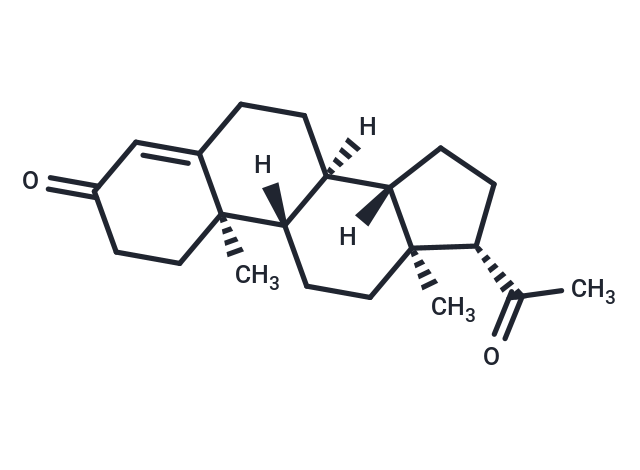
Progesterone (Alias: Pregn-4-ene-3,20-dione)

Catalog No. T0478 Copy Product Info
Purity: 99.89%
🥰Excellent
Progesterone is a steroid hormone that regulates the menstrual cycle and is essential for pregnancy. It is also commonly used to induce melasma models.

Progesterone

Copy Product Info
🥰Excellent
Catalog No. T0478
Alias Pregn-4-ene-3,20-dione

Progesterone is a steroid hormone that regulates the menstrual cycle and is essential for pregnancy. It is also commonly used to induce melasma models.

Progesterone
Cas No. 57-83-0
Pack SizePriceUSA StockGlobal StockQuantity
25 mg$30In StockIn Stock
50 mg$40In StockIn Stock
100 mg$55In StockIn Stock
500 mg$62In StockIn Stock
1 g$65-In Stock
5 g$88-In Stock
1 mL x 10 mM (in DMSO)$60In StockIn Stock
In stock · Estimated delivery: USA Stock (1-2 days) Global Stock (5-7 days)
Add to Cart
Add to Quotation
For research use only—not for human use. No sales to individuals. Use as intended only.
Questions
TargetMol
View More

Batch Information

Select Batch
Purity:99.89%
Color:White
Contact us for more batch information

Resource Download

Product Introduction

Bioactivity
Description
Progesterone is a steroid hormone that regulates the menstrual cycle and is essential for pregnancy. It is also commonly used to induce melasma models.
In vitro
Progesterone drives a series of events in which luminal cells may furnish basal cells with Wnt4 and RANKL signals, which in turn respond by upregulating homologous receptors, transcriptional targets, and markers of the cell cycle. Progesterone exhibits a biphasic effect on the proliferation of breast cancer cells; it stimulates growth during the initial cell cycle and subsequently impedes cell progression at the G1/S phase.
In vivo
Twenty-one days after dorsal medial thalamic nuclei damage, rats treated with progesterone exhibited reduced neuronal degeneration. In female 3xTg-AD mice, progesterone negated the advantageous effects against Abeta accumulation, yet it did not affect behavioral performance. During the Morris water maze spatial navigation task, progesterone-treated rats demonstrated less impairment compared to control rats.
Disease Modeling Protocol
Pulmonary fibrosis model
  • Modeling Mechanism:

    Progesterone exacerbates pulmonary fibrosis through multiple mechanisms: ① It promotes myofibroblast activation (increased α-SMA expression) and increases collagen deposition; ② It upregulates the key fibrotic cytokine TGF-β, inhibits matrix metalloproteinase 9 (MMP9) activity, and disrupts the degradation balance of the extracellular matrix (ECM); ③ It inhibits systemic inflammation (reducing serum TNF-α) while increasing cortisol levels, promoting excessive tissue repair through the imbalance of "anti-inflammatory-fibrotic"; ④ It directly induces subpleural fibrosis in normal lung tissue and, under pathological conditions, synergistically exacerbates damage with bleomycin.

  • Related Products:

    Progesterone (T0478)

  • Modeling Method:

    Experimental Subject:

    Mice: BALB/c strain, female, 6–8 weeks old, approximate body weight 20 g

    Dosage and Administration Route:

    ① Fibrosis induction: Bleomycin (1.5 U/mL) at 0.075 U/g administered via subcutaneous injection in the back, once daily for 28 days;
    ② Progesterone intervention:
    - Synchronised intervention group (BLM+P28): 1 mg/animal (50 μg/g) progesterone, subcutaneous injection, initiated concurrently with bleomycin, for 28 days;
    - Delayed intervention group (BLM+P21): 1 mg/animal progesterone, subcutaneous injection, initiated one week after bleomycin injection, for 21 days;
    ③ Control Groups: Pure bleomycin group (BLM), pure progesterone group (P21/P28), PBS control group

    Dosing Frequency and Duration Model:

    Bleomycin administered once daily for 28 days
    Progesterone intervention once daily for 21 or 28 days

  • Validation:

    Histological markers: Fibrosis degree: Masson trichrome staining showed significantly increased collagen deposition in the lung tissue of the BLM+P28 group (P<0.0001), while subpleural fibrosis was observed in the progesterone-only group (P28) (P<0.001); Molecular markers: Increased expression of α-SMA (P<0.01) and TGF-β (P<0.05) and decreased MMP9 activity (P<0.05) in the lung tissue of the BLM+P28 group, and downregulated expression of Col1a2, Ctgf, and Edn1 genes; Serum markers: Decreased TNF-α level (P<0.05) and increased cortisol level (P<0.05) in the BLM+P group; Specificity verification: Hydroxyproline detection showed increased hydroxyproline content in the lung tissue of the BLM+P28 group (P<0.05), consistent with the collagen deposition results, confirming the aggravation of fibrosis.

*Precautions: At the end of the study, the lung and injured skin were removed under deep anesthesia.

*References:Vafashoar F,et,al. Progesterone Aggravates Lung Fibrosis in a Mouse Model of Systemic Sclerosis. Front Immunol. 2021 Nov 29;12:742227.

SynonymsPregn-4-ene-3,20-dione
Chemical Properties
Molecular Weight314.46
FormulaC21H30O2
Cas No.57-83-0
SmilesC[C@@]12[C@@]3([C@]([C@]4([C@](C)(CC3)[C@@H](C(C)=O)CC4)[H])(CCC1=CC(=O)CC2)[H])[H]
Relative Density.1.08g/cm3
Storage & Solubility Information
Storagekeep away from moisture | Powder: -20°C for 3 years | In solvent: -80°C for 1 year | Shipping with blue ice/Shipping at ambient temperature.
Solubility Information
Ethanol: 31.5 mg/mL (100.17 mM), Sonication is recommended.
Methanol: < 1 mg/mL (insoluble)

DMSO: 47.48 mg/mL (150.99 mM), Sonication and heating are recommended.
In Vivo Formulation
10% DMSO+40% PEG300+5% Tween 80+45% Saline: 2 mg/mL (6.36 mM), Sonication is recommended.
Please add the solvents sequentially, clarifying the solution as much as possible before adding the next one. Dissolve by heating and/or sonication if necessary. Working solution is recommended to be prepared and used immediately. The formulation provided above is for reference purposes only. In vivo formulations may vary and should be modified based on specific experimental conditions.
Solution Preparation Table
Ethanol/DMSO
1mg5mg10mg50mg
1 mM3.1801 mL15.9003 mL31.8005 mL159.0027 mL
5 mM0.6360 mL3.1801 mL6.3601 mL31.8005 mL
10 mM0.3180 mL1.5900 mL3.1801 mL15.9003 mL
20 mM0.1590 mL0.7950 mL1.5900 mL7.9501 mL
50 mM0.0636 mL0.3180 mL0.6360 mL3.1801 mL
100 mM0.0318 mL0.1590 mL0.3180 mL1.5900 mL
Note : The dilution table applies only to solid products. For liquid products, please calculate the stock solution based on the stated concentration and/or density.

Calculator

  • Molarity Calculator
  • Dilution Calculator
  • Reconstitution Calculator
  • Molecular Weight Calculator

In Vivo Formulation Calculator (Clear solution)

Please enter your animal experiment information in the following box and click Calculate to obtain the stock solution preparation method and in vivo formula preparation method:
TargetMol | Animal experiments For example, if the intended dosage is 10 mg/kg for animals weighing 20 g , with a dosing volume of 100 μL per animal, TargetMol | Animal experiments and a total of 10 animals are to be administered, using a formulation of TargetMol | reagent 10% DMSO+ 40% PEG300+ 5% Tween 80+ 45% Saline/PBS/ddH2O , the resulting working solution concentration would be 2 mg/mL.

Stock Solution Preparation:

Dissolve 2 mg of the compound in 100 μL DMSOTargetMol | reagent to obtain a stock solution at a concentration of 20 mg/mL . If the required concentration exceeds the compound's known solubility, please contact us for technical support before proceeding.

Preparation of the In Vivo Formulation:

1) Add 100 μL of the DMSOTargetMol | reagent stock solution to 400 μL PEG300TargetMol | reagent and mix thoroughly until the solution becomes clear.

2) Add 50 μL Tween 80 and mix well until fully clarified.

3) Add 450 μL Saline,PBS or ddH2OTargetMol | reagent and mix thoroughly until a homogeneous solution is obtained.

This example is provided solely to demonstrate the use of the In Vivo Formulation Calculator and does not constitute a recommended formulation for any specific compound. Please select an appropriate dissolution and formulation strategy based on your experimental model and route of administration.
All co-solvents required for this protocol, includingDMSO, PEG300/PEG400, Tween 80, SBE-β-CD, and Corn oil, are available for purchase on the TargetMol website.
1 Enter information below:
mg/kg
g
μL
2 Enter the in vivo formulation:
% DMSO
%
% Tween 80
% Saline/PBS/ddH2O

Dose Conversion

You can also refer to dose conversion for different animals. More Dose Conversion

Tech Support

Please see Inhibitor Handling Instructions for more frequently ask questions. Topics include: how to prepare stock solutions, how to store products, and cautions on cell-based assays & animal experiments, etc

Keywords

Related Tags: buy Progesterone | purchase Progesterone | Progesterone cost | order Progesterone | Progesterone chemical structure | Progesterone in vivo | Progesterone in vitro | Progesterone formula | Progesterone molecular weight