


Shopping Cart
Remove All Your shopping cart is currently empty


Synonyms: PI 1840

| Pack Size | Price | USA Stock | Global Stock | Quantity |
|---|---|---|---|---|
| 10 mg | $38 | In Stock | In Stock | |
| 25 mg | $71 | In Stock | In Stock | |
| 50 mg | $139 | In Stock | In Stock | |
| 100 mg | $208 | In Stock | In Stock | |
| 1 mL x 10 mM (in DMSO) | $29 | In Stock | In Stock |
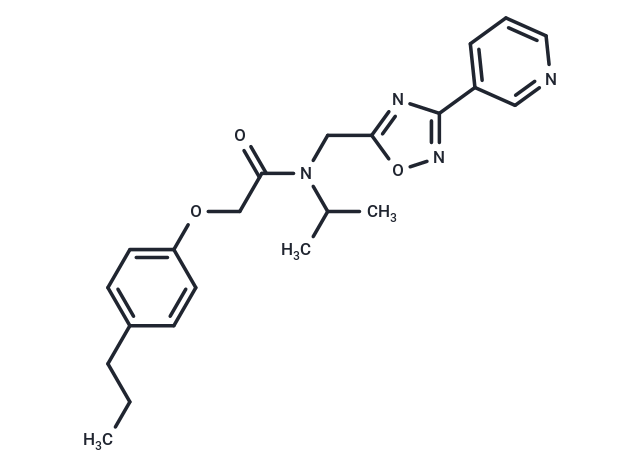
| Description | PI-1840(IC50 = 27 nM)is a reversible and selective chymotrypsin-like (CT-L) inhibitor, with little proteasome proteolytic effects on trypsin-like (T-L) and postglutamyl-peptide-hydrolysis-like (PGPH-L). |
| Targets & IC50 | Chymotrypsin-like proteasome:27 nM |
| In vitro | PI-1840 potently inhibits proteasomal CT-L activity with IC50 of 0.37 μM in intact human MDA-MB-468 cancer cells, and inhibits proliferation/survival of human MDA-MB-468 cells. [1] In intact cancer cells, PI-1840 inhibits CT-L activity, induces the accumulation of proteasome substrates p27, Bax, and IκB-α, inhibits survival pathways and viability, and induces apoptosis. [2] |
| In vivo | PI-1840 (150 mg/kg i.p.) inhibits the tumor growth in mice of MDA-MB-231 breast tumors. [2] |
| Synonyms | PI 1840 |
| Kinase Assay | CT-L, T-L, PGPH-L proteolytic activity assays: In the high-throughput screen, fluorogenic peptides are used as substrates to assay (at 10 μM) the 50,000 compounds library from ChemBridge for inhibitory activity against the CT-L proteolytic activity of the purified rabbit 20S proteasome. To test for selectivity for CT-L over T-L and PGPH-L the corresponding fluorogenic peptides are used. Briefly, 1 nM of purified 20S rabbit proteasome is incubated with 20 μM Suc-Leu-Leu-Val-Tyr-AMC for the CT-L activity, Bz-Val-Gly-Arg-AMC for the T-L activity, and benzyloxycarbonyl Z-Leu-Leu-Glu-AMC for the PGPH-L activity for 1 h at 37 °C in 100 μL of assay buffer (50 mM Tris-HCl, pH 7.6) with or without compound. After incubation, production of hydrolyzed 7-amido-4-methyl-coumarin (AMC) groups is measured using a WALLAC Victor2 1420 Multilabel Counter with an excitation filter of 355 nm and an emission filter of 460 nm. The amount of AMC released is within the linear range. Bortezomib is used as a positive control for IC50 determinations. To determine proteasome activity in whole cell, extracts (5 μg) from cultured cell lysate is used instead of 20S rabbit proteasome, and followed the same assay mentioned above. |
| Cell Research | Cells are plated in 96-well plates in 100 μL medium and allowed to attach overnight. Cells are then incubated for 120 h with varying concentrations of inhibitors. Media is aspirated and replaced with 100 μL complete media containing 1 mg/ml MTT and incubated for three hours at 37 °C in 5% CO2 humidified incubator. Media is then aspirated and DMSO is added. Cells are incubated for 10 min at room temperature while shaking, and the absorbance is determined at 540 nm using a μQuant spectrophotometric plate reader. The IC50 values are determined using equation under CT-L, T-L, PGPH-L proteolytic activity assays.(Only for Reference) |
| Molecular Weight | 394.47 |
| Formula | C22H26N4O3 |
| Cas No. | 1401223-22-0 |
| Smiles | CCCc1ccc(OCC(=O)N(Cc2nc(no2)-c2cccnc2)C(C)C)cc1 |
| Relative Density. | 1.165 g/cm3 (Predicted) |
| Storage | Powder: -20°C for 3 years | In solvent: -80°C for 1 year Shipping with blue ice/Shipping at ambient temperature. | ||||||||||||||||||||||||||||||||||||||||
| Solubility Information | Ethanol: 31 mg/mL (78.59 mM), Sonication is recommended. H2O: < 1 mg/mL (insoluble or slightly soluble) DMSO: 72 mg/mL (182.52 mM), Sonication is recommended. | ||||||||||||||||||||||||||||||||||||||||
| In Vivo Formulation | 10% DMSO+40% PEG300+5% Tween 80+45% Saline: 2 mg/mL (5.07 mM), Sonication is recommended. Please add the solvents sequentially, clarifying the solution as much as possible before adding the next one. Dissolve by heating and/or sonication if necessary. Working solution is recommended to be prepared and used immediately. The formulation provided above is for reference purposes only. In vivo formulations may vary and should be modified based on specific experimental conditions. | ||||||||||||||||||||||||||||||||||||||||
Solution Preparation Table | |||||||||||||||||||||||||||||||||||||||||
Ethanol/DMSO
DMSO
Note : The dilution table applies only to solid products. For liquid products, please calculate the stock solution based on the stated concentration and/or density. | |||||||||||||||||||||||||||||||||||||||||
 For example, if the intended dosage is 10 mg/kg for animals weighing 20 g , with a dosing volume of 100 μL per animal, and a total of 10 animals are to be administered, using a formulation of
  10% DMSO+ 40% PEG300+ 5% Tween 80+ 45% Saline/PBS/ddH2O , the resulting working solution concentration would be 2 mg/mL.
Dissolve 2 mg of the compound in 100 μL DMSO to obtain a stock solution at a concentration of 20 mg/mL . If the required concentration exceeds the compound's known solubility, please contact us for technical support before proceeding.
1) Add 100 μL of the DMSO stock solution to 400 µL PEG300 and mix thoroughly until the solution becomes clear.
2) Add 50 µL Tween 80 and mix well until fully clarified.
3) Add 450 µL Saline,PBS or ddH2O and mix thoroughly until a homogeneous solution is obtained.
| Size | Quantity | Unit Price | Amount | Operation |
|---|
 Feedback
 Hello! How can I help you today?
Copyright © 2015-2026 TargetMol Chemicals Inc. All Rights Reserved.
