


Shopping Cart
Remove All Your shopping cart is currently empty


Synonyms:

| Pack Size | Price | USA Stock | Global Stock | Quantity |
|---|---|---|---|---|
| 1 mg | $32 | In Stock | In Stock | |
| 5 mg | $73 | In Stock | In Stock | |
| 10 mg | $113 | In Stock | In Stock | |
| 25 mg | $215 | In Stock | In Stock | |
| 50 mg | $318 | In Stock | In Stock | |
| 100 mg | $469 | In Stock | In Stock | |
| 1 mL x 10 mM (in DMSO) | $74 | In Stock | In Stock |
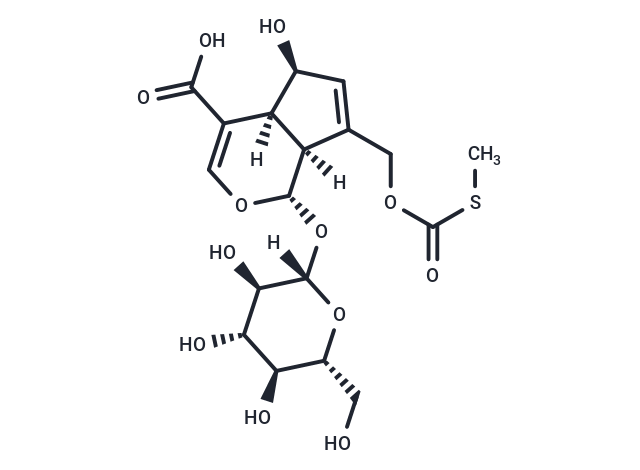
| Description | Paederosidic acid has significant anti-tumor, anticonvulsant and sedative effects. Paederosidic acid increases brain gamma-aminobutyric acid and decreases glutamic acid in the brain, and it up-regulates expressions of GAD 65, may be a promising future therapeutic agent for treatment of epilepsy. |
| In vitro | Paederosidic acid(PA) showed significant anti-tumor activity on lung cancer in vitro; the mechanisms were involved in inducing mitochondria-mediated apoptosis via up-regulation of caspase-3, caspase-8, caspase-9, Bid, Bax, down-regulation of Bcl-2 and stimulating the release of Cyto-C from mitochondria.JNK phosphorylation levels significantly increased concomitantly with decrease in Akt phosphorylation after treatment with PA in A549 cells. However, JNK siRNA-transfected cells diminished PA-induced caspase-3, 8 and 9, Bid and Bax activaton while enhanced the Bcl-2 activation. PA-induced JNK activation played an important functional role in apoptosis[1]. |
| In vivo | Anticonvulsant and sedative effects of paederosidic acid isolated from Paederia scandens (Lour.) Merrill. in mice and rats.Paederosidic acid (5, 10, 20, and 40 mg/kg, ip) had significant anticonvulsant and sedative effects. paederosidic acid increased brain gamma-aminobutyric acid and decreased glutamic acid in the brain, and it up-regulated expressions of GAD 65. Paederosidic acid may be a promising future therapeutic agent for treatment of epilepsy[2]. |
| Cell Research | The anti-proliferative effects of PA on A549 cells were evaluated by MTT method and the IC50 values were calculated. Furthermore, the PA-induced apoptosis in A549 cells was determined by fluorescence microscope via staining with DAPI and by flow cytometer via staining with FITC conjugated Annexin V/PI. The expression of apoptosis-related or signaling proteins was investigated by Western blotting[1] |
| Animal Research | Anticonvulsant activities of paederosidic acid were evaluated by maximal electroshock and pentylenetetrazole-induced seizures in male mice. Then, pentobarbital sodium-induced sleeping time and locomotor activity tests in mice were used to evaluate the sedative effects of paederosidic acid. Finally, the mechanism of paederosidic acid was explored by evaluating the contents of Glu and GABA in the brain, and Western blot was used to measure GAD65 expression in the mouse brain[2]. |
| Molecular Weight | 464.44 |
| Formula | C18H24O12S |
| Cas No. | 18842-98-3 |
| Smiles | [H][C@]12[C@H](O[C@]3([H])O[C@H](CO)[C@@H](O)[C@H](O)[C@H]3O)OC=C(C(O)=O)[C@@]1([H])[C@@H](O)C=C2COC(=O)SC |
| Relative Density. | 1.68g/cm3 |
| Storage | Powder: -20°C for 3 years | In solvent: -80°C for 1 year Shipping with blue ice/Shipping at ambient temperature. | |||||||||||||||||||||||||||||||||||
| Solubility Information | DMSO: 55 mg/mL (118.42 mM), Sonication is recommended.  | |||||||||||||||||||||||||||||||||||
| In Vivo Formulation | 10% DMSO+40% PEG300+5% Tween 80+45% Saline: 2 mg/mL (4.31 mM), Sonication is recommended. Please add the solvents sequentially, clarifying the solution as much as possible before adding the next one. Dissolve by heating and/or sonication if necessary. Working solution is recommended to be prepared and used immediately. The formulation provided above is for reference purposes only. In vivo formulations may vary and should be modified based on specific experimental conditions. | |||||||||||||||||||||||||||||||||||
Solution Preparation Table | ||||||||||||||||||||||||||||||||||||
DMSO
Note : The dilution table applies only to solid products. For liquid products, please calculate the stock solution based on the stated concentration and/or density. | ||||||||||||||||||||||||||||||||||||
 For example, if the intended dosage is 10 mg/kg for animals weighing 20 g , with a dosing volume of 100 μL per animal, and a total of 10 animals are to be administered, using a formulation of
  10% DMSO+ 40% PEG300+ 5% Tween 80+ 45% Saline/PBS/ddH2O , the resulting working solution concentration would be 2 mg/mL.
Dissolve 2 mg of the compound in 100 μL DMSO to obtain a stock solution at a concentration of 20 mg/mL . If the required concentration exceeds the compound's known solubility, please contact us for technical support before proceeding.
1) Add 100 μL of the DMSO stock solution to 400 µL PEG300 and mix thoroughly until the solution becomes clear.
2) Add 50 µL Tween 80 and mix well until fully clarified.
3) Add 450 µL Saline,PBS or ddH2O and mix thoroughly until a homogeneous solution is obtained.
| Size | Quantity | Unit Price | Amount | Operation |
|---|
 Feedback
 Hello! How can I help you today?
Copyright © 2015-2026 TargetMol Chemicals Inc. All Rights Reserved.
