


Shopping Cart
Remove All Your shopping cart is currently empty


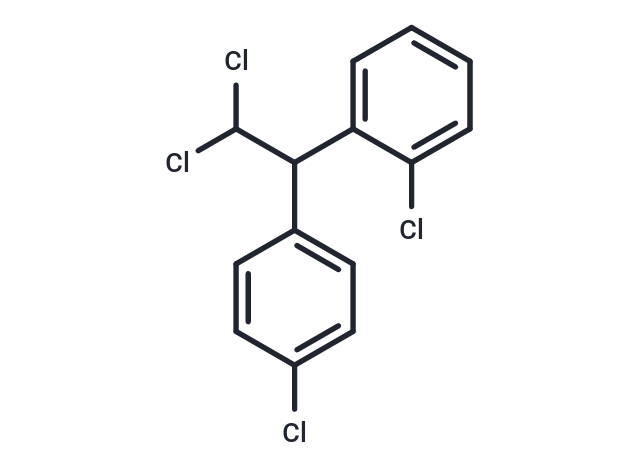
Synonyms: o,p'-DDD, NCI-C04933, Mitotan, 2,4′-DDD
| Pack Size | Price | USA Stock | Global Stock | Quantity |
|---|---|---|---|---|
| 50 mg | $30 | In Stock | In Stock | |
| 100 mg | $40 | In Stock | In Stock | |
| 500 mg | $88 | In Stock | In Stock | |
| 1 g | $128 | In Stock | In Stock | |
| 1 mL x 10 mM (in DMSO) | $39 | In Stock | In Stock |

| Description | Mitotane (NCI-C04933) is a derivative of the insecticide DICHLORODIPHENYLDICHLOROETHANE that specifically inhibits cells of the adrenal cortex and their production of hormones. It is used to treat adrenocortical tumors and causes CNS damage, but no bone marrow depression. |
| In vitro | 10-40 μM Mitotane inhibited basal and cAMP-induced cortisol secretion but did not cause cell death.Mitotane inhibited basal expression of StAR and P450scc proteins.40 μM Mitotane significantly reduced mRNA expression of StAR, CYP11A1 and CYP21.In H295R cells, the mRNA expression of StAR, CYP11A1 and CYP21 was significantly reduced by Mitotane. In H295R cells, Mitotane in combination with gemcitabine showed antagonistic effects and interfered with gemcitabine-mediated S-phase inhibition of the cell cycle.Mitotane inhibited the expression and secretion of thyroid stimulating hormone (TSH), blocked TSH response to thyrotropin-releasing hormone (THRH), decreased cell viability, and induced apoptosis in the mouse TalphaT1 cell line.Mitotane inhibited the expression and secretion of pituitary thyrotropin secretory hormone (PTHS) and induced apoptosis in the pituitary thyrotropin secretory hormone (PSH) cells. Mitotane induced adrenocortical necrosis, mitochondrial membrane damage, and irreversible binding of the protein CYP in pituitary thyrotropin-secreting mouse cells, without interfering with thyroid hormones, and directly reduced secretory activity and cell viability. |
| In vivo | 10-40 μM Mitotane inhibited basal and cAMP-induced cortisol secretion but did not cause cell death.Mitotane inhibited basal expression of StAR and P450scc proteins.40 μM Mitotane significantly reduced mRNA expression of StAR, CYP11A1 and CYP21.In H295R cells, the mRNA expression of StAR, CYP11A1 and CYP21 was significantly reduced by Mitotane. In H295R cells, Mitotane in combination with gemcitabine showed antagonistic effects and interfered with gemcitabine-mediated S-phase inhibition of the cell cycle.Mitotane inhibited the expression and secretion of thyroid stimulating hormone (TSH), blocked TSH response to thyrotropin-releasing hormone (THRH), decreased cell viability, and induced apoptosis in the mouse TalphaT1 cell line.Mitotane inhibited the expression and secretion of pituitary thyrotropin secretory hormone (PTHS) and induced apoptosis in the pituitary thyrotropin secretory hormone (PSH) cells. Mitotane induced adrenocortical necrosis, mitochondrial membrane damage, and irreversible binding of the protein CYP in pituitary thyrotropin-secreting mouse cells, without interfering with thyroid hormones, and directly reduced secretory activity and cell viability. |
| Synonyms | o,p'-DDD, NCI-C04933, Mitotan, 2,4′-DDD |
| Molecular Weight | 320.04 |
| Formula | C14H10Cl4 |
| Cas No. | 53-19-0 |
| Smiles | ClC(Cl)C(c1ccc(Cl)cc1)c1ccccc1Cl |
| Relative Density. | 1.372 g/cm3 |
| Storage | Store under nitrogen Powder: -20°C for 3 years | In solvent: -80°C for 1 year Shipping with blue ice/Shipping at ambient temperature. | |||||||||||||||||||||||||||||||||||
| Solubility Information | H2O: < 1 mg/mL (insoluble or slightly soluble) DMSO: 250 mg/mL (781.15 mM), Sonication is recommended.  Ethanol: 60 mg/mL (187.48 mM), Sonication is recommended. | |||||||||||||||||||||||||||||||||||
| In Vivo Formulation | 10% DMSO+90% Saline: 10 mg/mL (31.25 mM), Suspension. 10% DMSO+40% PEG300+5% Tween 80+45% Saline: 2 mg/mL (6.25 mM), Sonication is recommended. Please add the solvents sequentially, clarifying the solution as much as possible before adding the next one. Dissolve by heating and/or sonication if necessary. Working solution is recommended to be prepared and used immediately. The formulation provided above is for reference purposes only. In vivo formulations may vary and should be modified based on specific experimental conditions. | |||||||||||||||||||||||||||||||||||
Solution Preparation Table | ||||||||||||||||||||||||||||||||||||
Ethanol/DMSO
Note : The dilution table applies only to solid products. For liquid products, please calculate the stock solution based on the stated concentration and/or density. | ||||||||||||||||||||||||||||||||||||
 For example, if the intended dosage is 10 mg/kg for animals weighing 20 g , with a dosing volume of 100 μL per animal, and a total of 10 animals are to be administered, using a formulation of
  10% DMSO+ 40% PEG300+ 5% Tween 80+ 45% Saline/PBS/ddH2O , the resulting working solution concentration would be 2 mg/mL.
Dissolve 2 mg of the compound in 100 μL DMSO to obtain a stock solution at a concentration of 20 mg/mL . If the required concentration exceeds the compound's known solubility, please contact us for technical support before proceeding.
1) Add 100 μL of the DMSO stock solution to 400 µL PEG300 and mix thoroughly until the solution becomes clear.
2) Add 50 µL Tween 80 and mix well until fully clarified.
3) Add 450 µL Saline,PBS or ddH2O and mix thoroughly until a homogeneous solution is obtained.
| Size | Quantity | Unit Price | Amount | Operation |
|---|
 Feedback
 Hello! How can I help you today?
Copyright © 2015-2026 TargetMol Chemicals Inc. All Rights Reserved.
