


Shopping Cart
Remove All Your shopping cart is currently empty

Synonyms: SPI-0211, RU-0211

| Pack Size | Price | USA Stock | Global Stock | Quantity |
|---|---|---|---|---|
| 5 mg | $47 | In Stock | In Stock | |
| 10 mg | $77 | In Stock | In Stock | |
| 25 mg | $138 | In Stock | In Stock | |
| 50 mg | $227 | In Stock | In Stock | |
| 100 mg | $345 | In Stock | In Stock | |
| 500 mg | $825 | - | In Stock | |
| 1 mL x 10 mM (in DMSO) | $52 | In Stock | In Stock |
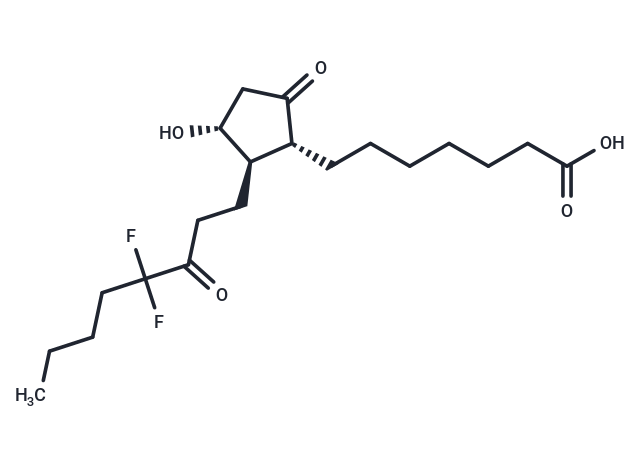
| Description | Lubiprostone (RU-0211), an activator of ClC-2 chloride channels, is used in the therapy of idiopathic chronic constipation. |
| In vitro | Lubiprostone induces a robust secretory response in T84 monolayers. Lubiprostone induces a rise in cAMP levels that was sensitive to EP(4)-receptor blockage in T84 cells. [1] Lubiprostone induces a contraction in rat and human stomach longitudinal muscle, which is inhibited by pretreatment with the EP(1) receptor antagonist but not by the EP(3) or EP(4) receptor antagonists. Lubiprostone also reduces electrically stimulated, neuronal contractions in rat and human colon circular muscle preparations. [2] Lubiprostone (1 mM) stimulates higher elevations in TER despite lower I(sc) responses compared with the nonselective secretory agonist PGE(2) (1 mM). Lubiprostone significantly reduces mucosal-to-serosal fluxes of (3)H-labeled mannitol to levels comparable to those of normal control tissues and restored occludin localization to tight junctions. [3] Lubiprostone causes comparable and maximal increases of I(sc) in T84 cells. Lubiprostone-induced increases in iodide efflux are ~80% of those obtained with forskolin. Lubiprostone activates Cl(-) secretion in T84 cells via cAMP, protein kinase A, and by increasing apical membrane CFTR protein. [4] Lubiprostone, applied to the small intestinal mucosa in eight concentrations ranging from 1-3000 nM, evokes increases in Isc in a concentration-dependent manner with an EC50 of 42.5 nM. Lubiprostone applied to the mucosa of the colon in eight concentrations ranging from 1-3000 nM evokes increases in Isc in a concentration-dependent manner with an EC50 of 31.7 nM. [5] |
| In vivo | Lubiprostone induces a CdCl(2)-insensitive secretory response in mouse intestine, but fail to induce intestinal Cl(-) secretion in Cftr-null mice. [1] |
| Synonyms | SPI-0211, RU-0211 |
| Kinase Assay | Fluorescence polarization-based competition assay: Inhibition constants ( Ki ) for the antagonists are determined by addition of the IAP protein constructs to wells containing serial dilutions of the antagonists or the peptide AVPW, and the Hid-FAM probe or AVP-diPhe-FAM probe, as appropriate, in the polarization buffer. Samples are read after a 30-minute incubation. Fluorescence polarization values are plotted as a function of the antagonist concentration, and the IC50 values are obtained by fitting the data to a 4-parameter equation using software. Ki values for the antagonists are determined from the IC50 valued. |
| Molecular Weight | 390.46 |
| Formula | C20H32F2O5 |
| Cas No. | 136790-76-6 |
| Smiles | CCCCC(F)(F)C(=O)CC[C@H]1[C@H](O)CC(=O)[C@@H]1CCCCCCC(O)=O |
| Relative Density. | 1.175 g/cm3 |
| Storage | Powder: -20°C for 3 years | In solvent: -80°C for 1 year Shipping with blue ice/Shipping at ambient temperature. | |||||||||||||||||||||||||||||||||||
| Solubility Information | Ethanol: 72 mg/mL (184.4 mM), Sonication is recommended. DMSO: 245 mg/mL (627.47 mM), Sonication is recommended.  H2O: < 1 mg/mL (insoluble or slightly soluble) | |||||||||||||||||||||||||||||||||||
| In Vivo Formulation | 10% DMSO+40% PEG300+5% Tween 80+45% Saline: 2.5 mg/mL (6.4 mM), Sonication is recommended. 10% DMSO+90% Saline: 10 mg/mL (25.61 mM), Suspension. Please add the solvents sequentially, clarifying the solution as much as possible before adding the next one. Dissolve by heating and/or sonication if necessary. Working solution is recommended to be prepared and used immediately. The formulation provided above is for reference purposes only. In vivo formulations may vary and should be modified based on specific experimental conditions. | |||||||||||||||||||||||||||||||||||
Solution Preparation Table | ||||||||||||||||||||||||||||||||||||
Ethanol/DMSO
Note : The dilution table applies only to solid products. For liquid products, please calculate the stock solution based on the stated concentration and/or density. | ||||||||||||||||||||||||||||||||||||
 For example, if the intended dosage is 10 mg/kg for animals weighing 20 g , with a dosing volume of 100 μL per animal, and a total of 10 animals are to be administered, using a formulation of
  10% DMSO+ 40% PEG300+ 5% Tween 80+ 45% Saline/PBS/ddH2O , the resulting working solution concentration would be 2 mg/mL.
Dissolve 2 mg of the compound in 100 μL DMSO to obtain a stock solution at a concentration of 20 mg/mL . If the required concentration exceeds the compound's known solubility, please contact us for technical support before proceeding.
1) Add 100 μL of the DMSO stock solution to 400 µL PEG300 and mix thoroughly until the solution becomes clear.
2) Add 50 µL Tween 80 and mix well until fully clarified.
3) Add 450 µL Saline,PBS or ddH2O and mix thoroughly until a homogeneous solution is obtained.
| Size | Quantity | Unit Price | Amount | Operation |
|---|
 Feedback
 Hello! How can I help you today?
Copyright © 2015-2026 TargetMol Chemicals Inc. All Rights Reserved.
