


Shopping Cart
Remove All Your shopping cart is currently empty

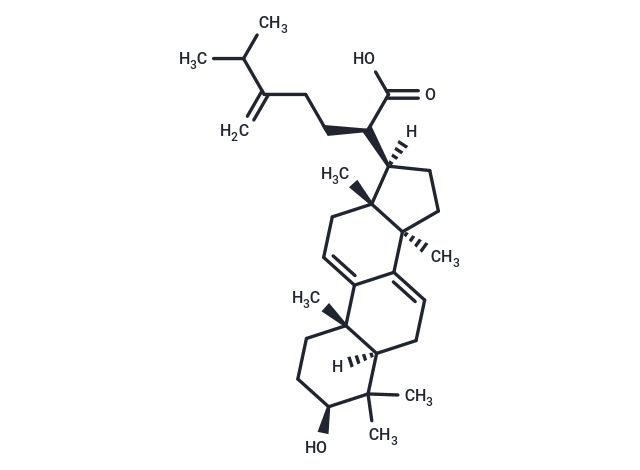
Synonyms: Dehydroeburicoic acid
| Pack Size | Price | USA Stock | Global Stock | Quantity |
|---|---|---|---|---|
| 1 mg | $326 | 7-10 days | 7-10 days | |
| 5 mg | $897 | 7-10 days | 7-10 days | |
| 1 mL x 10 mM (in DMSO) | $1,083 | 7-10 days | 7-10 days |
| Description | Dehydrotrametenolic acid (Dehydroeburicoic acid) induces necrotic cell death that involves Ca(2+) overload, mitochondrial dysfunction, and calpain activation in human glioblastomas. |
| In vitro | 3-(4,5-Dimethyl-thiazol-2-yl)-2,5-diphenyltetrazolium bromide and lactate dehydrogenase release assays indicated that Dehydroeburicoic acid inhibited the proliferation of the human glioblastoma cell U87MG. In addition, Annexin V and propidium iodide staining showed that Dehydroeburicoic acid treatment led to a rapid increase of glioblastomas in the necrotic/late apoptotic fraction, whereas cell cycle analysis revealed that Dehydroeburicoic acid failed to significantly enhance the population of U87MG cells in the hypodiploid (sub-G1) fraction. Using electron microscopy, we found that Dehydroeburicoic acid induced significant cell enlargements, massive cytoplasmic vacuolization, and loss of mitochondrial membrane integrity. Dehydroeburicoic acid treatment triggered an intracellular Ca(2+) increase, and Dehydroeburicoic acid-induced cell death was significantly attenuated by BAPTA-AM but not ethylenediaminetetraacetic acid or ethylene glycol tetraacetic acid. Dehydroeburicoic acid instigated a reduction of both mitochondrial transmembrane potential and intracellular ATP level. Moreover, Dehydroeburicoic acid induced proteolysis of alpha-spectrin by calpain, and Dehydroeburicoic acid cytotoxicity in U87MG cells was caspase-independent but was effectively blocked by calpain inhibitor. Interestingly, Dehydroeburicoic acid also caused autophagic response that was prevented by calpain inhibitor. |
| Synonyms | Dehydroeburicoic acid |
| Molecular Weight | 468.71 |
| Formula | C31H48O3 |
| Cas No. | 6879-05-6 |
| Smiles | [H][C@@]1(CC[C@@]2(C)C3=CC[C@@]4([H])C(C)(C)[C@@H](O)CC[C@]4(C)C3=CC[C@]12C)[C@@H](CCC(=C)C(C)C)C(O)=O |
| Relative Density. | 1.07 g/cm3 (Predicted) |
| Storage | Powder: -20°C for 3 years | In solvent: -80°C for 1 year Shipping with blue ice/Shipping at ambient temperature. | ||||||||||||||||||||
| Solubility Information | DMSO: 10 mM, Sonication is recommended. | ||||||||||||||||||||
Solution Preparation Table | |||||||||||||||||||||
DMSO
Note : The dilution table applies only to solid products. For liquid products, please calculate the stock solution based on the stated concentration and/or density. | |||||||||||||||||||||
 For example, if the intended dosage is 10 mg/kg for animals weighing 20 g , with a dosing volume of 100 μL per animal, and a total of 10 animals are to be administered, using a formulation of
  10% DMSO+ 40% PEG300+ 5% Tween 80+ 45% Saline/PBS/ddH2O , the resulting working solution concentration would be 2 mg/mL.
Dissolve 2 mg of the compound in 100 μL DMSO to obtain a stock solution at a concentration of 20 mg/mL . If the required concentration exceeds the compound's known solubility, please contact us for technical support before proceeding.
1) Add 100 μL of the DMSO stock solution to 400 µL PEG300 and mix thoroughly until the solution becomes clear.
2) Add 50 µL Tween 80 and mix well until fully clarified.
3) Add 450 µL Saline,PBS or ddH2O and mix thoroughly until a homogeneous solution is obtained.
| Size | Quantity | Unit Price | Amount | Operation |
|---|
 Feedback
 Hello! How can I help you today?
Copyright © 2015-2026 TargetMol Chemicals Inc. All Rights Reserved.
