


Shopping Cart
Remove All
  • TargetMol
    Your shopping cart is currently empty

Angiotensin II human

Copy Product Info
😃Good
Catalog No. T7040Cas No. 4474-91-3
Alias Hypertensin II, DRVYIHPF, Angiotensin II, Ang II
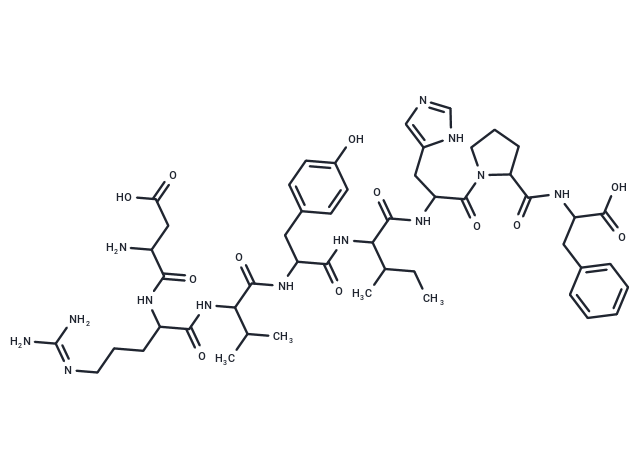
Angiotensin II is a major biologically active vasoconstrictor peptide that regulates blood pressure by binding to AT1R and AT2R receptors. It stimulates the sympathetic nervous system, promotes aldosterone synthesis, and enhances renal function. Additionally, it induces vascular smooth muscle cell proliferation and increases collagen synthesis, leading to vascular and myocardial hypertrophy and fibrosis. It also promotes apoptosis and endothelial capillary formation. Angiotensin II is commonly used to induce hypertension and cardiac hypertrophy animal models.

Angiotensin II human

Angiotensin II human

Copy Product Info
😃Good
Purity: 99.97%
Catalog No. T7040Alias Hypertensin II, DRVYIHPF, Angiotensin II, Ang IICas No. 4474-91-3
Angiotensin II is a major biologically active vasoconstrictor peptide that regulates blood pressure by binding to AT1R and AT2R receptors. It stimulates the sympathetic nervous system, promotes aldosterone synthesis, and enhances renal function. Additionally, it induces vascular smooth muscle cell proliferation and increases collagen synthesis, leading to vascular and myocardial hypertrophy and fibrosis. It also promotes apoptosis and endothelial capillary formation. Angiotensin II is commonly used to induce hypertension and cardiac hypertrophy animal models.
Pack SizePriceUSA WarehouseGlobal WarehouseQuantity
5 mg$37In StockIn Stock
10 mg$59In StockIn Stock
25 mg$123In StockIn Stock
50 mg$225In Stock-
100 mg$321In Stock-
500 mg$779InquiryInquiry
Add to Cart
Add to Quotation
In Stock Estimated shipping dateUSA Warehouse[1-2 days] Global Warehouse[5-7 days]
All TargetMol products are for research purposes only and cannot be used for human consumption. We do not provide products or services to individuals. Please comply with the intended use and do not use TargetMol products for any other purpose.
Questions
TargetMol
View More

Batch Information

Select Batch
Purity:99.97%
Color:White
Contact us for more batch information

Resource Download

Product Introduction

Bioactivity
Description
Angiotensin II is a major biologically active vasoconstrictor peptide that regulates blood pressure by binding to AT1R and AT2R receptors. It stimulates the sympathetic nervous system, promotes aldosterone synthesis, and enhances renal function. Additionally, it induces vascular smooth muscle cell proliferation and increases collagen synthesis, leading to vascular and myocardial hypertrophy and fibrosis. It also promotes apoptosis and endothelial capillary formation. Angiotensin II is commonly used to induce hypertension and cardiac hypertrophy animal models.
Targets&IC50
CHO cells viability:0.52 nM (EC50), CHO cells viability:1.5 nM
In vitro
METHODS: Human hepatocellular carcinoma cells (HCC) HepG-2, SMMC-7721, and MHCC97-H were treated with Angiotensin II (1-1000 nM) for 24-72 h. The cell viability was determined using MTT.
RESULTS: Angiotensin II induced HCC cell lines to show higher growth in a time- and concentration-dependent manner. [1]
METHODS: Neonatal rat cardiomyocytes were treated with Angiotensin II (1 μmol/L) for 5 min-48 h. HMGB1 and IL-6 expression levels were measured by ELISA and RT-qPCR.
RESULTS: Angiotensin II enhanced the expression levels of HMGB1 and IL-6 in cardiomyocytes. [2]
In vivo
METHODS: To determine insulin action in a human hypertensive mouse model, Angiotensin II (1.1 mg/kg in 0.9% saline) was administered to C57Bl/6J mice using an osmotic minipump for two to four weeks.
RESULTS: Blood pressure increased after Angiotensin II treatment. The increase in serum insulin was greater in Angiotensin II-treated mice after glucose administration. Long-term Angiotensin II treatment for four weeks enhanced glucose-stimulated insulin secretion in mice. [3]
METHODS: To analyze genotoxic effects in vivo, Angiotensin II (60 ng/kg/min-1 μg/kg/min) was administered using an osmotic minipump to C57Bl/6J mice for four weeks.
RESULTS: Angiotensin II increased SBP up to 38 mmHg over control and adversely affected renal function in mice. In the heart, a significant increase in reactive oxygen species formation and double-strand breaks were detected at the highest administered dose. In the kidney, a dose-dependent increase in superoxide formation, double-strand breaks and DNA base modification mutations were observed. [4]
Disease Modeling Protocol
Hypertension model
  • Modeling Mechanism:

    Angiotensin II human (Ang II) enhances vascular receptor affinity by binding to specific receptors on the surface of vascular smooth muscle cells, promoting vasoconstriction and increasing peripheral resistance. At the same time, it activates the sympathetic nervous system and regulates sodium balance (high sodium intake can further enhance receptor sensitivity), inducing persistent hypertension and mimicking the pathological process of clinical renin-angiotensin system activation related to hypertension.

  • Related Products:

    Angiotensin II human (T7040)

  • Modeling Method:

    Experimental Subject:Rats, Sprague-Dawley (SD), Male, Body weight 150–250 g

    Dosage and Administration Route:① Core modelling: Angiotensin II human, Dose adjusted as required for experiment (for receptor blockade studies, exogenously administered at 50 ng per dose to validate blockade effect), Dissolved in sterile physiological saline, Intravenous injection (i.v.); ② Dietary intervention: - High-sodium group: Standard diet+0.9% saline drinking water; - Normal sodium group: Standard diet (containing 0.42% sodium)+conventional drinking water; - Low-sodium group: Sodium-free diet+conventional drinking water; ③ Control treatment: Control group administered equal volume saline solution, with all other conditions identical; ④ Combined Preparation of Hypertensive Models: - Bilateral renal artery clamping (Goldblatt): Silver clamp applied to left renal artery, contralateral kidney preserved; - Unilateral nephrectomy (Goldblatt): Left renal artery ligated with silver clip, contralateral kidney removed; - DOCA hypertension: Subcutaneous implantation of 25 mg DOCA pellets (every 4 weeks)+high-sodium diet;

    Dosing Frequency and Duration Model:Single administration; dietary intervention commenced after 6 weeks

  • Validation:

    1. Blood Pressure Indicators: - Baseline Blood Pressure: Normal rat systolic blood pressure is 120-130 mmHg; after modeling, it reaches 175-195 mmHg in the two-kidney-one-clip type and over 210 mmHg in the one-kidney-one-clip type; spontaneously hypertensive rats reach 195-200 mmHg. - Receptor Blocking Verification: After injection of Ang II antibody, blood pressure can decrease by 20-50 mmHg (significant in the two-kidney-one-clip type, no significant decrease in the one-kidney-one-clip type). 2. Receptor Affinity: The high-sodium intake group requires 8 times more Ang II antibody than the low-sodium group to block the vascular response, proving that receptor sensitivity is positively correlated with sodium intake. 3. Metabolic Indicators: Plasma Ang II levels (approximately 150 pg/ml in the low-sodium group, < 20 pg/ml in the high-sodium group) show an inverse relationship with receptor affinity. 4. Specificity Verification: The antibody only blocks the pressor effect of Ang II and does not affect the blood pressure response to norepinephrine.

*Precautions:

*References:Brunner HR,et,al. Angiotensin II vascular receptors: their avidity in relationship to sodium balance, the autonomic nervous system, and hypertension. J Clin Invest. 1972 Jan;51(1):58-67.

Animal Research
(129×C57BL/6) F1 mice, which lack AT1A receptors Angiotensin II used, are fed 10 gm/day gelled 0.25% NaCl diet that contains all nutrients and water. After 28 days of Angiotensin II infusion, hearts are harvested, weighed fixed in formalin, sectioned, and stained with Masson trichrome.
SynonymsHypertensin II, DRVYIHPF, Angiotensin II, Ang II
Chemical Properties
Molecular Weight1046.18
FormulaC50H71N13O12
Cas No.4474-91-3
SmilesCCC(C)C(NC(=O)C(Cc1ccc(O)cc1)NC(=O)C(NC(=O)C(CCCN=C(N)N)NC(=O)C(N)CC(O)=O)C(C)C)C(=O)NC(Cc1cnc[nH]1)C(=O)N1CCCC1C(=O)NC(Cc1ccccc1)C(O)=O
Relative Density.1.43g/cm3
SequenceAsp-Arg-Val-Tyr-Ile-His-Pro-Phe
Sequence ShortDRVYIHPF
Storage & Solubility Information
Storagekeep away from moisture,store at low temperature | Powder: -20°C for 3 years | In solvent: -80°C for 1 year | Shipping with blue ice/Shipping at ambient temperature.
Solubility Information
H2O: 10.52 mg/mL (10.06 mM), Sonication is recommended.

DMSO: < 1 mg/mL (insoluble)
Solution Preparation Table
H2O
1mg5mg10mg50mg
1 mM0.9559 mL4.7793 mL9.5586 mL47.7929 mL
5 mM0.1912 mL0.9559 mL1.9117 mL9.5586 mL
10 mM0.0956 mL0.4779 mL0.9559 mL4.7793 mL

Calculator

  • Molarity Calculator
  • Dilution Calculator
  • Reconstitution Calculator
  • Molecular Weight Calculator

In Vivo Formulation Calculator (Clear solution)

Please enter your animal experiment information in the following box and click Calculate to obtain the stock solution preparation method and in vivo formula preparation method:
TargetMol | Animal experiments For example, if the intended dosage is 10 mg/kg for animals weighing 20 g , with a dosing volume of 100 μL per animal, TargetMol | Animal experiments and a total of 10 animals are to be administered, using a formulation of TargetMol | reagent 10% DMSO+ 40% PEG300+ 5% Tween 80+ 45% Saline/PBS/ddH2O , the resulting working solution concentration would be 2 mg/mL.

Stock Solution Preparation:

Dissolve 2 mg of the compound in 100 μL DMSOTargetMol | reagent to obtain a stock solution at a concentration of 20 mg/mL . If the required concentration exceeds the compound's known solubility, please contact us for technical support before proceeding.

Preparation of the In Vivo Formulation:

1) Add 100 μL of the DMSOTargetMol | reagent stock solution to 400 μL PEG300TargetMol | reagent and mix thoroughly until the solution becomes clear.

2) Add 50 μL Tween 80 and mix well until fully clarified.

3) Add 450 μL Saline,PBS or ddH2OTargetMol | reagent and mix thoroughly until a homogeneous solution is obtained.

This example is provided solely to demonstrate the use of the In Vivo Formulation Calculator and does not constitute a recommended formulation for any specific compound. Please select an appropriate dissolution and formulation strategy based on your experimental model and route of administration.
All co-solvents required for this protocol, includingDMSO, PEG300/PEG400, Tween 80, SBE-β-CD, and Corn oil, are available for purchase on the TargetMol website.
1 Enter information below:
mg/kg
g
μL
2 Enter the in vivo formulation:
% DMSO
%
% Tween 80
% Saline/PBS/ddH2O

Dose Conversion

You can also refer to dose conversion for different animals. More Dose Conversion

Tech Support

Please see Inhibitor Handling Instructions for more frequently ask questions. Topics include: how to prepare stock solutions, how to store products, and cautions on cell-based assays & animal experiments, etc

Keywords

Related Tags: buy Angiotensin II human | purchase Angiotensin II human | Angiotensin II human cost | order Angiotensin II human | Angiotensin II human chemical structure | Angiotensin II human in vivo | Angiotensin II human in vitro | Angiotensin II human formula | Angiotensin II human molecular weight




