


Shopping Cart
Remove All Your shopping cart is currently empty

Synonyms: peremin, Histamine 2HCl, Ceplene
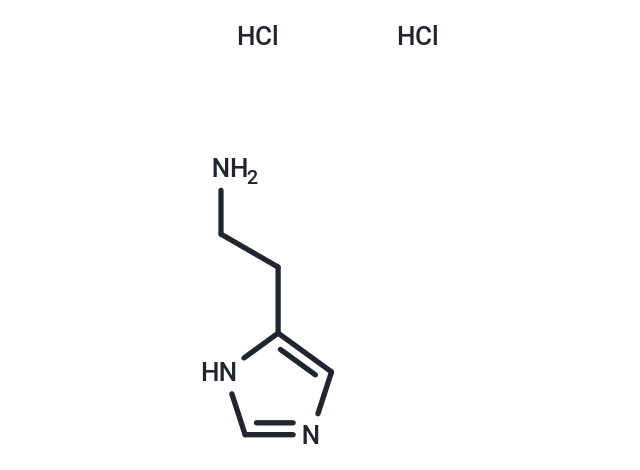
| Pack Size | Price | USA Stock | Global Stock | Quantity |
|---|---|---|---|---|
| 200 mg | $30 | In Stock | In Stock | |
| 500 mg | $38 | - | In Stock |
| Description | Histamine dihydrochloride (Ceplene) is the dihydrochloride salt form of histamine, an endogenous metabolic product. Histamine is an organic nitrogen-containing compound with diverse biological activities. It acts as a potent stimulator of gastric acid secretion, a bronchial smooth muscle constrictor, and a vasodilator, as well as a neurotransmitter with central nervous system activity. It is commonly used to induce gastric ulcer models in research. |
| In vitro | Histamine suppresses the generation of ROS through the Histaminetype-2 receptor (H2 receptor).[1] Histamine inhibits the generation and release of reactive oxygen species (ROS) by monocytes/macrophages (MO) during respiratory burst. Histamine and interleukin-2 (IL-2) act synergistically to activate NK cell cytotoxicity (NKCC). Histamine combined with IL-2 might improve response rates and disease-free survival by protecting the cells of the immune system from oxidative stress and inducing natural endogenous immune cytotoxicity. [2] |
| In vivo | Histamine treatment (0.5 mg/kg or 5.0 mg/kg, twice daily) protects against liver injury as evident by normal serum transaminase levels and significantly reduced liver pathology scores in a rat model with early alcohol-induced liver injury. The protective effect of histamine is blocked by Ranitidine (10 mg/kg), an H2 receptor antagonist, indicating that the histamine effect is predominantly mediated through the H2 receptor. [1] Histamine (30 pg/rat, icv) increases both 3,4-dihydroxyphenylalanine accumulation and 3,4-dihydroxyphenylalanine acid concentrations in the nucleus accumbens in male rats, and this effect is not affect by H2 antagonist zolantidine, indicating that histamine stimulates mesolimbic DA neurons through an action at the H1 receptor. [3] Histamine (0.5 mg/kg s.c.) reduces the liver tumour weight by 46% and subcutaneous tumour weight by 41% versus rats receiving subcutaneous saline injections. The anti-tumour effect observed by subcutaneous histamine injections is inhibited by Ranitidine (50 mg/kg s.c.) in rats sarcoma. [4] Histamine (1000 mg/kg s.c.) displays acute tissue damage after 24 hours and indications of pathological inflammation at the injection sites at 5 days and 28 days in Sprague-Dawley rats. Histamine (1000 mg/kg s.c.) results in Cmax of 167 mM, tmax of 0.5 hour, t1/2 of 0.95 and AUC of 186 mmol-h/L in male Sprague-Dawley rats. [5] |
| Synonyms | peremin, Histamine 2HCl, Ceplene |
| Disease Modeling Protocol | Duodenal Ulcer Model
*Precautions: Subjects were euthanized and sampled 8 hours after indomethacin administration; some animals were normally fed for 24 hours after the last histamine injection and sampled 32 hours after indomethacin administration. |
| Molecular Weight | 184.07 |
| Formula | C5H9N3·2HCl |
| Cas No. | 56-92-8 |
| Smiles | Cl.Cl.NCCC1=CN=CN1 |
| Relative Density. | 1.14 g/cm3 |
| Storage | Pure form: -20°C for 3 years | In solvent: -80°C for 1 year Shipping with blue ice/Shipping at ambient temperature. | ||||||||||||||||||||||||||||||||||||||||
| Solubility Information | H2O: 18.4 mg/mL (99.96 mM), Sonication is recommended. DMSO: 70 mg/mL (380.29 mM), Sonication is recommended.  | ||||||||||||||||||||||||||||||||||||||||
| In Vivo Formulation | 10% DMSO+40% PEG300+5% Tween 80+45% Saline: 2 mg/mL (10.87 mM), Sonication is recommended. Please add the solvents sequentially, clarifying the solution as much as possible before adding the next one. Dissolve by heating and/or sonication if necessary. Working solution is recommended to be prepared and used immediately. The formulation provided above is for reference purposes only. In vivo formulations may vary and should be modified based on specific experimental conditions. | ||||||||||||||||||||||||||||||||||||||||
Solution Preparation Table | |||||||||||||||||||||||||||||||||||||||||
H2O/DMSO
DMSO
Note : The dilution table applies only to solid products. For liquid products, please calculate the stock solution based on the stated concentration and/or density. | |||||||||||||||||||||||||||||||||||||||||
 For example, if the intended dosage is 10 mg/kg for animals weighing 20 g , with a dosing volume of 100 μL per animal, and a total of 10 animals are to be administered, using a formulation of
  10% DMSO+ 40% PEG300+ 5% Tween 80+ 45% Saline/PBS/ddH2O , the resulting working solution concentration would be 2 mg/mL.
Dissolve 2 mg of the compound in 100 μL DMSO to obtain a stock solution at a concentration of 20 mg/mL . If the required concentration exceeds the compound's known solubility, please contact us for technical support before proceeding.
1) Add 100 μL of the DMSO stock solution to 400 µL PEG300 and mix thoroughly until the solution becomes clear.
2) Add 50 µL Tween 80 and mix well until fully clarified.
3) Add 450 µL Saline,PBS or ddH2O and mix thoroughly until a homogeneous solution is obtained.
| Size | Quantity | Unit Price | Amount | Operation |
|---|
 Feedback
 Hello! How can I help you today?
Copyright © 2015-2026 TargetMol Chemicals Inc. All Rights Reserved.
