


Shopping Cart
Remove All
  • TargetMol
    Your shopping cart is currently empty

Glutathione oxidized

Copy Product Info
🥰Excellent
Catalog No. T1085LCas No. 27025-41-8
Alias Oxidized glutathione, L-Glutathione oxidized, L(-)-Glutathione, GSSG, Glutathione disulfide, Bi(glutathion-S-yl)
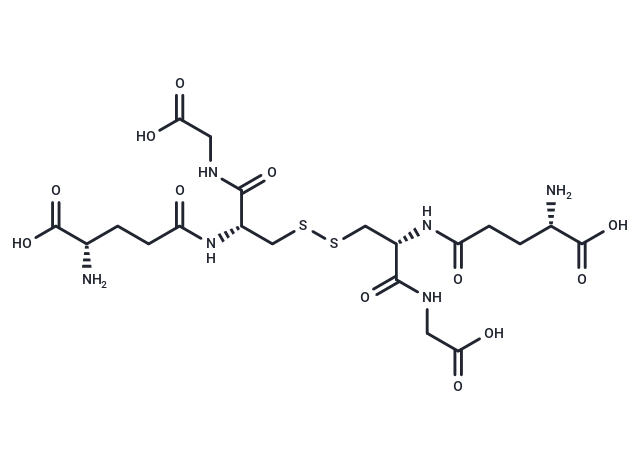
Glutathione oxidized (L(-) -glutathione) is the oxidized form of Glutathione, which is a major antioxidant and antidote in cells. Glutathione oxidized can be used to study sickle cells and red blood cells.

Glutathione oxidized

Glutathione oxidized

Copy Product Info
🥰Excellent
Purity: 99.88%
Catalog No. T1085LAlias Oxidized glutathione, L-Glutathione oxidized, L(-)-Glutathione, GSSG, Glutathione disulfide, Bi(glutathion-S-yl)Cas No. 27025-41-8
Glutathione oxidized (L(-) -glutathione) is the oxidized form of Glutathione, which is a major antioxidant and antidote in cells. Glutathione oxidized can be used to study sickle cells and red blood cells.
Pack SizePriceUSA WarehouseGlobal WarehouseQuantity
500 mg$39In StockIn Stock
1 g$47In StockIn Stock
1 mL x 10 mM (in H2O)$39In StockIn Stock
Add to Cart
Add to Quotation
In Stock Estimated shipping dateUSA Warehouse[1-2 days] Global Warehouse[5-7 days]
All TargetMol products are for research purposes only and cannot be used for human consumption. We do not provide products or services to individuals. Please comply with the intended use and do not use TargetMol products for any other purpose.
Questions
TargetMol
View More

Batch Information

Select Batch
Purity:99.88%
Appearance:Solid
Color:White
Contact us for more batch information

Resource Download

Product Introduction

Glutathione oxidized AI Summary
Glutathione oxidized exhibits a range of inhibitory activities across different biological systems and assays. It shows potent inhibitory activity against glutathione reductase in the presence of NADPH, with a Km value of 114,700.0 nM. The compound also modulates human MRP2-mediated estradiol-17-beta-glucuronide transport with an activity level of 136.0% relative to control in Sf9 cells inverted membrane vesicles and inhibits MRP1 with a Km value of 93,000.0 nM. Additionally, Glutathione oxidized acts as an inhibitor in various bioassays: it inhibits Tau fibril formation and Thioflavin T binding with potencies ranging from 19,952.6 nM to 39,810.7 nM; Bacillus subtilis Sfp phosphopantetheinyl transferase with potencies from 44,668.4 nM to 100,000.0 nM; and fructose-1,6-bisphosphate aldolase from Giardia Lamblia with a potency of 1,990.5 nM. It also inhibits human tyrosyl-DNA phosphodiesterase 1 (TDP1) in cells, with a potency of 23,715.0 nM. In antibacterial applications, Glutathione oxidized shows activity against both metronidazole-resistant and metronidazole-susceptible strains of Helicobacter pylori, with varying Km values indicating higher affinity in the susceptible strains (ranging from 2,300,000 nM to 4,900,000 nM) compared to the resistant ones (ranging from 3,000,000 nM to 5,200,000 nM). However, Glutathione oxidized exhibits no measurable inhibitory activity against wild type recombinant human histone lysine methyltransferase G9a or GLP, with an IC50 value greater than 100,000.0 nM for both enzymes. Lastly, it demonstrated bioactivity in reducing cell viability in Vero E6 cells infected with SARS-CoV-2 (strain BavPat1), with an inhibition index of 1.297, surpassing the activity of the control (arbidol)..
Note: Summary generated by AI. Data source: ChEMBL
Bioactivity
Description
Glutathione oxidized (L(-) -glutathione) is the oxidized form of Glutathione, which is a major antioxidant and antidote in cells. Glutathione oxidized can be used to study sickle cells and red blood cells.
Targets&IC50
[3H]-AMPA:0.8-15.9 μM
In vitro
METHODS: Sickle erythrocytes were treated with Glutathione oxidized (10 μmol/L) for 0, 90, 150, and 210 minutes to detect the difference in GSH concentration between intracellular and extracellular.
RESULTS: Increased efflux of Glutathione oxidized causes glutathione depletion and may impair the antioxidant defense of sickle erythrocytes. [1]
In vivo
METHODS: To study the effect of Glutathione oxidized on brain injury, Glutathione oxidized (100 mM) was injected into wild type mice.
RESULTS: Glutathione oxidized causes significant brain damage in wild type mice. [2]
SynonymsOxidized glutathione, L-Glutathione oxidized, L(-)-Glutathione, GSSG, Glutathione disulfide, Bi(glutathion-S-yl)
Chemical Properties
Molecular Weight612.63
FormulaC20H32N6O12S2
Cas No.27025-41-8
Smiles[C@@H](NC(CC[C@@H](C(O)=O)N)=O)(C(NCC(O)=O)=O)CSSC[C@H](NC(CC[C@@H](C(O)=O)N)=O)C(NCC(O)=O)=O
Relative Density.1.54g/cm3
Storage & Solubility Information
Storagekeep away from moisture | Powder: -20°C for 3 years | In solvent: -80°C for 1 year | Shipping with blue ice/Shipping at ambient temperature.
Solubility Information
DMSO: 1.39 mg/mL (2.27 mM), Sonication is recommended.

H2O: 165 mg/mL (269.33 mM), Sonication is recommended.
Solution Preparation Table
DMSO/H2O
1mg5mg10mg50mg
1 mM1.6323 mL8.1615 mL16.3231 mL81.6153 mL
H2O
1mg5mg10mg50mg
5 mM0.3265 mL1.6323 mL3.2646 mL16.3231 mL
10 mM0.1632 mL0.8162 mL1.6323 mL8.1615 mL
20 mM0.0816 mL0.4081 mL0.8162 mL4.0808 mL
50 mM0.0326 mL0.1632 mL0.3265 mL1.6323 mL
100 mM0.0163 mL0.0816 mL0.1632 mL0.8162 mL

Calculator

  • Molarity Calculator
  • Dilution Calculator
  • Reconstitution Calculator
  • Molecular Weight Calculator

In Vivo Formulation Calculator (Clear solution)

Please enter your animal experiment information in the following box and click Calculate to obtain the stock solution preparation method and in vivo formula preparation method:
TargetMol | Animal experiments For example, if the intended dosage is 10 mg/kg for animals weighing 20 g , with a dosing volume of 100 μL per animal, TargetMol | Animal experiments and a total of 10 animals are to be administered, using a formulation of TargetMol | reagent 10% DMSO+ 40% PEG300+ 5% Tween 80+ 45% Saline/PBS/ddH2O , the resulting working solution concentration would be 2 mg/mL.

Stock Solution Preparation:

Dissolve 2 mg of the compound in 100 μL DMSOTargetMol | reagent to obtain a stock solution at a concentration of 20 mg/mL . If the required concentration exceeds the compound's known solubility, please contact us for technical support before proceeding.

Preparation of the In Vivo Formulation:

1) Add 100 μL of the DMSOTargetMol | reagent stock solution to 400 μL PEG300TargetMol | reagent and mix thoroughly until the solution becomes clear.

2) Add 50 μL Tween 80 and mix well until fully clarified.

3) Add 450 μL Saline,PBS or ddH2OTargetMol | reagent and mix thoroughly until a homogeneous solution is obtained.

This example is provided solely to demonstrate the use of the In Vivo Formulation Calculator and does not constitute a recommended formulation for any specific compound. Please select an appropriate dissolution and formulation strategy based on your experimental model and route of administration.
All co-solvents required for this protocol, includingDMSO, PEG300/PEG400, Tween 80, SBE-β-CD, and Corn oil, are available for purchase on the TargetMol website.
1 Enter information below:
mg/kg
g
μL
2 Enter the in vivo formulation:
% DMSO
%
% Tween 80
% Saline/PBS/ddH2O

Dose Conversion

You can also refer to dose conversion for different animals. More Dose Conversion

Tech Support

Please see Inhibitor Handling Instructions for more frequently ask questions. Topics include: how to prepare stock solutions, how to store products, and cautions on cell-based assays & animal experiments, etc

Keywords

Related Tags: buy Glutathione oxidized | purchase Glutathione oxidized | Glutathione oxidized cost | order Glutathione oxidized | Glutathione oxidized chemical structure | Glutathione oxidized in vivo | Glutathione oxidized in vitro | Glutathione oxidized formula | Glutathione oxidized molecular weight





