


Shopping Cart
Remove All Your shopping cart is currently empty


Synonyms: Tetraethylthiuram disulfide, TETD, NSC 190940
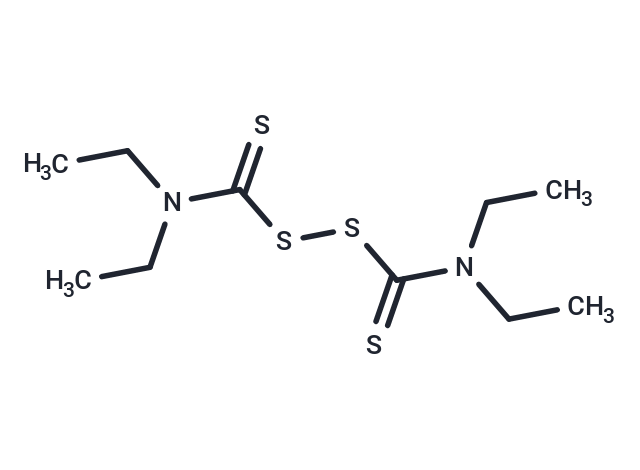
| Pack Size | Price | USA Stock | Global Stock | Quantity |
|---|---|---|---|---|
| 500 mg | $35 | In Stock | In Stock | |
| 1 g | $48 | In Stock | In Stock | |
| 1 mL x 10 mM (in DMSO) | $29 | In Stock | In Stock |
| Description | Disulfiram (TETD) is an inhibitor of the acetaldehyde dehydrogenase ALDH, inhibiting hALDH1 and hALDH2 (IC50=0.15/1.45 μM) with specificity. Disulfiram is acutely sensitized to alcohol and also inhibits GSDMD pore formation. |
| Targets & IC50 | Topo I:42 ± 8 μM, Topo II:30 ± 9 μM, NDM1:1.5 ± 0.6 μM, IMP-7:16.25 ± 1.6 μM |
| In vitro | Disulfiram inhibits the P-glycoprotein efflux pump, suppresses the transcription factor NF-κB (nuclear factor-κB), reduces angiogenesis, and inhibits tumor growth in mice. Its antitumor activity is associated with in vivo protease inhibition. Disulfiram also induces apoptosis. In severe combined immunodeficient mice with melanoma xenografts, it impedes growth and angiogenesis, an effect that is enhanced by zinc supplementation. |
| In vivo | Disulfiram, clinically employed as an anti-alcoholism agent, potently inhibits both constitutive and 5-FU-induced NF-κB activity in a dose-dependent manner. In the DLD-1 and RKO (WT) cell lines, Disulfiram significantly augments the apoptotic effects of 5-FU and synergistically enhances its cytotoxicity. In melanoma cells, co-treatment with copper or zinc ions reduces cyclin A expression compared to Disulfiram alone and inhibits proliferation in vitro. Moreover, Disulfiram decreases viable cell count, with copper chloride addition markedly intensifying DSF-induced cell death. |
| Synonyms | Tetraethylthiuram disulfide, TETD, NSC 190940 |
| Cell Research | The effect of disulfiram (0.15-5.0 μM) or sodium diethyldithiocarbamate (1.0 μM) on proliferation of malignant cell lines is studied in cultures stimulated with 10% FBS. Cell numbers are quantitated 24 to 72 hours later, as outlined below. In some experiments, disulfiram is added immediately after cells are plated. In other experiments, cells are plated and allowed to grow for 24 to 72 hours before fresh medium with disulfiram is added and cell numbers are assayed 24 to 72 hours later. Synergy is studied between disulfiram and?N,N′-bis(2-chloroethyl-N-nitrosourea (carmustine, 1.0-1,000 μM) or cisplatin (0.1-100 μg/mL) added to medium. The effect of metal ions on disulfiram is studied with 0.2 to 10 μM Cu2+?(provided as CuSO4), Zn2+?(as ZnCl2), Ag+?(as silver lactate), or Au3+?(as HAuCl4·3Water) ions added to growth medium, buffered to physiologic pH. To provide a biologically relevant source of copper, medium is supplemented with human ceruloplasmin at doses replicating low and high normal adult serum concentrations (250 and 500 mg/mL). |
| Molecular Weight | 296.54 |
| Formula | C10H20N2S4 |
| Cas No. | 97-77-8 |
| Smiles | CCN(CC)C(=S)SSC(=S)N(CC)CC |
| Relative Density. | 1.27 g/cm3 |
| Storage | Powder: -20°C for 3 years | In solvent: -80°C for 1 year Shipping with blue ice/Shipping at ambient temperature. | |||||||||||||||||||||||||||||||||||
| Solubility Information | DMSO: 250 mg/mL (843.06 mM), Sonication is recommended.  Ethanol: 29.7 mg/mL (100.16 mM), Sonication is recommended. | |||||||||||||||||||||||||||||||||||
| In Vivo Formulation | 20% Cremophor EL+80% Saline: 10 mg/mL (33.72 mM), Solution. 1% CMC-Na: 7.5 mg/mL (25.29 mM), Suspension. 10% DMSO+40% PEG300+5% Tween 80+45% Saline: 2.97 mg/mL (10.02 mM), Solution. Please add the solvents sequentially, clarifying the solution as much as possible before adding the next one. Dissolve by heating and/or sonication if necessary. Working solution is recommended to be prepared and used immediately. The formulation provided above is for reference purposes only. In vivo formulations may vary and should be modified based on specific experimental conditions. | |||||||||||||||||||||||||||||||||||
Solution Preparation Table | ||||||||||||||||||||||||||||||||||||
Ethanol/DMSO
Note : The dilution table applies only to solid products. For liquid products, please calculate the stock solution based on the stated concentration and/or density. | ||||||||||||||||||||||||||||||||||||
 For example, if the intended dosage is 10 mg/kg for animals weighing 20 g , with a dosing volume of 100 μL per animal, and a total of 10 animals are to be administered, using a formulation of
  10% DMSO+ 40% PEG300+ 5% Tween 80+ 45% Saline/PBS/ddH2O , the resulting working solution concentration would be 2 mg/mL.
Dissolve 2 mg of the compound in 100 μL DMSO to obtain a stock solution at a concentration of 20 mg/mL . If the required concentration exceeds the compound's known solubility, please contact us for technical support before proceeding.
1) Add 100 μL of the DMSO stock solution to 400 µL PEG300 and mix thoroughly until the solution becomes clear.
2) Add 50 µL Tween 80 and mix well until fully clarified.
3) Add 450 µL Saline,PBS or ddH2O and mix thoroughly until a homogeneous solution is obtained.
| Size | Quantity | Unit Price | Amount | Operation |
|---|
 Feedback
 Hello! How can I help you today?
Copyright © 2015-2026 TargetMol Chemicals Inc. All Rights Reserved.
