


Shopping Cart
Remove All Your shopping cart is currently empty


Synonyms:
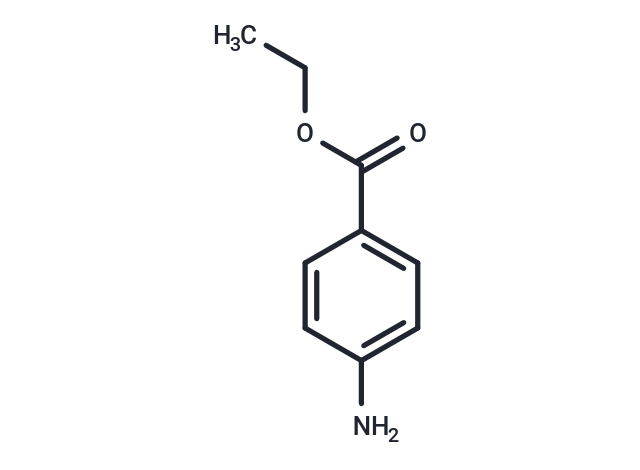
| Pack Size | Price | USA Stock | Global Stock | Quantity |
|---|---|---|---|---|
| 1 g | $35 | In Stock | In Stock | |
| 1 mL x 10 mM (in DMSO) | $29 | In Stock | In Stock |
| Description | Benzocaine is a surface anesthetic that acts by preventing transmission of impulses along nerve fibers and at nerve endings. |
| Targets & IC50 | Na+ channel:0.8 mM (IC50) |
| In vitro | Benzocaine blocks μ1 wild-type Na+ currents in a dose-dependent manner, with an IC50 of 0.8 mM in HEK293T cells. At 1 mM, Benzocaine inhibits approximately 55% of wild-type Na+ current, about 95% of μ1-N1584A mutant current, and about 80% of μ1-I1575A mutant current. [1] Benzocaine produces a biphasic (protective/inductive) concentration-dependent hemolytic effect on rat erythrocytes, with effective Benzocaine:lipid molar ratios in the membrane for protection (RePROT), onset of hemolysis (ReSAT), and 100% membrane solubilization (ReSOL) at 1.0:1, 1.1:1, and 1.3:1, respectively. [2] During repetitive pulses, Benzocaine and 4-hydroxybenzoate interact with the open and inactivated channels, but the complex dissociates too rapidly during interpulse to achieve a significant use-dependent Na+ current block. [3] Benzocaine (500 μM) reduces peak and steady-state currents and increases the amplitude of the inactivating component from 21.7% to 30.2% (n=7, P<0.05), resulting in an average block of 30.9% at the end of pulses to +60 mV (n=7). It also significantly accelerates the initial phase of deactivation (τf=27.2±2.6 ms, n=7, P<0.01) without affecting the slow phase of tail current decline. Benzocaine binds with high affinity to an intracellular site producing 'agonist' effects and a low-affinity subsite in the inner mouth producing blocking effects. Benzocaine and extracellular K(+) interact to alter the voltage-dependence of channel opening. [4] |
| In vivo | Benzocaine is absorbed rapidly and similarly through both viable and nonviable skin of the hairless guinea pig, the absorption of the two acidic compounds, benzoic acid and PABA, is greater through nonviable skin. [5] |
| Molecular Weight | 165.19 |
| Formula | C9H11NO2 |
| Cas No. | 94-09-7 |
| Smiles | CCOC(=O)C1=CC=C(N)C=C1 |
| Relative Density. | 1.17 g/cm3 |
| Storage | Powder: -20°C for 3 years | In solvent: -80°C for 1 year Shipping with blue ice/Shipping at ambient temperature. | |||||||||||||||||||||||||||||||||||
| Solubility Information | DMSO: 250 mg/mL (1513.41 mM), Sonication is recommended.  Ethanol: 250 mg/mL (1513.41 mM), Sonication is recommended. | |||||||||||||||||||||||||||||||||||
| In Vivo Formulation | 10% DMSO+40% PEG300+5% Tween 80+45% Saline: 10 mg/mL (60.54 mM), Solution. 10% DMSO+90% Saline: < 10 mg/mL (60.54 mM), Lower concentrations may be soluble, but exact solubility limit is unknown. Please add the solvents sequentially, clarifying the solution as much as possible before adding the next one. Dissolve by heating and/or sonication if necessary. Working solution is recommended to be prepared and used immediately. The formulation provided above is for reference purposes only. In vivo formulations may vary and should be modified based on specific experimental conditions. | |||||||||||||||||||||||||||||||||||
Solution Preparation Table | ||||||||||||||||||||||||||||||||||||
DMSO/Ethanol
Note : The dilution table applies only to solid products. For liquid products, please calculate the stock solution based on the stated concentration and/or density. | ||||||||||||||||||||||||||||||||||||
 For example, if the intended dosage is 10 mg/kg for animals weighing 20 g , with a dosing volume of 100 μL per animal, and a total of 10 animals are to be administered, using a formulation of
  10% DMSO+ 40% PEG300+ 5% Tween 80+ 45% Saline/PBS/ddH2O , the resulting working solution concentration would be 2 mg/mL.
Dissolve 2 mg of the compound in 100 μL DMSO to obtain a stock solution at a concentration of 20 mg/mL . If the required concentration exceeds the compound's known solubility, please contact us for technical support before proceeding.
1) Add 100 μL of the DMSO stock solution to 400 µL PEG300 and mix thoroughly until the solution becomes clear.
2) Add 50 µL Tween 80 and mix well until fully clarified.
3) Add 450 µL Saline,PBS or ddH2O and mix thoroughly until a homogeneous solution is obtained.
| Size | Quantity | Unit Price | Amount | Operation |
|---|
 Feedback
 Hello! How can I help you today?
Copyright © 2015-2026 TargetMol Chemicals Inc. All Rights Reserved.
