


Shopping Cart
Remove All Your shopping cart is currently empty


Synonyms: CL 318952, BPD-MA

| Pack Size | Price | USA Stock | Global Stock | Quantity |
|---|---|---|---|---|
| 1 mg | $34 | In Stock | In Stock | |
| 2 mg | $47 | In Stock | In Stock | |
| 5 mg | $77 | In Stock | In Stock | |
| 10 mg | $117 | In Stock | In Stock | |
| 25 mg | $237 | In Stock | In Stock | |
| 50 mg | $385 | In Stock | In Stock | |
| 100 mg | $486 | In Stock | In Stock | |
| 1 mL x 10 mM (in DMSO) | $123 | In Stock | In Stock |
| Description | Verteporfin (BPD-MA) is a YAP inhibitor that inhibits YAP-TEAD interactions. Verteporfin is also a photosensitizer used in photodynamic therapy. Verteporfin also induces apoptosis and inhibits autophagy. |
| Targets & IC50 | OMM1 cells:5.89 μM, Mel 270 cells:6.43 μM, Omm 2.3 cells:7.27 μM |
| In vitro | Verteporfin metabolizes into a less active form within the body and is rapidly cleared, primarily excreted via feces and to a lesser extent through urine. Its therapy is effective and selectively prevents fluorescein dye leakage from choroidal neovascularization (CNV) induced in experimental monkeys. Verteporfin quickly accumulates in the choroidal vasculature, retinal pigment epithelium (RPE), and photoreceptors of established rabbit eyes. Upon intravenous injection in mice, peak tissue levels of Verteporfin are reached within 3 hours, followed by a rapid decline within 24 hours. |
| In vivo | Verteporfin forms a complex with LDL, which may be taken up by proliferating cells (e.g., neovascular endothelial cells) through LDL receptors or endocytosis. The therapy with Verteporfin achieves complete vascular occlusion through thrombosis in the vascular channels following selective endothelial damage. As shown by optical and electron microscopy, Verteporfin therapy selectively induces occlusion in regenerating and detached choroidal capillaries, without altering the overlying photoreceptors or ganglion cells. Verteporfin rapidly exhibits apoptotic changes in conjunction with light, as demonstrated by the activation of caspase-3 and caspase-9 and the cleavage of PARP in HL-60 cells, changes that are inhibited by the broad-spectrum caspase inhibitor ZVAD.fmk. |
| Synonyms | CL 318952, BPD-MA |
| Kinase Assay | Cells (5 × 10³) are plated in 96 well plates. Cells are treated the next day for 24 to 48 hours and then assessed for caspase-3 activity by Caspase-Glo-3/7 Assay, as per manufacturer's instructions and a luminescence plate reader. |
| Cell Research | Verteporfin is dissolved in DMSO. PDX cells co-cultured with S17 cells are treated with 16 combinations of verteporfin (60 nM, 120 nM, 180 nM, and 240 nM) and dasatinib (12 nM, 24 nM, 36 nM, and 48 nM). The viabilities of cells treated with each combination are measured after 48 h using FACS Aria flow cytometer. In order to estimate drug interaction between verteporfin and dasatinib, a normalized isobologram and fraction affectedcombination index (CI) plot are made using CompuSyn software. CI values greater than 1.0 indicated antagonistic effects, equal to 1.0 additive effects, and below 1.0 synergistic effects. |
| Molecular Weight | 718.79 |
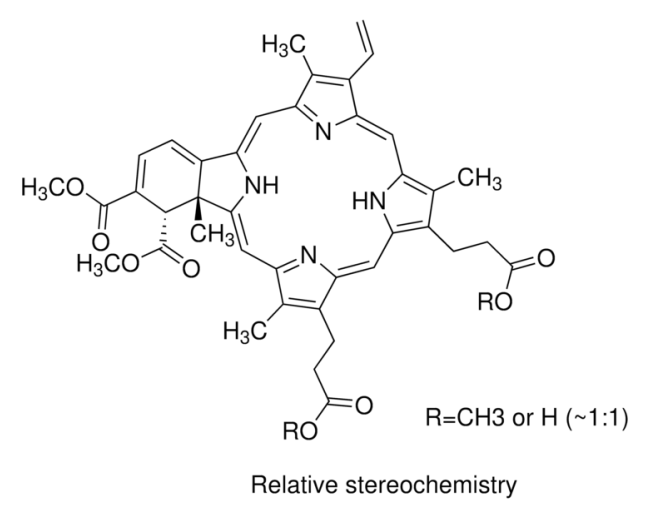
| Formula | C41H42N4O8 |
| Cas No. | 129497-78-5 |
| Smiles | COC(=O)CCc1c(C)c2cc3[nH]c(cc4nc(cc5[nH]c(cc1n2)c(CCC(O)=O)c5C)[C@]1(C)[C@H](C(=O)OC)C(=CC=C41)C(=O)OC)c(C)c3C=C |
| Relative Density. | no data available |
| Storage | Keep away from direct sunlight,Keep away from moisture,Store at low temperature Powder: -20°C for 3 years | In solvent: -80°C for 1 year Shipping with blue ice/Shipping at ambient temperature. | |||||||||||||||||||||||||||||||||||
| Solubility Information | Ethanol: < 1 mg/mL (insoluble or slightly soluble) DMSO: 130 mg/mL (180.86 mM), Sonication is recommended.  H2O: < 1 mg/mL (insoluble or slightly soluble) | |||||||||||||||||||||||||||||||||||
| In Vivo Formulation | 10% DMSO+40% PEG300+5% Tween 80+45% Saline: 5 mg/mL (6.96 mM), Sonication is recommended. Please add the solvents sequentially, clarifying the solution as much as possible before adding the next one. Dissolve by heating and/or sonication if necessary. Working solution is recommended to be prepared and used immediately. The formulation provided above is for reference purposes only. In vivo formulations may vary and should be modified based on specific experimental conditions. | |||||||||||||||||||||||||||||||||||
Solution Preparation Table | ||||||||||||||||||||||||||||||||||||
DMSO
Note : The dilution table applies only to solid products. For liquid products, please calculate the stock solution based on the stated concentration and/or density. | ||||||||||||||||||||||||||||||||||||
 For example, if the intended dosage is 10 mg/kg for animals weighing 20 g , with a dosing volume of 100 μL per animal, and a total of 10 animals are to be administered, using a formulation of
  10% DMSO+ 40% PEG300+ 5% Tween 80+ 45% Saline/PBS/ddH2O , the resulting working solution concentration would be 2 mg/mL.
Dissolve 2 mg of the compound in 100 μL DMSO to obtain a stock solution at a concentration of 20 mg/mL . If the required concentration exceeds the compound's known solubility, please contact us for technical support before proceeding.
1) Add 100 μL of the DMSO stock solution to 400 µL PEG300 and mix thoroughly until the solution becomes clear.
2) Add 50 µL Tween 80 and mix well until fully clarified.
3) Add 450 µL Saline,PBS or ddH2O and mix thoroughly until a homogeneous solution is obtained.
| Size | Quantity | Unit Price | Amount | Operation |
|---|
 Feedback
 Hello! How can I help you today?
Copyright © 2015-2026 TargetMol Chemicals Inc. All Rights Reserved.
