


Shopping Cart
Remove All Your shopping cart is currently empty


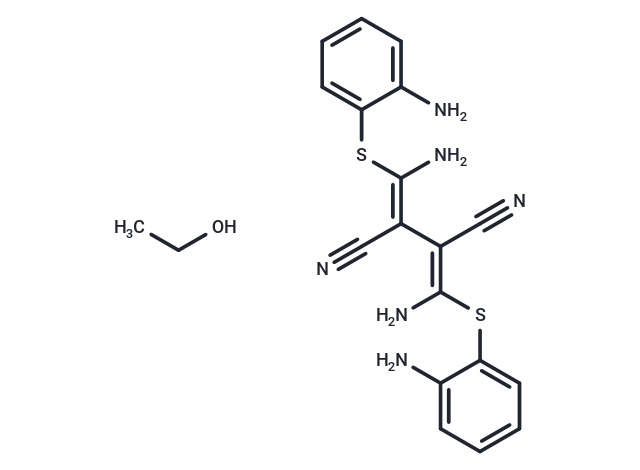
Synonyms: U0126 Ethanol, U0126
| Pack Size | Price | USA Stock | Global Stock | Quantity |
|---|---|---|---|---|
| 5 mg | $30 | In Stock | In Stock | |
| 10 mg | $47 | In Stock | In Stock | |
| 25 mg | $65 | In Stock | In Stock | |
| 50 mg | $78 | In Stock | In Stock | |
| 100 mg | $98 | In Stock | In Stock | |
| 1 mL x 10 mM (in DMSO) | $32 | In Stock | In Stock |
| Description | U0126-etoh (U0126 Ethanol) is a non-ATP competitive inhibitor of MEK1 (IC50=72 nM) and MEK2 (IC50=58 nM) with selectivity. U0126-EtOH inhibited autophagy and mitophagy. |
| Targets & IC50 | MEK2:60 nM (cell free), MDCKII cells (H1N1v):74.7 ± 1.0 μM (EC50), MEK1:70 nM (cell free), A549 cells (H1N1v):1.2 ± 0.4 μM (EC50) |
| In vitro | METHODS: The transcriptional activity of AP-1 in COS-7 cells was detected after treatment with U0126-EtOH. RESULTS: U0126-EtOH inhibits AP-1 transcriptional activity (IC50=1 μM). [1] METHODS: HCT116 cells were treated with U0126-EtOH and colony formation was detected by soft AGAR growth assay. HeLa cells were treated with U0126-EtOH and the ELK1-luciferase reporter gene was detected. RESULTS: U0126-EtOH inhibited adheron-independent colony formation (IC50=19.4 μM), and U0126-EtOH inhibited EGF-stimulated Elk1 luciferase reporter gene (IC50=0.29 μM). [2] METHODS: Mouse RAS-3T3 cells were treated with U0126-EtOH, and the phosphorylation level of ERK1/2 was detected by ELISA. RESULTS: U0126-EtOH at a concentration of 10-40 μM inhibits MEK-mediated phosphorylation of ERK1/2. [3] |
| In vivo | METHODS: To study the anti-tumor activity of U0126-EtOH, U0126-EtOH (10.5 mg/kg) was intraperitoneally injected into mice every day for treatment. RESULTS: U0126-EtOH led to a significant reduction in tumor implantation and early growth. The tumor volume decreased by 60-70% 9 days after injection and remained in this state thereafter. [4] METHODS: To study the effect of U0126-EtOH on vascular constriction, rats received 120 minutes of temporary midcerebral artery occlusion (tMCAO), and then U0126-EtOH (30 mg/kg) was intraperitoneally injected into the rats. RESULTS: After treatment with U0126-EtOH, the vasoconstriction of S6c was significantly reduced. [5] |
| Synonyms | U0126 Ethanol, U0126 |
| Kinase Assay | The amount of immunoprecipitated wild type MEK used in these assays was adjusted to give a similar amount of activity units as obtained with 10 nM recombinant MEK. All other assays were performed with a recombinant, constitutively activated mutant MEK-1 (ΔN3-S218E/S222D) or constitutively active MEK-2(S222E/S226D). Reaction velocities were measured using a 96-well nitrocellulose filter apparatus as described below. Unless otherwise noted, reactions were carried out at an enzyme concentration of 10 nM, in 20 mM Hepes, 10 mM MgCl2, 5 mM β-mercaptoethanol, 0.1 mg/ml BSA, pH 7.4, at room temperature. Reactions were initiated by the addition of [γ-33P]ATP into the premixed MEK/ERK/inhibitor reaction mixture, and an aliquot of 100 μl was taken every 6 min and transferred to the 96-well nitrocellulose membrane plate which had 50 mM EDTA to stop the reaction. The membrane plate was drawn and washed 4 times with buffer under vacuum. Wells were then filled with 30 μl of Microscint-20 scintillation fluid, and the radioactivity of33P-phosphorylated ERK was counted with a Top Count scintillation counter. Velocities were obtained from the slopes of radioactivity versus time plots. Concentrations of ERK and ATP were 400 nM and 40 μM, respectively, unless otherwise indicated [2]. |
| Cell Research | HEK293 cells were maintained in Dulbecco's modification of Eagle's medium (low glucose) plus 10% foetal bovine serum. HeLa cells stably expressing wild type or kinase-dead LKB1 have been described. AMPK activity was determined by immunoprecipitate kinase assays using anti-AMPK-a1 and -a2 antibodies. Antibodies recognising AMPK phosphorylated on Thr-172 (anti-pT172), AMPK-α1 and -α2 and acetyl-CoA carboxylase-1 (ACC1) phosphorylated on Ser-80 [16] were described previously. Quantification of ratios of signals from phosphorylated and total protein using these antibodies was performed by dual labelling using the LI-COR Odyssey IR imager as described. Contents of ATP and ADP were determined for cells in 6 cm culture dishes by quickly pouring off the medium, adding 350 μl of ice-cold 5% perchloric acid, scraping the cells off with a plastic scraper, and centrifuging (14 000 · g; 3 min, 4 °C) to remove insoluble material. The perchloric acid was then extracted from the supernatant and nucleotides analysed by capillary electrophoresis of perchloric acid extracts as described previously. All incubations of cells were performed in triplicate and results are expressed as means ± S.E.M [3]. |
| Animal Research | Prior to injection, FI cells were labeled with a stable fluorescent dye molecule, DiA at 10 μg/ml for 5 h at 37 1C. After washing to remove free DiA, cells were trypsinized for inoculation (U0126 experiments) or transfection (RNAi experiments). Biliary epithelial cells were injected subcutaneously, at the indicated times, into the tibia of nude mice. In the chemical experiments, 3h after inoculation, mice were treated with U0126 (10.5 mg/kg) daily by intraperitoneal injection. The length and width of each tumor were measured every day by using a caliper. The following formula was used to calculate tumor volumes ? width2 length/2. Mice were killed at the end of experiment. Tumors were immediately frozen in liquid nitrogen [5]. |
| Molecular Weight | 426.6 |
| Formula | C18H16N6S2·C2H6O |
| Cas No. | 1173097-76-1 |
| Smiles | CCO.N\C(Sc1ccccc1N)=C(\C#N)/C(/C#N)=C(\N)Sc1ccccc1N |
| Relative Density. | no data available |
| Storage | Powder: -20°C for 3 years | In solvent: -80°C for 1 year Shipping with blue ice/Shipping at ambient temperature. | |||||||||||||||||||||||||||||||||||
| Solubility Information | Ethanol: < 1 mg/mL (insoluble or slightly soluble)  DMSO: 255 mg/mL (597.75 mM), Sonication is recommended. | |||||||||||||||||||||||||||||||||||
| In Vivo Formulation | 10% DMSO+40% PEG300+5% Tween 80+45% Saline: 7.9 mg/mL (18.52 mM), Solution. Please add the solvents sequentially, clarifying the solution as much as possible before adding the next one. Dissolve by heating and/or sonication if necessary. Working solution is recommended to be prepared and used immediately. The formulation provided above is for reference purposes only. In vivo formulations may vary and should be modified based on specific experimental conditions. | |||||||||||||||||||||||||||||||||||
Solution Preparation Table | ||||||||||||||||||||||||||||||||||||
DMSO
Note : The dilution table applies only to solid products. For liquid products, please calculate the stock solution based on the stated concentration and/or density. | ||||||||||||||||||||||||||||||||||||
 For example, if the intended dosage is 10 mg/kg for animals weighing 20 g , with a dosing volume of 100 μL per animal, and a total of 10 animals are to be administered, using a formulation of
  10% DMSO+ 40% PEG300+ 5% Tween 80+ 45% Saline/PBS/ddH2O , the resulting working solution concentration would be 2 mg/mL.
Dissolve 2 mg of the compound in 100 μL DMSO to obtain a stock solution at a concentration of 20 mg/mL . If the required concentration exceeds the compound's known solubility, please contact us for technical support before proceeding.
1) Add 100 μL of the DMSO stock solution to 400 µL PEG300 and mix thoroughly until the solution becomes clear.
2) Add 50 µL Tween 80 and mix well until fully clarified.
3) Add 450 µL Saline,PBS or ddH2O and mix thoroughly until a homogeneous solution is obtained.
| Size | Quantity | Unit Price | Amount | Operation |
|---|
 Feedback
 Hello! How can I help you today?
Copyright © 2015-2026 TargetMol Chemicals Inc. All Rights Reserved.
