


Shopping Cart
Remove All Your shopping cart is currently empty


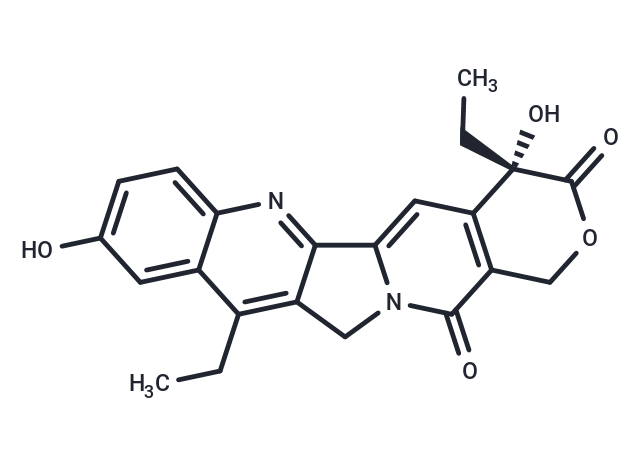
Synonyms: SN 38, NK012
| Pack Size | Price | USA Stock | Global Stock | Quantity |
|---|---|---|---|---|
| 25 mg | $39 | In Stock | In Stock | |
| 50 mg | $55 | In Stock | In Stock | |
| 100 mg | $77 | In Stock | In Stock | |
| 500 mg | $150 | In Stock | In Stock |
| Description | SN-38 (NK012) is the active metabolite of Irinotecan, a DNA topoisomerase I (Topo I) inhibitor, which inhibits DNA and RNA synthesis (IC50=0.077/1.3 μM). SN-38 has antitumor activity and induces autophagy. |
| Targets & IC50 | CLM22 organoids:10.67 nM, DNA synthesis:0.077 μM, CWH22 organoids:7.54 nM, A549 cells proliferation:200.0 ± 14.9 ng/mL, RNA synthesis:1.3 μM, MCF-7 cells proliferation:16.0 ± 0.7 ng/mL |
| In vitro | METHODS: Lung cancer cells LLC, A549 and H358 were treated with SN-38 (10-1000 nM) for 48 h. Cell viability was detected using MTT assay. RESULTS: SN-38 started to exhibit effects at 10 nM concentration and induced about 50% cell death at 100 nM. [1] METHODS: Colorectal cancer cells KM12C, KM12SM and KM12L4a were treated with SN-38 (2.5 µg/mL) for 4-48 h. Cell cycle and apoptosis were detected by Flow cytometry. RESULTS: SN-38 induced S-phase and G2-phase block, with KM12L4a cells responding most strongly in a time-dependent manner. apoptosis increased over time in the KM12SM and KM12L4a cell lines, but there was no such change in the KM12C cells. [2] |
| In vivo | METHODS: To test the antitumor activity in vivo, SN-38 (2 mg/kg) was administered by single intraperitoneal injection to C57BL/6 mice transplanted with LLC cells in the peritoneal cavity. RESULTS: A single intraperitoneal injection of SN-38 significantly attenuated the growth of LLC tumors, resulting in a 22.7% reduction in tumor growth. [1] METHODS: To test the antitumor activity in vivo, SN-38 (10 mg/kg in 0.5% carboxymethylcellulose sodium, intraperitoneal injection) and gefitinib (100 mg/kg, subcutaneous injection) were administered to BALB/c nude mice bearing human oral squamous tumors HSC-2 five times per week for three weeks. RESULTS: Only gefitinib was administered to mice with human oral squamous tumors. RESULTS: There was no significant difference in tumor growth inhibition between gefitinib only and gefitinib plus SN-38 treatment. However, some tumors in the gefitinib-only group showed new growth when tumor measurements were continued after treatment was stopped. [3] |
| Synonyms | SN 38, NK012 |
| Kinase Assay | Topoisomerase I Assay: One unit (the minimum amount for full relaxation of 0.5 μg SV40 DNA under the conditions of this study) of topoisomerase I, 0.5 μL of the test compounds, and 0.5μg SV40 DNA are added sequentially to the reaction buffer, which is composed of 25 mM Tris-HCl (pH 7.5), 50 mM KC1, 5 mM MgCl2, 0.25 mM EDTA disodium salt, 0.25 mM dithiothreitol, 15μg /mL bovine serum albumin, and 5% glycerol. Then, the reaction mixture (50 μL) is incubated for 10 min at 37 °C, and the reaction is terminated by treatment with 7.5 μL of a solution consisting of 1% sodium dodecyl sulfate, 20 mM EDTA disodium salt, and 0.5 mg/mL proteinase K for an additional 30 min at 37°C. The samples are mixed with 5 μL of the loading buffer containing 10 mM Na2HPO4, 31.3% sucrose, and 0.3% bromophenol blue. Relaxed (form Ir) DNA is separated from supercoiled (form I) and nicked (form II) DNA by electrophoresis on 0.8% agarose gel at 50 mA and 20 V for 17 h in the presence of 2 μg/mL chloroquine, 10 mM EDTA, 30 mM NaH2PO4, and 36 Mm Tris-HCl (pH 7.8). After electrophoresis, the gel is stained with 0.05% ethidium bromide and photographed with UV light (302 nm). The amount of DNA is quantified using a densitometer. |
| Cell Research | MTT assay(Only for Reference) |
| Molecular Weight | 392.40 |
| Formula | C22H20N2O5 |
| Cas No. | 86639-52-3 |
| Smiles | C(C)C1=C2C(C=3N(C2)C(=O)C4=C(C3)[C@](CC)(O)C(=O)OC4)=NC=5C1=CC(O)=CC5 |
| Relative Density. | 1.51 g/cm3 |
| Storage | Store at low temperature Powder: -20°C for 3 years | In solvent: -80°C for 1 year Shipping with blue ice/Shipping at ambient temperature. | |||||||||||||||||||||||||||||||||||
| Solubility Information | Ethanol: < 1 mg/mL (insoluble)  DMSO: 50.00 mg/mL (127.42 mM), Sonication is recommended. | |||||||||||||||||||||||||||||||||||
| In Vivo Formulation | 10% DMSO+40% PEG300+5% Tween 80+45% Saline: 3.93 mg/mL (10.02 mM), Suspension. Please add the solvents sequentially, clarifying the solution as much as possible before adding the next one. Dissolve by heating and/or sonication if necessary. Working solution is recommended to be prepared and used immediately. The formulation provided above is for reference purposes only. In vivo formulations may vary and should be modified based on specific experimental conditions. | |||||||||||||||||||||||||||||||||||
Solution Preparation Table | ||||||||||||||||||||||||||||||||||||
DMSO
Note : The dilution table applies only to solid products. For liquid products, please calculate the stock solution based on the stated concentration and/or density. | ||||||||||||||||||||||||||||||||||||
 For example, if the intended dosage is 10 mg/kg for animals weighing 20 g , with a dosing volume of 100 μL per animal, and a total of 10 animals are to be administered, using a formulation of
  10% DMSO+ 40% PEG300+ 5% Tween 80+ 45% Saline/PBS/ddH2O , the resulting working solution concentration would be 2 mg/mL.
Dissolve 2 mg of the compound in 100 μL DMSO to obtain a stock solution at a concentration of 20 mg/mL . If the required concentration exceeds the compound's known solubility, please contact us for technical support before proceeding.
1) Add 100 μL of the DMSO stock solution to 400 µL PEG300 and mix thoroughly until the solution becomes clear.
2) Add 50 µL Tween 80 and mix well until fully clarified.
3) Add 450 µL Saline,PBS or ddH2O and mix thoroughly until a homogeneous solution is obtained.
| Size | Quantity | Unit Price | Amount | Operation |
|---|
 Feedback
 Hello! How can I help you today?
Copyright © 2015-2026 TargetMol Chemicals Inc. All Rights Reserved.
