


Shopping Cart
Remove All Your shopping cart is currently empty

Synonyms: PNU155950E mesylate, PNU 155950E, FCE20124 mesylate, Edronax
| Pack Size | Price | USA Stock | Global Stock | Quantity |
|---|---|---|---|---|
| 5 mg | $35 | In Stock | In Stock | |
| 10 mg | $65 | In Stock | In Stock | |
| 25 mg | $159 | In Stock | In Stock | |
| 50 mg | $306 | In Stock | In Stock | |
| 100 mg | $487 | In Stock | - | |
| 500 mg | $1,060 | Inquiry | Inquiry | |
| 1 mL x 10 mM (in DMSO) | $40 | In Stock | In Stock |
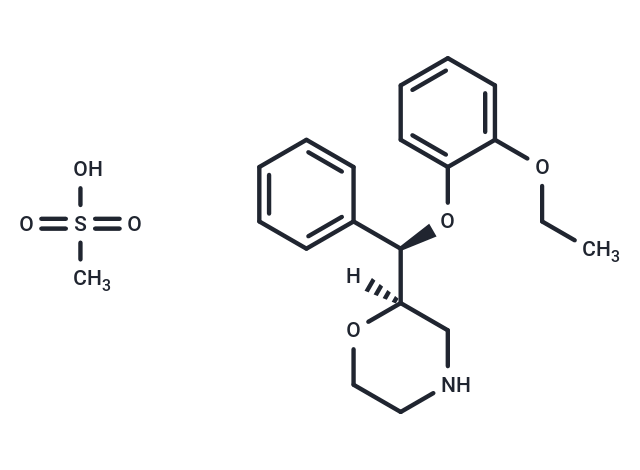
| Description | Reboxetine mesylate (FCE20124 mesylate) is a norepinephrine reuptake inhibitor with a Ki of 8.2 nM. |
| Targets & IC50 | Norepinephrine reuptake:8.2 nM(Ki) |
| In vitro | Reboxetine dose-dependently and completely inhibits [3H]-dopamine uptake to the human norepinephrine transporters (hNET) with Ki value of 11 nM in Madin–Darby canine kidney (MDCK) cells. [1] |
| In vivo | Reboxetine dose-dependently and potently inhibits locus coeruleus neuronal firing in rats with ED50 of 191 μg/kg. Reboxetine inhibition of the locus coeruleus neurons is reversible by the α2 antagonist piperoxan (1.5 mg/kg, IV). Reboxetine dose-dependently reverses reserpine-induced blepharospasm and hypothermia in the mouse. Reboxetine is also found to antagonize clonidine-induced hypothermia dose-dependently in mice. Reboxetine reverses reserpine-induced blepharospasm and hypothermia in rats with ED50 of 10 mg/kg and 3 mg/kg (p.o.), respectively. [1] Reboxetine results in a significant reduction in the mean number of panic attacks and phobic symptoms in patients with DSM-III-R panic disorder. Reboxetine also results in improvement in Hamilton Rating Scale for Depression, Hopkins Symptom Checklist-90, and Sheehan Disability Scale scores. [2] Reboxetine is associated with a markedly lower relapse rate than placebo (22% vs. 56%) and a greater cumulative probability of a maintained response during long-term treatment in patients with recurrent DSM-III-R major depression. Reboxetine effectively prevents recurrence of depressive symptoms following episode resolution. [3] Acute systemic administration of Reboxetine (0.3 mg/kg-20 mg/kg) dose-dependently increases extracellular norepinephrine in the rat frontal cortex while having no effect on extracellular serotonin. Reboxetine (20 mg/kg) also increases extracellular dopamine in the rat frontal cortex. Chronic administration of Reboxetine for 14 days results in elevated basal concentrations of extracellular norepinephrine and dopamine and a greater net increase of extracellular norepinephrine and dopamine, but not serotonin in the rat frontal cortex. [4] Reboxetine dose dependently decreases nicotine self-administration by ~60%. Repeated administration of Reboxetine (5.6 mg/kg) decreases nicotine self-administration and sucrose-maintained responding across the 14 sessions. [5] |
| Synonyms | PNU155950E mesylate, PNU 155950E, FCE20124 mesylate, Edronax |
| Molecular Weight | 409.5 |
| Formula | C19H23NO3·CH4O3S |
| Cas No. | 98769-84-7 |
| Smiles | CS(O)(=O)=O.[H][C@@]1(CNCCO1)[C@H](Oc1ccccc1OCC)c1ccccc1 |
| Relative Density. | no data available |
| Storage | Powder: -20°C for 3 years | In solvent: -80°C for 1 year Shipping with blue ice/Shipping at ambient temperature. | ||||||||||||||||||||||||||||||||||||||||
| Solubility Information | H2O: 20.5 mg/mL (50.06 mM), Sonication is recommended. DMSO: 250 mg/mL (610.5 mM), Sonication is recommended.  | ||||||||||||||||||||||||||||||||||||||||
| In Vivo Formulation | 10% DMSO+90% Saline: 10 mg/mL (24.42 mM), Solution. 10% DMSO+40% PEG300+5% Tween 80+45% Saline: 5 mg/mL (12.21 mM), Sonication is recommended. Please add the solvents sequentially, clarifying the solution as much as possible before adding the next one. Dissolve by heating and/or sonication if necessary. Working solution is recommended to be prepared and used immediately. The formulation provided above is for reference purposes only. In vivo formulations may vary and should be modified based on specific experimental conditions. | ||||||||||||||||||||||||||||||||||||||||
Solution Preparation Table | |||||||||||||||||||||||||||||||||||||||||
H2O/DMSO
DMSO
Note : The dilution table applies only to solid products. For liquid products, please calculate the stock solution based on the stated concentration and/or density. | |||||||||||||||||||||||||||||||||||||||||
 For example, if the intended dosage is 10 mg/kg for animals weighing 20 g , with a dosing volume of 100 μL per animal, and a total of 10 animals are to be administered, using a formulation of
  10% DMSO+ 40% PEG300+ 5% Tween 80+ 45% Saline/PBS/ddH2O , the resulting working solution concentration would be 2 mg/mL.
Dissolve 2 mg of the compound in 100 μL DMSO to obtain a stock solution at a concentration of 20 mg/mL . If the required concentration exceeds the compound's known solubility, please contact us for technical support before proceeding.
1) Add 100 μL of the DMSO stock solution to 400 µL PEG300 and mix thoroughly until the solution becomes clear.
2) Add 50 µL Tween 80 and mix well until fully clarified.
3) Add 450 µL Saline,PBS or ddH2O and mix thoroughly until a homogeneous solution is obtained.
| Size | Quantity | Unit Price | Amount | Operation |
|---|
 Feedback
 Hello! How can I help you today?
Copyright © 2015-2026 TargetMol Chemicals Inc. All Rights Reserved.
