


Shopping Cart
Remove All
  • TargetMol
    Your shopping cart is currently empty

Procainamide hydrochloride

Copy Product Info
🥰Excellent
Catalog No. T0018Cas No. 614-39-1
Alias Pronestyl, Procapan, Procanbid, Procainamide HCl
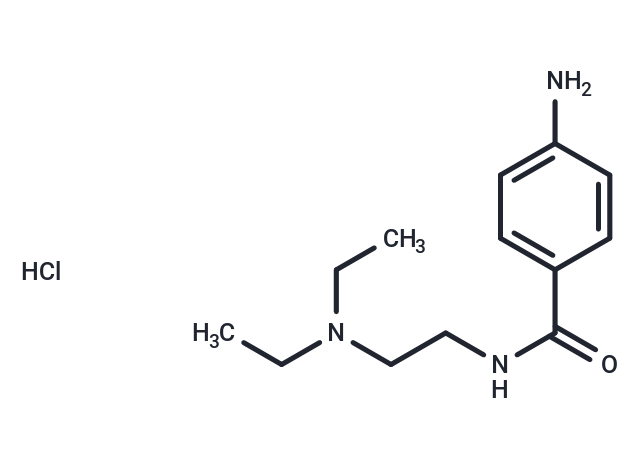
Procainamide Hydrochloride (Procapan) is the hydrochloride salt form of procainamide, an amide derivative exhibiting class 1A antiarrhythmic property and analog of procaine. Procainamide hydrochloride reversibly binds to and blocks activated (open) voltage-gated sodium channels, thereby blocks the influx of sodium ions into the cell, which leads to an increase in threshold for excitation and inhibit depolarization during phase 0 of the action potential.

Procainamide hydrochloride

Procainamide hydrochloride

Copy Product Info
🥰Excellent
Purity: 99.97%
Catalog No. T0018Alias Pronestyl, Procapan, Procanbid, Procainamide HClCas No. 614-39-1
Procainamide Hydrochloride (Procapan) is the hydrochloride salt form of procainamide, an amide derivative exhibiting class 1A antiarrhythmic property and analog of procaine. Procainamide hydrochloride reversibly binds to and blocks activated (open) voltage-gated sodium channels, thereby blocks the influx of sodium ions into the cell, which leads to an increase in threshold for excitation and inhibit depolarization during phase 0 of the action potential.
Pack SizePriceUSA WarehouseGlobal WarehouseQuantity
25 mg$31In StockIn Stock
50 mg$41In StockIn Stock
100 mg$59In StockIn Stock
500 mg$138In StockIn Stock
1 g$198In StockIn Stock
1 mL x 10 mM (in DMSO)$50In StockIn Stock
Add to Cart
Add to Quotation
In Stock Estimated shipping dateUSA Warehouse[1-2 days] Global Warehouse[5-7 days]
All TargetMol products are for research purposes only and cannot be used for human consumption. We do not provide products or services to individuals. Please comply with the intended use and do not use TargetMol products for any other purpose.
Questions
TargetMol
View More

Batch Information

Select Batch
Purity:99.97%
Appearance:Solid
Color:White
Contact us for more batch information

Resource Download

Product Introduction

Procainamide hydrochloride AI Summary
Procainamide hydrochloride exhibits diverse bioactivities across multiple biological systems. In in vitro electrophysiological studies on canine cardiac tissues, it impacts action potential duration (APD95), with a decrease of up to -8.0% at 10 µM, and shows minimal changes in Vmax and conduction time (CT) at 0.1-100 µM concentrations. It increases the functional refractory period (FRP) by 2.0% to 27.0% at 10 µM. Additionally, it demonstrates antiarrhythmic activity in ouabain intoxicated dog models at 29.0 mg/kg and reduces normal beats in dogs following i.v. infusion. Moreover, in molecular assays, it shows potent modulation of Lamin A splicing (4.0 nM) and inhibition of various targets, including Bloom's syndrome helicase (50.1 nM) and Marburg Virus (177.8 nM). In antiviral studies, it affects SARS-CoV-2 induced cytotoxicity and the 3CL-Pro protease, though with varying degrees of inhibition. Its antifungal and antibacterial activities extend across multiple pathogens, including Candida albicans and Pseudomonas aeruginosa. Procainamide hydrochloride's diverse profile suggests potential therapeutic applications, though variability in specific activity levels indicates the need for targeted research..
Note: Summary generated by AI. Data source: ChEMBL
Bioactivity
Description
Procainamide Hydrochloride (Procapan) is the hydrochloride salt form of procainamide, an amide derivative exhibiting class 1A antiarrhythmic property and analog of procaine. Procainamide hydrochloride reversibly binds to and blocks activated (open) voltage-gated sodium channels, thereby blocks the influx of sodium ions into the cell, which leads to an increase in threshold for excitation and inhibit depolarization during phase 0 of the action potential.
SynonymsPronestyl, Procapan, Procanbid, Procainamide HCl
Chemical Properties
Molecular Weight271.79
FormulaC13H21N3O·HCl
Cas No.614-39-1
SmilesCl.CCN(CC)CCNC(=O)C1=CC=C(N)C=C1
Relative Density.1.2027 g/cm3 (Estimated)
Storage & Solubility Information
StoragePowder: -20°C for 3 years | In solvent: -80°C for 1 year | Shipping with blue ice/Shipping at ambient temperature.
Solubility Information
DMSO: 45 mg/mL (165.57 mM), Sonication is recommended.

H2O: 183.97 mM, Sonication is recommended.
In Vivo Formulation
10% DMSO+40% PEG300+5% Tween 80+45% Saline: 2.5 mg/mL (9.2 mM), Sonication is recommended.
Please add the solvents sequentially, clarifying the solution as much as possible before adding the next one. Dissolve by heating and/or sonication if necessary. Working solution is recommended to be prepared and used immediately. The formulation provided above is for reference purposes only. In vivo formulations may vary and should be modified based on specific experimental conditions.
Solution Preparation Table
DMSO/H2O
1mg5mg10mg50mg
1 mM3.6793 mL18.3966 mL36.7931 mL183.9656 mL
5 mM0.7359 mL3.6793 mL7.3586 mL36.7931 mL
10 mM0.3679 mL1.8397 mL3.6793 mL18.3966 mL
20 mM0.1840 mL0.9198 mL1.8397 mL9.1983 mL
50 mM0.0736 mL0.3679 mL0.7359 mL3.6793 mL
100 mM0.0368 mL0.1840 mL0.3679 mL1.8397 mL

Calculator

  • Molarity Calculator
  • Dilution Calculator
  • Reconstitution Calculator
  • Molecular Weight Calculator

In Vivo Formulation Calculator (Clear solution)

Please enter your animal experiment information in the following box and click Calculate to obtain the stock solution preparation method and in vivo formula preparation method:
TargetMol | Animal experiments For example, if the intended dosage is 10 mg/kg for animals weighing 20 g , with a dosing volume of 100 μL per animal, TargetMol | Animal experiments and a total of 10 animals are to be administered, using a formulation of TargetMol | reagent 10% DMSO+ 40% PEG300+ 5% Tween 80+ 45% Saline/PBS/ddH2O , the resulting working solution concentration would be 2 mg/mL.

Stock Solution Preparation:

Dissolve 2 mg of the compound in 100 μL DMSOTargetMol | reagent to obtain a stock solution at a concentration of 20 mg/mL . If the required concentration exceeds the compound's known solubility, please contact us for technical support before proceeding.

Preparation of the In Vivo Formulation:

1) Add 100 μL of the DMSOTargetMol | reagent stock solution to 400 μL PEG300TargetMol | reagent and mix thoroughly until the solution becomes clear.

2) Add 50 μL Tween 80 and mix well until fully clarified.

3) Add 450 μL Saline,PBS or ddH2OTargetMol | reagent and mix thoroughly until a homogeneous solution is obtained.

This example is provided solely to demonstrate the use of the In Vivo Formulation Calculator and does not constitute a recommended formulation for any specific compound. Please select an appropriate dissolution and formulation strategy based on your experimental model and route of administration.
All co-solvents required for this protocol, includingDMSO, PEG300/PEG400, Tween 80, SBE-β-CD, and Corn oil, are available for purchase on the TargetMol website.
1 Enter information below:
mg/kg
g
μL
2 Enter the in vivo formulation:
% DMSO
%
% Tween 80
% Saline/PBS/ddH2O

Dose Conversion

You can also refer to dose conversion for different animals. More Dose Conversion

Tech Support

Please see Inhibitor Handling Instructions for more frequently ask questions. Topics include: how to prepare stock solutions, how to store products, and cautions on cell-based assays & animal experiments, etc

Keywords

Related Tags: buy Procainamide hydrochloride | purchase Procainamide hydrochloride | Procainamide hydrochloride cost | order Procainamide hydrochloride | Procainamide hydrochloride chemical structure | Procainamide hydrochloride formula | Procainamide hydrochloride molecular weight





