


Shopping Cart
Remove All Your shopping cart is currently empty


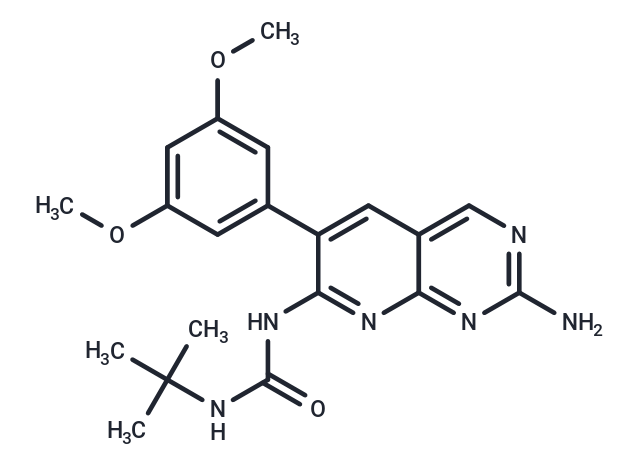
Synonyms: PD166866

| Pack Size | Price | USA Stock | Global Stock | Quantity |
|---|---|---|---|---|
| 2 mg | $34 | In Stock | In Stock | |
| 5 mg | $55 | In Stock | In Stock | |
| 10 mg | $87 | In Stock | In Stock | |
| 25 mg | $162 | In Stock | In Stock | |
| 50 mg | $321 | In Stock | In Stock | |
| 100 mg | $477 | In Stock | In Stock | |
| 1 mL x 10 mM (in DMSO) | $56 | In Stock | In Stock |
| Description | PD-166866 is a selective FGFR tyrosine kinase inhibitor. |
| Targets & IC50 | FGFR1:52.4 nM |
| In vitro | The treatment with PD166866 apparently causes a mitochondrial deficit and an oxidative stress[1]. PD 166866 inhibits human full-length FGFR-1 tyrosine kinase with an IC50 value of 52.4 ± 0.1 nM but has no effect on c-Src, platelet-derived growth factor receptor-β, epidermal growth factor receptor or insulin receptor tyrosine kinases or on mitogen-activated protein kinase, protein kinase C and CDK4 at concentrations as high as 50 μM. PD 166866 is a potent inhibitor of basic fibroblast growth factor (bFGF)-mediated receptor autophosphorylation in NIH 3T3 cells expressing endogenous FGFR-1 and in L6 cells overexpressing the human FGFR-1 tyrosine kinase, confirming a tyrosine kinase-mediated mechanism. PD 166866 does not inhibit platelet-derived growth factor, epidermal growth factor or insulin-stimulated receptor autophosphorylation in vascular smooth muscle, A431 or NIHIR cells, respectively, further supporting its specificity for the FGFR-1. Besides, PD 166866 is found to be a potent inhibitor of microvessel outgrowth (angiogenesis) from cultured artery fragments of human placenta. Phosphorylated 44- and 42-kDa MAPK isoforms are inhibited in L6 cells by PD 166866 with IC50 values of 4.3 and 7.9 nM, respectively[2]. PD166866 induces autophagy through repressing Akt/mTOR signaling pathway[3]. |
| Synonyms | PD166866 |
| Cell Research | HeLa cells are treated with PD166866 for 24 hours, the growth medium is removed, the cells are washed with PBS and fixed for 1 hour at 25°C adding a freshly made paraformaldheyde solution (4% in PBS). Samples are washed again with PBS and the endogenous oxidases were blocked for 2 minutes in the dark. Further washes with PBS followed and blocking the unspecific sites is done for 1 hour at 25℃. PARP is evidenced by immunolocalization utilizing a polyclonal antibody, directed against the N-terminal proteolytic fragment. Immuno-reaction is revealed by a secondary anti-rabbit antibody after incubation for 16 hours at 4°C. After exhaustive washing with PBS the samples are incubated for 30 minutes in solution ABC. Eventually, DAB (3,3'-Diaminobenzidine) is added and the samples are incubated for 10 minutes in the dark. The samples are washed again the plates are sealed and ready for microscopic observation.(Only for Reference) |
| Molecular Weight | 396.44 |
| Formula | C20H24N6O3 |
| Cas No. | 192705-79-6 |
| Smiles | COc1cc(OC)cc(c1)-c1cc2cnc(N)nc2nc1NC(=O)NC(C)(C)C |
| Relative Density. | 1.277g/cm3 |
| Storage | Powder: -20°C for 3 years | In solvent: -80°C for 1 year Shipping with blue ice/Shipping at ambient temperature. | ||||||||||||||||||||||||||||||
| Solubility Information | DMSO: 12 mg/mL (30.27 mM), Sonication is recommended.  H2O: < 1 mg/mL (insoluble or slightly soluble) Ethanol: 3 mg/mL (7.57 mM), Sonication is recommended. | ||||||||||||||||||||||||||||||
Solution Preparation Table | |||||||||||||||||||||||||||||||
Ethanol/DMSO
DMSO
Note : The dilution table applies only to solid products. For liquid products, please calculate the stock solution based on the stated concentration and/or density. | |||||||||||||||||||||||||||||||
 For example, if the intended dosage is 10 mg/kg for animals weighing 20 g , with a dosing volume of 100 μL per animal, and a total of 10 animals are to be administered, using a formulation of
  10% DMSO+ 40% PEG300+ 5% Tween 80+ 45% Saline/PBS/ddH2O , the resulting working solution concentration would be 2 mg/mL.
Dissolve 2 mg of the compound in 100 μL DMSO to obtain a stock solution at a concentration of 20 mg/mL . If the required concentration exceeds the compound's known solubility, please contact us for technical support before proceeding.
1) Add 100 μL of the DMSO stock solution to 400 µL PEG300 and mix thoroughly until the solution becomes clear.
2) Add 50 µL Tween 80 and mix well until fully clarified.
3) Add 450 µL Saline,PBS or ddH2O and mix thoroughly until a homogeneous solution is obtained.
| Size | Quantity | Unit Price | Amount | Operation |
|---|
 Feedback
 Hello! How can I help you today?
Copyright © 2015-2026 TargetMol Chemicals Inc. All Rights Reserved.
