


Shopping Cart
Remove All
  • TargetMol
    Your shopping cart is currently empty

Oxidopamine hydrobromide (Alias: 6-OHDA hydrobromide, 6-Hydroxydopamine hydrobromide)

Catalog No. T12352L Copy Product Info
Purity: 99.88%
🥰Excellent
Oxidopamine hydrobromide (6-OHDA hydrobromide) is a widely used neurotoxin and an antagonist of the neurotransmitter dopamine. It selectively destroys dopaminergic neurons, promotes COX-2 activation, induces PGE2 synthesis, and stimulates the secretion of the pro-inflammatory cytokine IL-1β. It is commonly used to establish animal models of Parkinson’s disease (PD).

Oxidopamine hydrobromide

Copy Product Info
🥰Excellent
Catalog No. T12352L
Alias 6-OHDA hydrobromide, 6-Hydroxydopamine hydrobromide
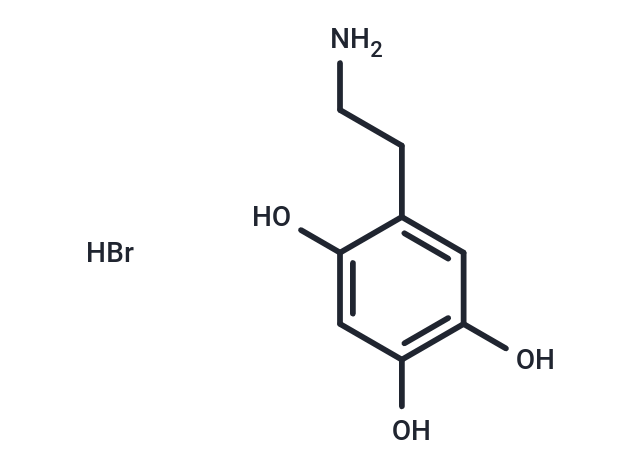
Oxidopamine hydrobromide (6-OHDA hydrobromide) is a widely used neurotoxin and an antagonist of the neurotransmitter dopamine. It selectively destroys dopaminergic neurons, promotes COX-2 activation, induces PGE2 synthesis, and stimulates the secretion of the pro-inflammatory cytokine IL-1β. It is commonly used to establish animal models of Parkinson’s disease (PD).

Oxidopamine hydrobromide
Cas No. 636-00-0
Pack SizePriceUSA StockGlobal StockQuantity
50 mg$30In Stock-
100 mg$48In Stock-
500 mg$159InquiryInquiry
In stock · Estimated delivery: USA Stock (1-2 days) Global Stock (5-7 days)
Add to Cart
Add to Quotation
For research use only—not for human use. No sales to individuals. Use as intended only.
Questions
TargetMol
View More

Batch Information

Select Batch
Purity:99.88%
Color:Yellow to Black
Contact us for more batch information

Resource Download

Product Introduction

Oxidopamine hydrobromide AI Summary
Oxidopamine hydrobromide shows significant bioactivities in a variety of assays targeting multiple molecular entities. It acts as an inhibitor of enzymes including Glucose-6-phosphate dehydrogenase, Polymerases (Iota, Eta, and Kappa), Thioredoxin Reductase 1, human tyrosyl-DNA phosphodiesterase 1, WRN Helicase, Pin1, and PLK1-PDB. It also exhibits inhibitory effects on regulatory proteins such as USP1/UAF1 and RGS 4. Furthermore, Oxidopamine hydrobromide targets viral entities, demonstrating activity against both Hepatitis C Virus and Marburg Virus. Additionally, it shows selectivity by inhibiting specific cellular activities such as induced DNA re-replication and DNA integration processes..
Note: Summary generated by AI. Data source: ChEMBL
Bioactivity
Description
Oxidopamine hydrobromide (6-OHDA hydrobromide) is a widely used neurotoxin and an antagonist of the neurotransmitter dopamine. It selectively destroys dopaminergic neurons, promotes COX-2 activation, induces PGE2 synthesis, and stimulates the secretion of the pro-inflammatory cytokine IL-1β. It is commonly used to establish animal models of Parkinson’s disease (PD).
Disease Modeling Protocol
Parkinson's Disease (PD) Model
  • Modeling Mechanism:

    Oxidopamine hydrobromide, as a neurotoxin specific to dopaminergic neurons, induces PD pathology through multiple mechanisms: ① It is selectively taken up by dopamine transporters (DAT), generating large amounts of reactive oxygen species (ROS) within neurons, triggering oxidative stress damage; ② It disrupts mitochondrial function, activates apoptosis pathways, leading to progressive death of tyrosine hydroxylase (TH)-positive dopaminergic neurons in the substantia nigra pars compacta (SNc) of the midbrain; ③ It damages dopaminergic projection fibers in the medial forebrain tract (MFB), leading to striatal dopamine neurotransmitter depletion; simultaneously, as the disease progresses, it causes dysfunction of the hypothalamic orexin system, mimicking PD-related sleep disorders.

  • Related Products:

    Oxidopamine hydrobromide (T12352L)

  • Modeling Method:

    Experimental Subject:

    Rats, Sprague Dawley (SD), Male, Body weight 250–300 g

    Dosage and Administration Route:

    ① Core modelling: Oxidopamine (4 μg/μL) dissolved in 0.2% ascorbic acid solution; bilateral two-point injection into the medial forebrain bundle (MFB) (coordinates: AP: 3.7/4.4 mm, ML: 1.7/1.2 mm, DV: 8.4/8.2 mm); 6 μL injected per site;
    ② Surgical Procedure: Intraperitoneal anaesthesia with sodium pentobarbital (40 mg/kg), stereotaxic fixation of the head, microinjection via slow administration with a microinjector following cranial drilling (avoiding backflow);
    ③ Control treatment: Equal volume of 0.2% ascorbic acid solution administered via identical injection protocol;
    ④ Model validation: From day 14 post-surgery, weekly intraperitoneal apomorphine injections (0.5 mg/kg) administered with rotational behaviour recorded; ≥7 revolutions per minute indicated successful model establishment

    Dosing Frequency and Duration Model:

    Single-dose Oxidopamine injection

  • Validation:

    Pathological indicators: Neuronal degeneration: 7 days post-surgery, 62.0±6.2% of TH-positive neurons remained; 14 days later, this decreased to 24.5±3.5%; and 21 days later, only 2.1±0.4% remained. Orexin-A-positive neurons began to decrease at 21 days, decreased by 30% at 49 days (72.0±6.0% remaining), and showed no further decrease at 63 days. Behavioral indicators: Rats with successful modeling exhibited apomorphine-induced rotational behavior, accompanied by typical PD motor symptoms such as bradykinesia and rigidity. Molecular indicators: Cerebrospinal fluid orexin-A levels showed no significant fluctuations, and the density of orexin-A-positive fibers in the tuberous-papillary nucleus (TN) region did not decrease significantly. Specificity verification: The results conformed to the core characteristics of PD: "progressive loss of dopaminergic neurons - motor dysfunction - sleep-related neuropeptide system disorder," consistent with the pathological progression of clinical PD patients.

*Precautions: Cerebrospinal fluid collection should be performed at ZT 0 (with lights on) to avoid interfering with circadian rhythms.

*References:Cui LB,et,al. Progressive changes of orexin system in a rat model of 6-hydroxydopamine-induced Parkinson's disease. Neurosci Bull. 2010 Oct;26(5):381-7. doi: 10.1007/s12264-010-0410-9. Erratum in: Neurosci Bull. 2016 Jun 22;32(4):421.

Synonyms6-OHDA hydrobromide, 6-Hydroxydopamine hydrobromide
Chemical Properties
Molecular Weight250.09
FormulaC8H12BrNO3
Cas No.636-00-0
SmilesBr.NCCc1cc(O)c(O)cc1O
Relative Density.no data available
Storage & Solubility Information
Storagestore at low temperature,keep away from direct sunlight,store under nitrogen,The compound is unstable in solution. Please use soon | Powder: -20°C for 3 years | Shipping with blue ice/Shipping at ambient temperature.
Solubility Information
H2O: 100 mg/mL (399.86 mM), Sonication is recommended. The compound is unstable in solution, please use soon.

DMSO: 125 mg/mL (499.82 mM), Sonication is recommended. The compound is unstable in solution, please use soon.
In Vivo Formulation
10% DMSO+40% PEG300+5% Tween 80+45% Saline: 4 mg/mL (15.99 mM), Sonication is recommended.
Please add the solvents sequentially, clarifying the solution as much as possible before adding the next one. Dissolve by heating and/or sonication if necessary. Working solution is recommended to be prepared and used immediately. The formulation provided above is for reference purposes only. In vivo formulations may vary and should be modified based on specific experimental conditions.
Solution Preparation Table
H2O/DMSO
1mg5mg10mg50mg
1 mM3.9986 mL19.9928 mL39.9856 mL199.9280 mL
5 mM0.7997 mL3.9986 mL7.9971 mL39.9856 mL
10 mM0.3999 mL1.9993 mL3.9986 mL19.9928 mL
20 mM0.1999 mL0.9996 mL1.9993 mL9.9964 mL
50 mM0.0800 mL0.3999 mL0.7997 mL3.9986 mL
100 mM0.0400 mL0.1999 mL0.3999 mL1.9993 mL
Note : The dilution table applies only to solid products. For liquid products, please calculate the stock solution based on the stated concentration and/or density.

Calculator

  • Molarity Calculator
  • Dilution Calculator
  • Reconstitution Calculator
  • Molecular Weight Calculator

In Vivo Formulation Calculator (Clear solution)

Please enter your animal experiment information in the following box and click Calculate to obtain the stock solution preparation method and in vivo formula preparation method:
TargetMol | Animal experiments For example, if the intended dosage is 10 mg/kg for animals weighing 20 g , with a dosing volume of 100 μL per animal, TargetMol | Animal experiments and a total of 10 animals are to be administered, using a formulation of TargetMol | reagent 10% DMSO+ 40% PEG300+ 5% Tween 80+ 45% Saline/PBS/ddH2O , the resulting working solution concentration would be 2 mg/mL.

Stock Solution Preparation:

Dissolve 2 mg of the compound in 100 μL DMSOTargetMol | reagent to obtain a stock solution at a concentration of 20 mg/mL . If the required concentration exceeds the compound's known solubility, please contact us for technical support before proceeding.

Preparation of the In Vivo Formulation:

1) Add 100 μL of the DMSOTargetMol | reagent stock solution to 400 μL PEG300TargetMol | reagent and mix thoroughly until the solution becomes clear.

2) Add 50 μL Tween 80 and mix well until fully clarified.

3) Add 450 μL Saline,PBS or ddH2OTargetMol | reagent and mix thoroughly until a homogeneous solution is obtained.

This example is provided solely to demonstrate the use of the In Vivo Formulation Calculator and does not constitute a recommended formulation for any specific compound. Please select an appropriate dissolution and formulation strategy based on your experimental model and route of administration.
All co-solvents required for this protocol, includingDMSO, PEG300/PEG400, Tween 80, SBE-β-CD, and Corn oil, are available for purchase on the TargetMol website.
1 Enter information below:
mg/kg
g
μL
2 Enter the in vivo formulation:
% DMSO
%
% Tween 80
% Saline/PBS/ddH2O

Dose Conversion

You can also refer to dose conversion for different animals. More Dose Conversion

Tech Support

Please see Inhibitor Handling Instructions for more frequently ask questions. Topics include: how to prepare stock solutions, how to store products, and cautions on cell-based assays & animal experiments, etc

Keywords

Related Tags: buy Oxidopamine hydrobromide | purchase Oxidopamine hydrobromide | Oxidopamine hydrobromide cost | order Oxidopamine hydrobromide | Oxidopamine hydrobromide chemical structure | Oxidopamine hydrobromide formula | Oxidopamine hydrobromide molecular weight





