


Shopping Cart
Remove All Your shopping cart is currently empty

Synonyms: Wy21743, Oxaprozinum
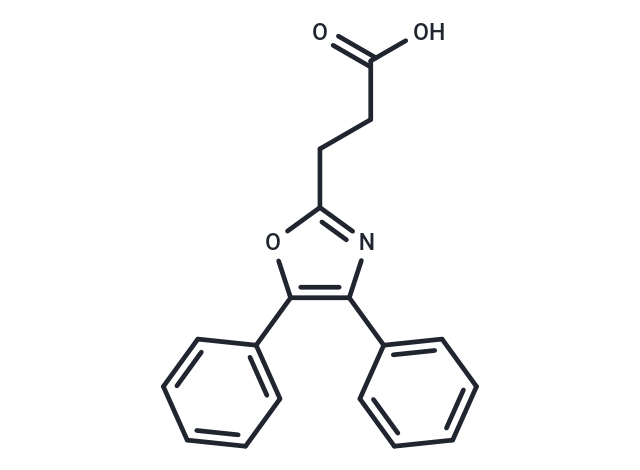
| Pack Size | Price | USA Stock | Global Stock | Quantity |
|---|---|---|---|---|
| 25 mg | $35 | In Stock | In Stock | |
| 50 mg | $48 | In Stock | In Stock | |
| 100 mg | $68 | In Stock | In Stock | |
| 500 mg | $135 | In Stock | In Stock | |
| 1 g | $198 | - | In Stock | |
| 1 mL x 10 mM (in DMSO) | $29 | In Stock | In Stock |
| Description | Oxaprozin (Oxaprozinum) is a Nonsteroidal Anti-inflammatory Drug. The mechanism of action of oxaprozin is as a Cyclooxygenase Inhibitor. The chemical classification of oxaprozin is Nonsteroidal Anti-inflammatory Compounds. |
| Targets & IC50 | COX-1:2.2 μM, COX-2:36 μM |
| In vivo | The anti-inflammatory effect of Oxaprozin is thought to be due to its inhibition of cyclooxygenases in platelets that block prostaglandin synthesis. This may be due to Oxaprozin's antipyretic effect on the hypothalamus, leading to an increase in peripheral blood flow, vasodilation, and subsequent heat dissipation.Oxaprozin has a lower selectivity for COX-2, implying a higher selectivity for COX-1. |
| Synonyms | Wy21743, Oxaprozinum |
| Kinase Assay | 9L cells are treated with drug for the times indicated in each experiment. Floating and attached cells are collected, pooled, resuspended in lysis buffer (10 mM HEPES buffer, pH 7.4, containing 2 mM EDTA, 0.1% CHAPS detergent, 5 mM DTT, 350 ng/mL phenylmethylsulfonyl fluoride, 10 ng/mL pepstatin A, 10 ng/mL aprotinin, and 20 ng/mL leupeptin) and lysed by three freeze-thaw cycles (alternating between a dry ice isopropanol bath and a 37°C water bath). Lysates are spun in a bench top centrifuge at full speed for 15 min and the supernatant (cell extract) fraction transferred to a new tube. Cell extracts (20 μL) are assayed for caspase 9, caspase 8, and caspase 3 activity by incubation at 37°C for either 1 h (caspase 3) or 3 h (caspase 9 and caspase 8) in 500 μL of reaction buffer (10 mM HEPES, pH 7.4, 2 mM EDTA, 0.1% CHAPS, and 5 mM DTT) containing 50 μM caspase form-selective substrate: Ac-LETD-AFC for caspase 8; Ac-LEHD-AFC for caspase 9; and Ac-DEVD-AMC for caspase 3. Background activity is determined for each sample as follows. Cell extracts are preincubated for 15 min at room temperature, with or without caspase form-selective inhibitor: 1 μM z-LETD-FMK for caspase 8, 1 μM z-LEHD-FMK for caspase 9, and 5 μL of Casputin for caspase 3. Caspase activity measured in the absence of inhibitor is divided by the background caspase activity measured in the presence of inhibitor. A value of 1 is subtracted from each measured activity, such that a caspase activity of 0 corresponds to no increase in the specific caspase activity with drug treatment. Fluorescence of the caspase product (excitation at 395 nm and emission at 525 nm for AFC substrates, and excitation at 380 nm and emission at 460 nm for the AMC substrate) is measured using a Shimadzu model RF-1501 spectrofluorophotometer and the manufacturer's PC-1501 software package. |
| Molecular Weight | 293.32 |
| Formula | C18H15NO3 |
| Cas No. | 21256-18-8 |
| Smiles | C(CC(O)=O)C1=NC(=C(O1)C2=CC=CC=C2)C3=CC=CC=C3 |
| Relative Density. | 1.222 g/cm3 |
| Storage | Powder: -20°C for 3 years | In solvent: -80°C for 1 year Shipping with blue ice/Shipping at ambient temperature. | ||||||||||||||||||||||||||||||||||||||||
| Solubility Information | Ethanol: 26 mg/mL (88.64 mM), Sonication is recommended. DMSO: 250 mg/mL (852.31 mM), Sonication is recommended.  | ||||||||||||||||||||||||||||||||||||||||
| In Vivo Formulation | 10% DMSO+90% Saline: < 10 mg/mL (34.09 mM), Lower concentrations may be soluble, but exact solubility limit is unknown. 10% DMSO+40% PEG300+5% Tween 80+45% Saline: 10 mg/mL (34.09 mM), Solution. Please add the solvents sequentially, clarifying the solution as much as possible before adding the next one. Dissolve by heating and/or sonication if necessary. Working solution is recommended to be prepared and used immediately. The formulation provided above is for reference purposes only. In vivo formulations may vary and should be modified based on specific experimental conditions. | ||||||||||||||||||||||||||||||||||||||||
Solution Preparation Table | |||||||||||||||||||||||||||||||||||||||||
Ethanol/DMSO
DMSO
Note : The dilution table applies only to solid products. For liquid products, please calculate the stock solution based on the stated concentration and/or density. | |||||||||||||||||||||||||||||||||||||||||
 For example, if the intended dosage is 10 mg/kg for animals weighing 20 g , with a dosing volume of 100 μL per animal, and a total of 10 animals are to be administered, using a formulation of
  10% DMSO+ 40% PEG300+ 5% Tween 80+ 45% Saline/PBS/ddH2O , the resulting working solution concentration would be 2 mg/mL.
Dissolve 2 mg of the compound in 100 μL DMSO to obtain a stock solution at a concentration of 20 mg/mL . If the required concentration exceeds the compound's known solubility, please contact us for technical support before proceeding.
1) Add 100 μL of the DMSO stock solution to 400 µL PEG300 and mix thoroughly until the solution becomes clear.
2) Add 50 µL Tween 80 and mix well until fully clarified.
3) Add 450 µL Saline,PBS or ddH2O and mix thoroughly until a homogeneous solution is obtained.
| Size | Quantity | Unit Price | Amount | Operation |
|---|
 Feedback
 Hello! How can I help you today?
Copyright © 2015-2026 TargetMol Chemicals Inc. All Rights Reserved.
