


Shopping Cart
Remove All Your shopping cart is currently empty

Synonyms: RTA-408
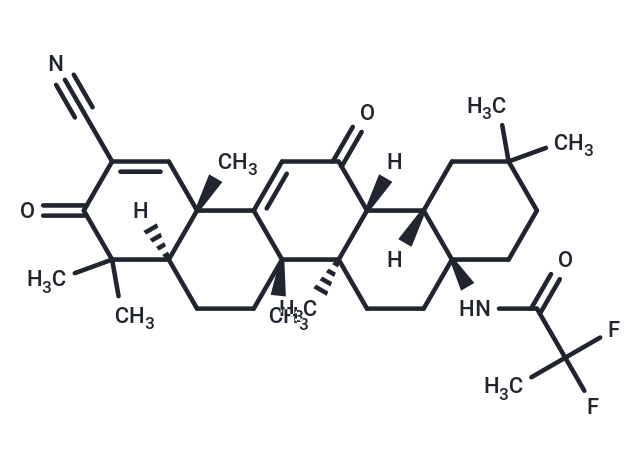

| Pack Size | Price | USA Stock | Global Stock | Quantity |
|---|---|---|---|---|
| 1 mg | $38 | In Stock | In Stock | |
| 2 mg | $54 | In Stock | In Stock | |
| 5 mg | $89 | In Stock | In Stock | |
| 10 mg | $122 | In Stock | In Stock | |
| 25 mg | $222 | In Stock | In Stock | |
| 50 mg | $372 | In Stock | In Stock | |
| 100 mg | $538 | In Stock | In Stock | |
| 500 mg | $1,150 | - | In Stock | |
| 1 mL x 10 mM (in DMSO) | $109 | In Stock | In Stock |
| Description | Omaveloxolone (RTA-408) is an oral, potent, and selective activator of the nuclear factor erythropoietin-related factor 2 (Nrf2) pathway, as well as a low-potency PPARγ agonist. Omaveloxolone inhibits osteoclast formation by suppressing the STING-dependent NF-κB signaling pathway. Omaveloxolone is being investigated for use in ALS, multiple sclerosis, non-alcoholic steatohepatitis, neurodegenerative diseases, and oncology research. |
| Targets & IC50 | Human tumor cells:260 nM (GI50), HT29 cells:1.41 μM (EC50), L929 cells:5.25 μM (EC50), NO:4.4 ± 1.8 nM |
| In vitro | Methods: HT22 cells were treated with Omaveloxolone (100, 500, 1000 nM) for 24 hours, followed by Western blot analysis for NRF2, HO-1, and NQO1. Results: Omaveloxolone dose-dependently upregulated NRF2, HO-1, and NQO1 protein levels. [1] Methods: Human FA patient skin fibroblasts were treated with Omaveloxolone (50 nM) or DMF (10 μM) for 48 hours, followed by DCFDA fluorescence probe detection of reactive oxygen species (ROS) levels. Results: Omaveloxolone significantly reduced basal ROS levels in FA cells. [2] |
| In vivo | Methods: 10-month-old APP/PS1 transgenic mice (AD model) and wild-type (WT) controls received intraperitoneal injections of Omaveloxolone (1 mg/kg/day, once daily) for 2 consecutive months. Results: Omaveloxolone significantly improved the Y-maze alternation rate, number of platform crossings in the water maze, and time spent in the target quadrant in APP/PS1 mice, demonstrating cognitive enhancement.[1] Methods: Cardio/skeletal muscle-specific FXN knockout mice (FXN-cKO) received oral Omaveloxolone (24 mg/kg/day) mixed with peanut butter from 3 weeks of age until 8 weeks of age (5 weeks total). Results: Omarsolon significantly improved cardiac function: EF increased from 26% to 47.5% (P<0.001), and FS increased from 22% to 42.5%. [2] |
| Synonyms | RTA-408 |
| Cell Research | For growth inhibition assays, cells are plated in duplicate 96-well culture dishes at 3 x 10³ cells per well. The following day, one plate is treated with RTA 408 and the other is immediately processed for the sulforhodamine B (SRB) assay (time 0). Cells in the RTA 408-treated plate are processed for the SRB assay 72 hours after the start of treatment. Percentage of growth relative to vehicle-treated cells is calculated using: [(Ti-Tz)/(C-Tz)] x 100 where (Tz) is the absorbance value at time zero, (C) is absorbance value from vehicle treated wells after 72 hours, and (Ti) is the absorbance value from wells treated with the drug. Dose-response curves are plotted in GraphPad Prism and GI50 values are calculated(Only for Reference) |
| Molecular Weight | 554.71 |
| Formula | C33H44F2N2O3 |
| Cas No. | 1474034-05-3 |
| Smiles | [H][C@@]12CC(C)(C)CC[C@@]1(CC[C@]1(C)[C@]2([H])C(=O)C=C2[C@@]1(C)CC[C@@]1([H])C(C)(C)C(=O)C(=C[C@]21C)C#N)NC(=O)C(C)(F)F |
| Relative Density. | 1.19 g/cm3 (Predicted) |
| Storage | Store at low temperature Powder: -20°C for 3 years | In solvent: -80°C for 1 year Shipping with blue ice/Shipping at ambient temperature. | ||||||||||||||||||||||||||||||||||||||||
| Solubility Information | Ethanol: 16 mg/mL (28.84 mM), Sonication is recommended. DMSO: 240 mg/mL (432.66 mM), Sonication is recommended.  H2O: < 1 mg/mL (insoluble or slightly soluble) | ||||||||||||||||||||||||||||||||||||||||
| In Vivo Formulation | 10% DMSO+90% Corn Oil: 3.3 mg/mL (5.95 mM), Sonication is recommended. Please add the solvents sequentially, clarifying the solution as much as possible before adding the next one. Dissolve by heating and/or sonication if necessary. Working solution is recommended to be prepared and used immediately. The formulation provided above is for reference purposes only. In vivo formulations may vary and should be modified based on specific experimental conditions. | ||||||||||||||||||||||||||||||||||||||||
Solution Preparation Table | |||||||||||||||||||||||||||||||||||||||||
Ethanol/DMSO
DMSO
Note : The dilution table applies only to solid products. For liquid products, please calculate the stock solution based on the stated concentration and/or density. | |||||||||||||||||||||||||||||||||||||||||
 For example, if the intended dosage is 10 mg/kg for animals weighing 20 g , with a dosing volume of 100 μL per animal, and a total of 10 animals are to be administered, using a formulation of
  10% DMSO+ 40% PEG300+ 5% Tween 80+ 45% Saline/PBS/ddH2O , the resulting working solution concentration would be 2 mg/mL.
Dissolve 2 mg of the compound in 100 μL DMSO to obtain a stock solution at a concentration of 20 mg/mL . If the required concentration exceeds the compound's known solubility, please contact us for technical support before proceeding.
1) Add 100 μL of the DMSO stock solution to 400 µL PEG300 and mix thoroughly until the solution becomes clear.
2) Add 50 µL Tween 80 and mix well until fully clarified.
3) Add 450 µL Saline,PBS or ddH2O and mix thoroughly until a homogeneous solution is obtained.
| Size | Quantity | Unit Price | Amount | Operation |
|---|
 Feedback
 Hello! How can I help you today?
Copyright © 2015-2026 TargetMol Chemicals Inc. All Rights Reserved.
